


Teradar reveals its first terahertz-band vision sensor for cars
Teradar reveals its first terahertz-band vision sensor for cars
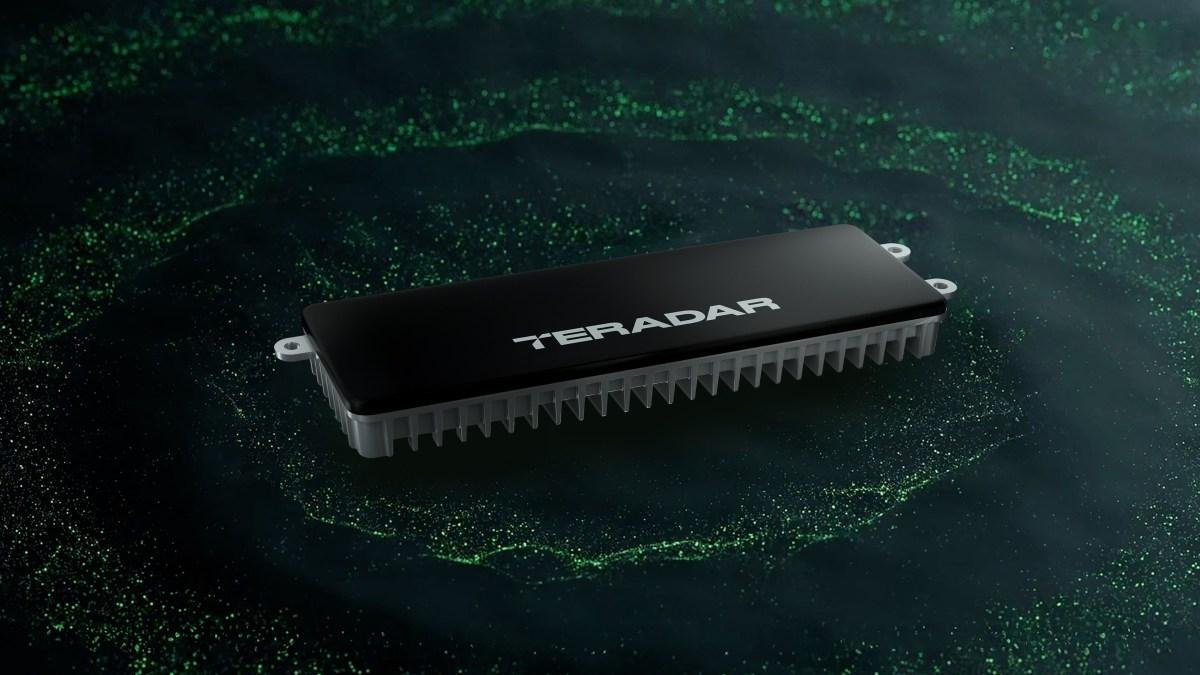
Two months after coming out of stealth with a $150 million raise, Boston-based Teradar is showing off its first flagship terahertz sensor at this week’s 2026 Consumer Electronics Show. The company is positioning the sensor, called Summit, as the first long-range high-resolution sensor of its kind “designed for high performance in any type of weather, filling a critical gap left by legacy radar and lidar sensors.”
The sensor will start shipping until 2028 if Teradar can lock down contracts with automakers. If that happens, the company expects the Summit will help enable those companies to add partial, or even full, autonomy features to their vehicles.
Teradar’s whole approach is about leveraging the relatively-unused terahertz band of the electromagnetic spectrum between microwaves and infrared. On top of that, it’s a solid-state sensor, meaning there are no moving parts. All this is meant to give Teradar’s sensor the best qualities of lidar and radar sensors, with few of the drawbacks.
It’s a potentially attractive proposition for automakers who might wince at the cost of lidars or the limitations of radars, and Teradar says it’s already doing the work to prove out its tech. The company says it has been in development with five top automakers from the U.S. and Europe and three Tier 1 suppliers.
Teradar’s impending entry into the market comes at a pivotal moment for automotive sensor suppliers. Leading U.S. lidar company Luminar just filed for bankruptcy protection in December after contracts with Volvo and Mercedes-Benz fell apart, as those automakers backed away from the tech.
Those deals also crumbled in part because of low-cost competition from China, according to Luminar. Lidar adoption has been strong in China’s auto market, and shows little sign of slowing up. In October, Chinese lidar company Hesai announced it built more than 1 million lidar sensors in 2025.
Other U.S. companies in the space, like Ouster — which acquired and merged with rival Velodyne after a wave of consolidation — have diversified beyond automotive into potential markets like robotics and smart infrastructure.
Techcrunch event
San Francisco | October 13-15, 2026
Teradar is looking beyond automotive, too, and that vision was reflected in its recent raise. The $150 million Series B included funding from Lockheed Martin’s venture arm and VXI Capital, a new defense-focused fund led by the former CTO of the U.S. military’s Defense Innovation Unit.
Lidar isn’t completely dead in the auto industry. Rivian announced in December that it will integrate a roof-mounted lidar sensor (from an unnamed supplier) in its upcoming R2 SUV, signaling that there is still an appetite to use advanced sensor technology to bring autonomy to passenger vehicles — especially if it’s affordable.
Teradar CEO Matt Carey told TechCrunch in November that he believes his terahertz sensor can meet all those marks, and sounded eager to pounce on the opportunity.
“Our main job is to make sure our sensor gets on all automobiles, and whatever the best way to do that is, that’s what we’re going to pursue,” he said.
Sean O’Kane is a reporter who has spent a decade covering the rapidly-evolving business and technology of the transportation industry, including Tesla and the many startups chasing Elon Musk. Most recently, he was a reporter at Bloomberg News where he helped break stories about some of the most notorious EV SPAC flops. He previously worked at The Verge, where he also covered consumer technology, hosted many short- and long-form videos, performed product and editorial photography, and once nearly passed out in a Red Bull Air Race plane.
You can contact or verify outreach from Sean by emailing sean.okane@techcrunch.com or via encrypted message at okane.01 on Signal.
Sponsorizzato
Sponsorizzato
Sponsorizzato
Sponsorizzato
Pubblicità
Categorie
Leggi tutto
Ousted Luminar CEO Austin Russell wants to buy the company Austin Russell, the billionaire founder of Luminar, has made a bid to acquire the lidar-maker five months after he was replaced as CEO following an ethics inquiry. The takeover effort was disclosed in an SEC filing by Russell early Friday morning. It would involve his new company, Russell AI Labs, purchasing 100% of the outstanding...

The FDA Clears the Apple Watch for Hypertension Alerts The Apple Watch Series 9 and newer and Apple Watch Ultra 2 and later get the tool next week. Vanessa Hand Orellana Lead Writer Vanessa is a lead writer at CNET, reviewing and writing about the latest smartwatches and fitness trackers. She joined the brand first as an on-camera reporter for CNET's Spanish-language site, then...

The best guide to spotting AI writing comes from Wikipedia We’ve all felt the creeping suspicion that something we’re reading was written by a large language model — but it’s remarkably difficult to pin down. For a few months last year, everyone became convinced that specific words like “delve” or “underscore” could give models away, but the evidence is thin, and as models have grown more...

Why January Ventures is funding underrepresented AI founders While everyone’s chasing the next AI infrastructure play in San Francisco, some of the most defensible AI companies are being built by founders with deep expertise in legacy industries — and they’re not getting funded. January Ventures aims to fill that gap, writing pre-seed checks for underrepresented founders transforming...

Myanmar election: Fear and intimidation ahead of vote held by military rulers'We will vote but not with our hearts': Inside the election staged by Myanmar's military rulersJonathan HeadSouth East Asia correspondent, Mandalay, MyanmarJonathan Head/ BBCA campaign rally in Mandalay ahead of a controversial election being held by Myanmar's military rulers on 28 DecemberOn a patch of rough ground...

