I would scream in my sleep: Women from Syria's Alawite minority tell of kidnap and rape

 BBC
BBC
Warning: This report contains accounts of sexual assault and violence that some readers may find distressing.
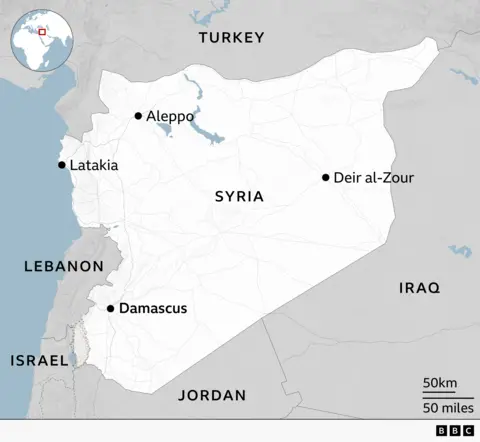
Ramia was preparing for a family picnic, on a warm summer day in her village in Latakia province in western Syria, when a white car drove up, she said.
Three armed men got out, saying they were government security forces, and dragged her into the vehicle, the teenager, whose name has been changed for her safety and to protect her identity, told the BBC World Service.
The men beat her, she said, hitting her harder when she started crying and screaming.
"One of them asked if I was Sunni or Alawite. When I said Alawite, they began insulting the sect," she added.
Ramia is one of dozens of women reported kidnapped since the fall of the dictatorship of Bashar al-Assad in December 2024.
The Syrian Feminist Lobby (SFL), an advocacy group for women's rights, says it has recorded reports - from families, media and other sources - of more than 80 women who have gone missing. It says it has confirmed 26 of those cases to be kidnappings.
Nearly all those reported missing are members of the Alawite sect, an offshoot of Shia Islam that makes up about 10% of Syria's population and to which the ousted president belongs.
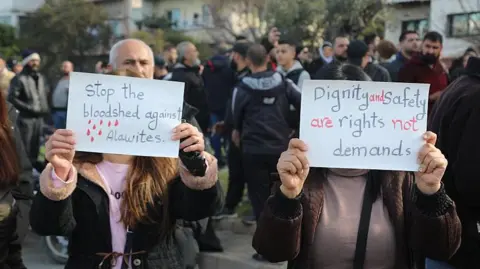 Kenana Hendawi/Anadolu via Getty Image
Sectarian violence
Two Alawite women and the families of three others have shared details of abduction and assault with the BBC. All their names have all been changed for reasons of privacy and safety.
All of them said the interim government's General Security Service - which is responsible for policing - had failed to investigate fully. One says its officers mocked her when she reported her ordeal.
The interior ministry's spokesman said in November that it had investigated 42 alleged kidnappings, and found all but one were "false". When contacted by the BBC, it said it had no further comment. However, a security source told the BBC that kidnappings had occurred, including some involving members of the security service, who he said had been dismissed.
The kidnappings and disappearances recorded by the SFL span a period from February 2025 to early December. This is both before and after March, when more than 1,400 people, mostly Alawite civilians, were killed in sectarian violence in the western coastal regions. Forces loyal to the Sunni Islamist-led government were accused of a wave of revenge killings following a deadly ambush by Assad supporters.
Many members of the Assad regime's elite were Alawites, but other members of the sect faced repression for opposing the former president.
'Suicide attempts'
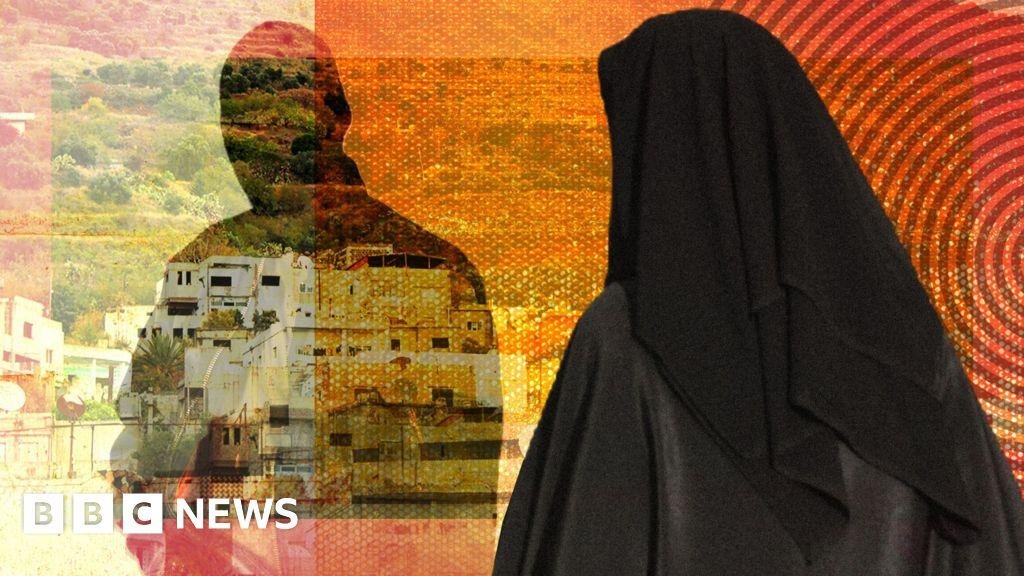
Ramia spoke quietly as she described being forced to wear a full body covering and niqab - a veil which leaves just the eye area exposed. She said she was locked in an underground room furnished with a bed and a dresser, on which lay toiletries and a condom.
Held for two days, she tried to escape once and attempted suicide twice, she said.
Her captor did not speak Arabic fluently and had "Asian features", she said, adding that he removed her niqab and took photos.
A woman living in the same building, who said she was the captor's wife, explained the photo "was to determine her price for sale", Ramia said.
She said the woman told her "many" others had been kidnapped before her, and that some had been raped and released, while others had been "sold".
The BBC could not verify any cases of money being exchanged for kidnapped women, but activists have reported cases where victims said they were threatened with being sold or forced into marriage.
'Raped multiple times'
Nesma, a mother in her 30s, told the BBC she was taken from her village, also in Latakia province, and driven away in a van with curtained windows.
Her voice shook over the phone as she described being held for seven days in a room with high windows that appeared to be in an industrial facility, and interrogated by three men about the residents of her village and any links to the former regime.
She said her captors were all masked and spoke in the Syrian Arabic dialect. She says they told her "Alawite women were created to be sabaya" - an archaic Arabic term meaning "female captives" and used by some Islamist extremists to refer to women treated as sex slaves.
 Abdulvacit Haci Isteyfi/Anadolu via Getty Images
Her captors raped her multiple times, she said: "All I could think about was death - that I would die and leave my child without a mother."
Leen, another teenager, endured beatings, threats at gunpoint and daily sexual assault, her mother Hasna told the BBC.
Her captor kept his face covered, spoke poor Arabic and boasted about taking part in killings of Alawites during March's violence, Hasna said.
"He used to call our girls sabaya, because 'they do not believe in God'," Hasna says - some Sunni extremists consider Alawites to be heretics.
The BBC also spoke to Ali, who said his wife Noor was kidnapped and held for several weeks, and a mother, Somaya, who said her teenage daughter was sexually assaulted "for 10 consecutive days".
'Threats by phone'
Nesma told the BBC that security officers treated her "mockingly and disrespectfully" when she went to tell them she had been kidnapped: "They said to me 'you should say you were on a picnic'."
Ramia said officers initially seemed engaged with her case, but stopped taking her calls once they identified her captor. The family received threats by phone that they "would pay a price if we talked", she said. They decided to flee the country.
Ali told the BBC: "They arrested the kidnapper, but we don't know what happened next." He said he was afraid the kidnapper may be released and "will come after us".
Leen's mother said her daughter was interviewed "with interest and sympathy" several times by security officers, but that no results from investigations were shared, even after months. Somaya says she reported what happened, but received no updates.
In November, Syria's interior ministry, which oversees the General Security Service, held a press conference on its findings on 42 reported kidnappings.
Spokesperson Nour al-Din al-Baba said only one case was a "genuine kidnapping". He said the others were explained as "voluntary elopement," "staying with relatives or friends," "fleeing domestic violence," "false claims on social media" or "involvement in prostitution and extortion", while four were "criminal offences for which arrests were made".
The ministry dealt with such reports with "utmost seriousness and responsibility", he stressed.
Later in November, the BBC contacted the ministry for its response to the accounts we have gathered. It said it had no further comment.
 OMAR HAJ KADOUR/AFP via Getty Images
A security source from a coastal area, speaking to the BBC on condition of anonymity, claimed: "There are undisciplined actions by some elements who carry out temporary kidnappings for the purpose of financial extortion, or due to recklessness, or personal motives inherited from the time of the previous regime."
He said this included members of the General Security Service. "Some officers adopt the idea of kidnapping as a means of revenge," he said. "Some cases have been uncovered, and the officers involved were immediately dismissed."
Four of the women and families who spoke to the BBC said they did not know who the kidnappers were. One did, and said it was not someone from the security services. Two said they were released after public pressure, the others said they did not know why they were freed.
'Climate of impunity'
In July, Amnesty International said it had received credible reports of abductions and kidnappings of at least 36 Alawite women and girls, aged between three and 40, and had documented eight cases in detail.
In "almost all" the cases it documented, families "received no meaningful updates and no credible sense of progress on investigations," deputy regional director Kristine Beckerle told the BBC.
Yamen Hussein, a Syrian human rights activist and writer based in Germany who has followed the issue, said survivors' accounts showed the kidnappings had an ideological basis "built on the notion of violating the defeated side", and aiming to "spread fear among Alawite women".
However, a "general climate of impunity" had also encouraged groups with no ideological motive to carry out kidnappings, he added.
According to the Syrian Feminist Lobby, a small number of Druze and Sunni women were reported kidnapped, but were released later. It says 16 women - all of them Alawite - are still missing.
For the families the BBC spoke to, fear persists - both of retribution for speaking out and of social stigma associated with sexual assault.
Leen lives in constant anxiety, fearing knocks at the door, her mother said. Nesma's marriage has collapsed. "I would scream in my sleep," says Ramia. She says she is seeing a therapist but still struggles to sleep and "can't find comfort".
Ali told the BBC he and Noor were too afraid to seek justice, while Somaya said her daughter had returned to school, but "nobody around me knows anything about what happened".
"We should not deny what happened to us but also we should not expose ourselves to danger," she said.
If you, or someone you know, have been affected by the issues raised in this story, details of organisations offering information and support are available at BBC ActionLine.

- This is part of the Global Women series from the BBC World Service, sharing untold and important stories from around the globe