Paul AdamsDiplomatic correspondent in Kyiv

 Reuters
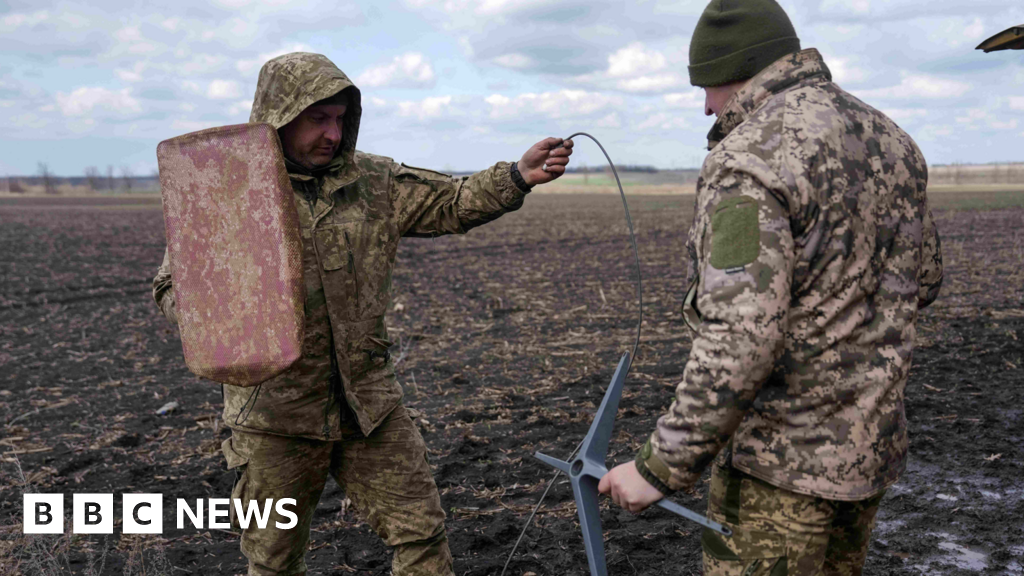
Evidence is mounting that Elon Musk's decision to deny Russian forces access to his Starlink satellite-based internet service has blunted Moscow's advance, caused confusion among Russian soldiers and handed an advantage to Ukraine's defenders.
But for how long? And what can Ukraine's military achieve in the meantime?
"The Russians… lost their ability to control the field," a Ukrainian drone operator who goes by the callsign Giovanni told us.
"I think they lost 50% of their capacity for offence," he said. "That's what the numbers show. Fewer assaults, fewer enemy drones, fewer everything."
It's still early to assess the impact of a change that only came into effect at the beginning of the month, after Ukraine's defence minister, Mykhailo Fedorov, asked Elon Musk's SpaceX company to block Russian access to Starlink.
But in some areas of the long front line, especially east of the city of Zaporizhzhia, there is some evidence of Russian forces being forced to retreat.
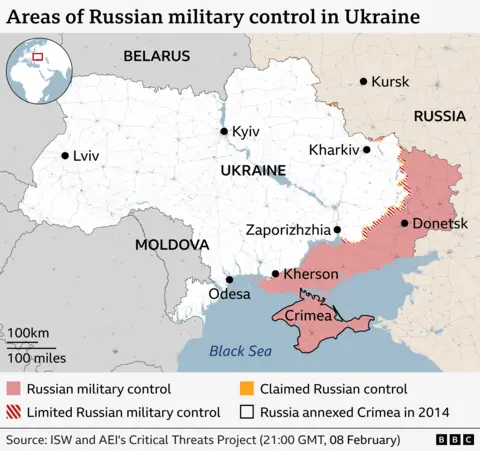
The request from Federov came as evidence mounted that use of Starlink was enabling Russian forces to mount increasingly accurate attacks, including multiple instances of $400 (£300) units being attached to drones, allowing operators to use real-time video links to guide drones onto targets.
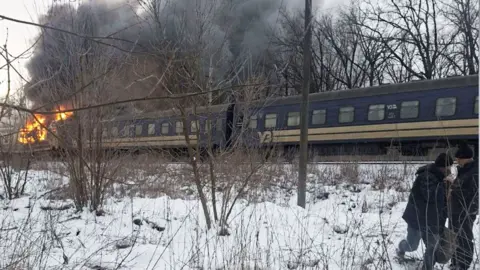
SpaceX's satellite communications have proved vital to both armies during the four-year war. It's widely believed that a deadly Russian attack on a moving passenger train in the Kharkiv region last month involved a Geran-2 drone, equipped with a Starlink terminal.
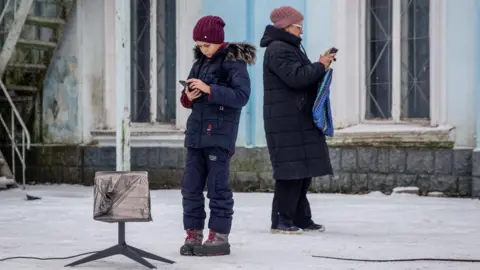
But since 1 February, all that has changed. SpaceX switched off all terminals operating in Ukraine, except those on a "white list" approved by the Defence Ministry in Kyiv.
Private users across the country had to re-register their units, along with their personal ID numbers, before being reconnected.
At this point, Ukrainian online activists from volunteer group InformNapalm decided to exploit the situation, launching a successful phishing operation that persuaded Russian soldiers to reveal details of their Starlink terminals.
"When people started messaging us, we directed them to closed group chats," says Mykhailo Makaruk, spokesman for InformNapalm. "We wanted to show that it was top secret."
Makaruk says his group successfully identified 2,425 Starlink terminals, from the Crimean peninsula in the south to the city of Gomel in eastern Belarus.
Believing they were on a fast track to having their terminals reconnected, some soldiers were even tricked into making online payments totalling $5,000.
Once the locations of the terminals close to the front lines had been established, many were targeted by Ukrainian artillery and drones.
 Omar/93rd brigade
Amid reports that Russian soldiers were attempting to bribe Ukrainian collaborators to register Starlink terminals on their behalf, InformNapalm identified around 30 people who had been ready to share their data.
A week ago, Ukraine's Security Service, the SBU, said it was "actively countering Russian attempts to recruit Ukrainian citizens for the illegal registration of Starlink systems".
The SBU has warned all Ukrainians "to remain vigilant and not fall for such provocations", warning that collaboration with Russia is regarded as high treason and can lead to lengthy prison sentences.
Makaruk says Russia's FSB Security Service is issuing its own warnings, telling soldiers not to fall for the scam, but he says the phishing operation has had a disruptive psychological effect.
"They don't trust each other anymore," he says, sharing screenshots of expletive-laden Russian chats in which the dangers of keeping a Starlink terminal nearby are discussed.
On the battle front, Ukrainian soldiers have noticed a difference too.
Deprived of Starlink's high speed, jam-resistant internet connectivity, their Russian opponents have been scrambling to find workarounds.
"In our area, they began to use radio communication," one told the BBC, on condition of anonymity. "It became easier to understand their actions."
Signs of hasty Russian adaptation have been observed up and down the long front line.
"The Russians are now urgently switching to wired communication," another told us.
Artem, a soldier with an engineering unit, said his Russian opponents were struggling to guide their drones as effectively as before.
"This is important for the protection of our critical infrastructure, logistics and control points," he said. "The Russians have lost frontline communications in many places."
 Reuters
Ukrainian military analysts say the impact on drone strikes on Ukrainian logistics and positions far from the front is crucial.
"Russian drone operators [used] to control and directly strike selected targets 100-250 kilometres from the front line," said Serhii Kuzan, chairman of the Ukrainian Security and Co-operation Centre.
"Now they no longer have this capability."
In a war where the speed of communication can mean the difference between life and death, some Ukrainian soldiers sense this is a moment of real opportunity.
"If we can beat the enemy's command transmission by even five or 10 seconds, it's a total game-changer at the front," one told us.
Ukraine's military intelligence (HUR) has published what it says are intercepts of Russian communications, which it says illustrate the frustration at the failure of some home-grown systems to compensate for the lack of Starlink.
"From what I know, this 'Gazprom' [terminal] is just total crap," one Russian soldier is quoted as saying, apparently referring to equipment produced by Gazprom Space Systems, using its own Yamal satellites.
The BBC is not able to verify the source of the alleged intercept.
HUR's conclusion, in a press release on Tuesday, was that the shutdown of Starlink "has already led to serious problems with unit co-ordination, logistics, and the deployment of various unmanned systems – from ground-based to aerial drones."
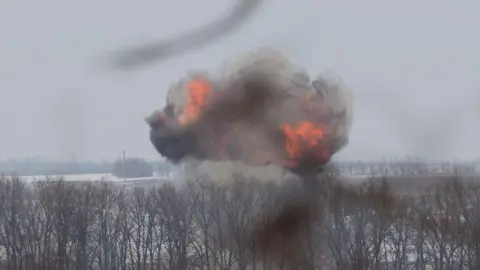
Videos circulating on social media, which the BBC has not verified, purport to show Russian soldiers being targeted by Ukrainian drones while attempting to rig up alternative wi-fi bridges on electricity bridges and TV towers.
 AFP via Getty Images
Not all Ukrainian soldiers are convinced that the situation has changed dramatically, with some saying they have noticed little difference, or suggesting that other factors, including the weather and planned troop rotations, may also be at play.
"Drone and artillery shelling continue as before," one told us.
In Moscow, Russian military officials, speaking on state TV, said the loss of Starlink had not affected their operations, with one claiming that Starlink had only been used by a handful of units, "primarily to mislead the enemy".
Speaking to the BBC from his position close to the contested eastern city of Pokrovsk, Giovanni said it wouldn't be long before the Russians figured out a solution.
"I have no doubt they will adapt," he said.
How long this will take is anyone's guess.
In the meantime, Ukrainian forces are trying to take as much advantage as possible, attempting to expand the dangerous expanse of no-man's land between the two sides, an area often described as the "grey zone" or "kill zone".
"We're clearing up the grey zone now," Vlad Voloshyn, spokesman for the army's Southern Command, told the BBC.
"We try to strike the enemy wherever they are."
Voloshyn disputed media reports that Ukraine had launched a major counter-offensive, recapturing more than 200 sq km (77 sq miles) of territory in a matter of days last week. The goals, he said, were more modest.
"We didn't let the enemy entrench in the grey zone and we stopped their storm groups," he said.
Former Ukrainian intelligence officer Ivan Stupak says the military probably has a couple of months in which to exploit the current situation.
"The Russian armoured forces on the ground are partly blind and partly deaf," he says. "Maybe they will be so frustrated and demoralised that even a small counter-offensive could be on the same scale as 2022."
A repeat of the lightning successes of the summer and autumn of 2022, when Ukrainian forces retook huge swathes of territory in the north and the south, seems unlikely at this point.
But Stupak says any territorial gains will strengthen the Ukrainian leader's position at the negotiating table.
"We could repulse Russian forces, regain our territory and then we could start this negotiation, but with new cards," he says.