
 Getty Images
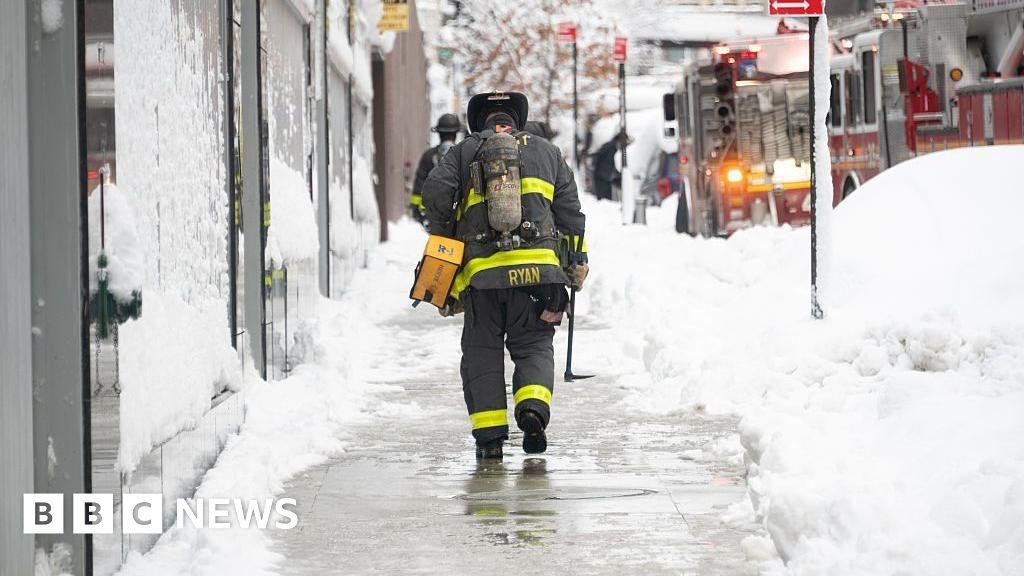
A powerful winter blizzard that hit the north-eastern US has left two dead in Maryland and continues to delay flights and cause widespread power outages across the region.
In Calvert County, Maryland, on Sunday afternoon, a vehicle was struck by a falling tree that toppled onto the road way, killing Michael Simpson, 60, and Virginia Quesenberry, 43, the sheriff's office said.
Parts of Maryland saw as much as 16in (40cm) of snowfall during the storm, while Providence, Rhode Island, saw the biggest blizzard in history with 37.9in of snow.
Travel bans and school closures are still in place for Rhode Island and parts of Massachusetts as residents dig out of the storm.
The hazardous and snowy conditions also led to serious flight disruptions on Monday and Tuesday. Over 5,000 flights were cancelled on Monday, while as of Tuesday morning, over 2,000 flights were cancelled and nearly 1,000 delayed, according to flight tracker FlightAware.
The most heavily affected airports were Boston's Logan International Airport and New York's John F Kennedy International and Laguardia airports.
The blizzard was the ninth biggest winter storm in the history of New York City, which recorded over 20in of snow.
On Sunday and Monday, New York Mayor Zohran Mamdani enacted a travel ban to keep the roads clear from dangerous conditions. He said 2,600 sanitation workers were plowing roads, plus an additional 1,400 emergency snow shovelers who were clearing sidewalks and bus stops.
The city went back to in-person schooling on Tuesday, while parts of neighbouring states of New Jersey and Pennsylvannia announced school delays and virtual learning.
In Boston, Massachusetts, the blizzard led news outlet Boston Globe to halt printing of its newspaper for the first time in 153 years because conditions made it impossible to make paper deliveries on Tuesday.
As of Tuesday morning, 250,000 people in Massachusetts were still without power, according to poweroutage.us.
In the small coastal town of Scituate, Massachusetts, officials said on Monday that half the town was without electricity, and that residents "should expect several days without power" as powerful winds would make it challenging for companies to restore power.
The so-called "nor'easter" has now moved away from the US and across coastal parts of eastern Canada, though strong winds are expected to persist, according to the National Weather Service.