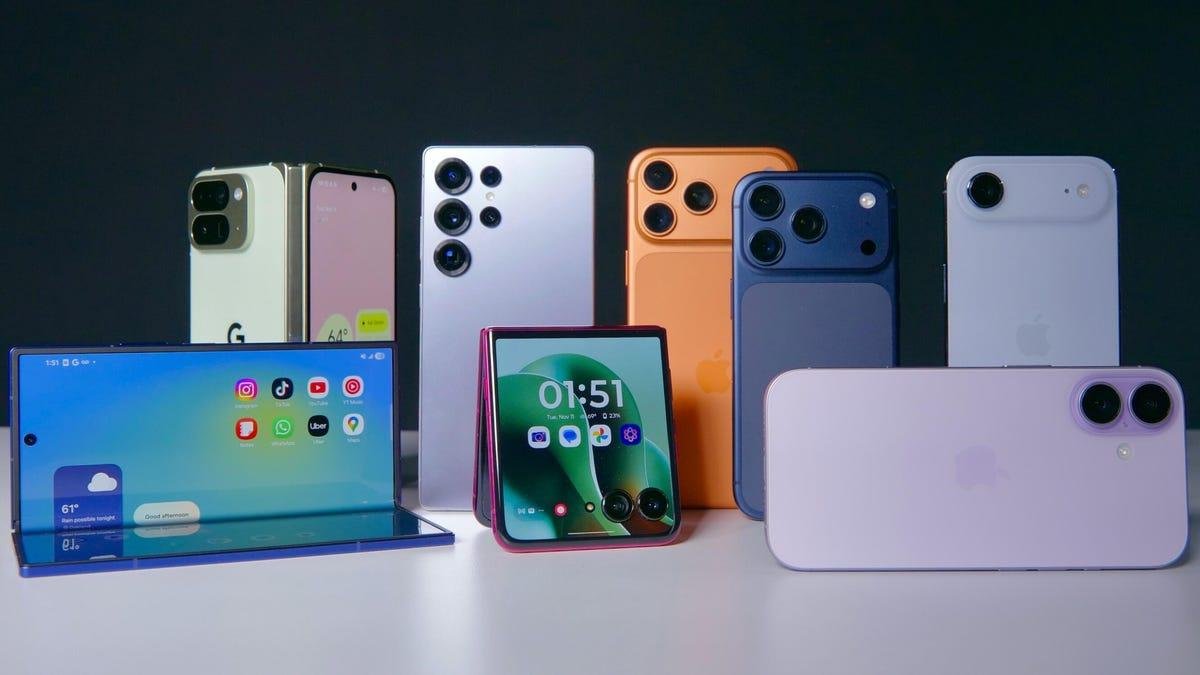
One quarter in, and we've already seen some polarizing smartphone launches in 2026. While Google's Pixel 10A and Samsung's Galaxy S26 Plus are arguably the most iterative upgrades, phones like the Galaxy Z TriFold, Xiaomi 17 Ultra and Oppo Find N6 are keeping us on the edge of our seats. These are strong follow-ups to the best phones of 2025, a year that saw Samsung reinvent the Galaxy Z Fold and Apple announce an all-new, slim and light iPhone Air.
After early 2026 phone launches, there should be room for a few more surprises. But a RAM shortage and the increasing competition around generative AI might be a larger challenge for phone-makers to overcome this year. And that puts more pressure on brands to release bold designs and add features that are as useful as they are innovative.
The folding phone market is expected to attract more entrants. We could finally see Apple launch a folding iPhone, Motorola teased its first-ever book-style foldable -- the Razr Fold -- and rumors say that Samsung might release a wide-screen foldable, similar to the Huawei Pura X.
The bottom line? There are a bunch of exciting smartphones to look forward to in 2026.
Phones that have already been released in 2026
Apple
The iPhone 17 Pro and Pro Max marked the return of vibrant colors to Apple's highest-end iPhones.
Prakhar Khanna/CNETA split iPhone 18 launch strategy
Apple introduced a slew of upgrades with the iPhone 17 line -- an 18-megapixel selfie shooter, upgraded rear camera optics, thermal cooling on the Pro variants, among other updates. It also added the thin iPhone Air to the lineup. This year, the Cupertino company could shake up its iPhone launch timeline.
For years, Apple has continued to announce the base iPhone model alongside its Pro siblings, while also experimenting with Mini, Plus and Air variants. This could change in 2026. According to a report from The Information and Apple analyst Ming-Chi Kuo, the Cupertino-based company may push the launch of the vanilla iPhone 18 to early 2027 in a bid to make space for the iPhone Fold.
Apple could still announce multiple iPhone models in September 2026, but the lineup and timing would look slightly different. Later this year, we could see the launch of the next-gen. iPhone Air, iPhone 18 Pro and 18 Pro Max in new colors and the all-new iPhone Fold. But the standard iPhone 18 is tipped to be released alongside the iPhone 18E in March 2027.
The new Apple iPhone launch cycle might be:
- March 2026: iPhone 17E
- September 2026: iPhone Air 2, iPhone 18 Pro/Pro Max and iPhone Fold
- March 2027: iPhone 18 and iPhone 18E
- September 2027: iPhone Air 3, iPhone 19 Pro/Pro Max and iPhone 20 (named to honor the 20th anniversary of the original iPhone's 2007 debut)
Since the standard iPhone 18 model is rumored to be released in 2027, let's focus on the iPhone variants that are more likely to be launched this year.
Apple iPhone 18 Pro and Pro Max
CNET's Jeffrey Hazelwood created these custom renders of what an iPhone 18 Pro might look like in purple, coffee and burgundy.
Jeffrey Hazelwood/CNETThe iPhone 18 Pro models are expected to have the same design language as the iPhone 17 Pro and Pro Max but be available in new colors. Apple is said to be considering three color options to replace 2025's cosmic orange: coffee, purple and burgundy.
I'd love to have a burgundy or coffee brown iPhone 18 Pro. I'm more intrigued by the latter, thanks to CNET Jeffrey Hazelwood's mock-ups of the iPhone 18 Pro in purple, coffee and burgundy, which you can see above.
Both the iPhone 18 Pro and Pro Max are expected to have the same 6.3-inch and 6.9-inch displays, respectively, as the current models. However, Apple is rumored to opt for an under-display Face ID True Depth camera to make the Dynamic Island smaller.
There have also been rumors about the iPhone 18 Pro lineup including an under-display Face ID, alongside a punch-hole cutout for the selfie shooter, which is common on Android phones. According to the same The Information report cited above, the iPhone 18 Pro duo will have a small hole on the top-left corner to house the front-facing camera. So, we shouldn't expect a full-screen display with an under-display camera.
I've used phones with under-display cameras (RedMagic 10 Pro and Samsung Galaxy Z Fold 5), and while I love having a full-screen experience, I look smudgy on video calls and selfies with these cameras. No phone manufacturer has figured out a way to retain photo quality while delivering a full-screen experience with an under-display camera.
If Apple can do that, I'd be pleasantly surprised. But it seems unlikely as current-gen iPhones launched with a new industry-leading 18-megapixel Center Stage camera on the front. I don't think Apple would mess with that. I expect the same photo and video quality on the next iPhone.
Apple moved to a new camera plateau design with the iPhone 17 Pro lineup.
Celso Bulgatti/CNETMoving to the rear optics, Apple is reportedly introducing a variable aperture lens on the iPhone 18 Pro and 18 Pro Max. It might be irrelevant to most people, but for those who use their iPhones for photography, a variable aperture would offer more control over their photos. It would allow you to manually adjust the amount of light reaching the sensor and the depth of field on a subject.
This isn't groundbreaking new technology. Samsung introduced it with the Galaxy S9 in 2018 but it remained ineffective due to the small sensor size and the fact that the aperture could only switch between two f-stops: f/1.5 and f/2.4.
Xiaomi and Huawei did a better job with their flagships in 2023. The Huawei Mate 50 Pro offered 10 steps of aperture (f/1.4 to f/4.0), while the Xiaomi 13 Ultra included a dual-aperture design (f/1.9 and f/4.0), paired with a larger 1-inch-type image sensor.
Based on these examples, Apple will likely need to add a larger image sensor and more flexibility with aperture control to make it actually useful. It could be a godsend to improve the iPhone's portrait mode, which trails behind the likes of current Vivo, Oppo and Xiaomi phones.
The iPhone 18 Pro is also rumored to get a new three-layer stacked image sensor developed by Samsung. For years, Sony has supplied the image sensors for the iPhone. Samsung's sensor could reduce noise in images, improve the dynamic range and make the iPhone's camera more responsive.
The iPhone 18 Pro series is expected to be powered by the A20 Pro chipset, which would be built on TSMC's 2nm process. It could have architectural changes, such as having RAM integrated directly onto the same wafer as the CPU, GPU and neural engine, instead of it being adjacent to the chip and connected via an interposer. It could allow for 30% better efficiency and 15% faster performance than the A19 chips. The next iPhones may also use Apple's next-generation C2 modem chip for enhanced wireless connectivity.
The iPhone Fold
This is a mock-up of what a possible iPhone Fold might look like, according to CNET designer Jeffrey Hazelwood.
Jeffrey Hazelwood/CNETThere are conflicting rumors about the launch timeline of Apple's foldable iPhone. Some say it'll be released alongside the iPhone 18 Pro series this year, while a report from The Elec claims that the launch could be delayed to 2027. It's worth noting that rumors of Apple's book-style foldable iPhone date back to 2019.
Apple's first folding phone is likely to be a book-style foldable, like the Galaxy Z Fold, rather than a clamshell flip phone. It'll have a smaller outer display and a wider folding display -- like the first-gen Google Pixel Fold, per Kuo. I used the Oppo Find N in 2022, which had a similar passport-size form factor. While Oppo's foldable is better for watching videos, it didn't offer the best experience for browsing the web.
One of the best aspects of the first Pixel Fold was its passport book-style design and size.
James Martin/CNETIf Apple can find the middle ground between the Pixel Fold and Galaxy Z Fold 7, the iPhone Fold could be an enticing choice. It is rumored to include a 5.5-inch cover screen and a 7.8-inch display when unfolded.
According to Apple analyst Ming-Chi Kuo, the first folding iPhone is expected to measure 4.5mm thick when unfolded. For context, the Samsung Galaxy Z Fold 7 measures 4.2mm, while the Huawei Mate XT (the tri-fold) is 3.6mm thick when fully opened.
In his blog, Kuo gave more clarity on the expected release date and shipment delays. He says that the development of the foldable iPhone "is behind earlier expectations." The new Apple iPhone is still on track to be launched in 2026 but "smooth shipments may not occur until 2027."
Here's a mock-up of the Galaxy Z Fold with iPadOS overlayed on top of the screen.
Celso Bulgatti/CNETA report from The Elec (via DigiTimes) says that Apple will use ultra-thin glass for its first foldable iPhone. It could have a hole-punch selfie shooter on the cover screen and an under-display camera behind the inner screen. It'll likely lack Face ID and rely on Touch ID for biometric authentication.
Kuo also reported that the first Apple foldable will minimize the crease by using a combination of titanium, stainless steel and liquid metal for the hinge. It's also tipped to use titanium for its frame and aluminum in other areas. The foldable iPhone is rumored to house a 48-megapixel primary camera alongside a 48-megapixel ultrawide-angle sensor. Apple might not give it a telephoto camera.
Recently, longtime Apple leaker Sonny Dickson shared what appear to be 3D CAD renderings of the rumored device. These renderings are in line with a separate CAD leak from December published by GSMArena. They show a book-style foldable iPhone with a wide aspect ratio -- giving us an iPad Mini-size display. It appears to be a hybrid of the iPhone 17 Pro and the iPhone Air, with a dual-tone look and a pill-shaped camera module at the top. The upcoming iPhone Fold looks like a passport-sized phone.
Another recent Mark Gurman report from Bloomberg revealed new information about how Apple will tweak iOS for its new iPhone. The iPhone Fold is expected to run iOS 27, which could have a new iOS app layout. Apple is touted to revamp its core iPhone programs to add sidebars along the left edge of the screen, similar to iPadOS. This is a necessary step because iOS, in its current state, lacks true multitasking. Unlike its Android counterparts, there's no multi-window or pop-up window support. And if we're to make the most of iPhone Fold's expansive inner screen, iOS must borrow certain iPadOS multitasking features.
Apple's iPhone Fold is said to cost between $1,800 and $2,500. While earlier rumors suggested the latter price, recent rumors have said that the folding iPhone will cost the same as the Samsung Galaxy Z Fold 7 and Google Pixel 10 Pro Fold.
Samsung
The Galaxy S25 Ultra debuted in January 2025.
Josh Steinbauer/CNETGalaxy Z Fold 8 and Flip 8
CNET's Abrar Al-Heeti holds the Galaxy Z Fold 7 (left) and the Galaxy Z Flip 7 (right).
Zooey Liao/Numi Prasarn/CNETSamsung surprised us with the Galaxy Z Fold 7. It overhauled the design of its book-style foldable to make it the thinnest and lightest foldable in the US. I've loved using it, especially because it weighs less than my iPhone 17 Pro Max yet unfolds to offer a bigger 8-inch screen. However, there's room for improvement.
The South Korean company hasn't upgraded the battery size on its Galaxy Z Fold in four generations. The Fold 7 packs the same 4,400-mAh battery as the 2021-launched Galaxy Z Fold 3. While the current-gen Fold will last an entire day with moderate use, I struggle to get through the day on a single charge when I'm traveling. The next-gen Galaxy Z Fold needs a battery upgrade, and it might finally get one.
Samsung could increase the Galaxy Z Fold 8's battery capacity to about 5,000-mAh in 2026, according to the South Korean outlet Dealsite. While the Oppo Find N5 and Honor Magic V3 pack larger battery capacities, a 5,000-mAh cell should be a good boost. The report also claims that Samsung will use a new "laser-drilling metal plate" technology (similar to what Apple is rumored to do with the iPhone Fold) to further minimize the display crease.
This year, Samsung also removed the digitizer from the Galaxy Z Fold 7's display to make it thinner. But the S Pen could make a comeback this year, as per a report by The Elec. It'll be interesting to see if that makes the Fold 8 thicker than the current-gen foldable.
As for the Galaxy Z Flip 8, there aren't many rumors at this point, but I hope Samsung improves the cover screen's usability. When compared to the Razr 2025, the Galaxy Z Flip 7 cover screen still feels limited for running third-party apps.
A new wide-screen foldable
The wide-screen Samsung Fold and iPhone Fold could be like the original Oppo Find N, launched in 2021.
Eli Blumenthal/CNETA new report from ETNews claims that Samsung is developing a new Galaxy Z Fold that will unfold into a wide-screen mini tablet. It is said to have a 7.6-inch OLED inner screen with a 4:3 aspect ratio, which could be similar to the rumored iPhone Fold. This is wider than the almost square aspect ratio on the Galaxy Z Fold 7. Ideally, a wider aspect ratio is better for watching videos as it minimizes letterboxing and gives you more room for watchable content. A phone this size can then be rotated to read and browse on the web, making it the ideal 2-in-1 phone.
The rumored wide-screen Samsung foldable phone could have a 5.4-inch cover screen and support 25-watt wireless charging, which is faster than the 15-watt wireless charging supported on the Galaxy Z Flip 7 and Fold 7. "Samsung Electronics plans to release the Wide Fold in the fall," says the report. It could be added to the Galaxy Z series and unveiled alongside the Flip 8 and Fold 8 in 2026.
The camera array on the back of the Pixel 10 Pro.
Andrew Lanxon/CNETGoogle Pixel 11 lineup
This year, Google added a telephoto camera to its base Pixel 10 and gave the Pro models an AI-enabled 30-100x zoom, which is one of the best implementations of digital zoom I've used on any phone. It also added a MagSafe-like PixelSnap capability for wireless charging and magnetic accessories. While the new Tensor G5 is faster than last year's G4 chip, it still struggles against processors from Qualcomm, Apple and MediaTek -- its rivals.
An Android Authority story reports that the Tensor G6 will be a minor improvement over 2025's model. It could move to TSMC's next-gen N3P process node and adopt a new architecture focused on power consumption improvements over raw performance gains. The Tensor G6 is rumored to move to a TSMC 2nm process, enabling improvements in battery efficiency and thermal performance -- both of which the Pixel could use. The Google chip is also touted to have a new TPU and a secondary nano-TPU, which will help handle lower-power tasks more efficiently.
The Google Pixel 11 series could get a new low-light video recording feature, 4K 30fps Cinematic Blur and an AI-powered capability that would let you tweak the lighting after video is recorded, according to another Android Authority story. The lineup might also include upgraded camera hardware. It sounds more like a Pro update, but as of now, it's unclear if it'll be part of the Pixel 11 Pro Fold and the base model.
For years, Google has announced its flagship Pixel phones in October. However, the Pixel 9 broke this tradition in 2024 with an August launch, and it was followed by an August announcement of the Pixel 10 series. Google will likely continue with an August launch in 2026.
Motorola
The Motorola Razr Ultra was our favorite clamshell foldable phone in 2025 and even earned a CNET Editor's Choice Award.
James Martin/CNETRazr 2026 lineup
This year, the Motorola Razr Ultra maintained its lead over the Samsung Galaxy Z Flip 7, but it also costs $1,300, $200 more than the base Z Flip 7. At that price, the Razr Ultra provided the best flip phone experience in 2025. However, Motorola needs to work on longer-term software support and improve its camera processing on the next generation Razr phones.
As of now, there haven't been many concrete leaks and rumors regarding the Motorola Razr 2026 lineup. You can still expect the upcoming series to have three models: Razr 2026, Razr Plus (2026) and the Razr Ultra (2026). They'll primarily vary by chipset prowess, cover screen size, price and optics. Based on previous Motorola launches, you can expect at least one Razr 2026 model to be announced late spring/early summer 2026.
An all-new Razr Fold
The Motorola Razr Fold has a very premium finish on its back.
Prakhar Khanna/CNETAt CES 2026, Motorola unveiled its first-ever book-style foldable phone, the Razr Fold. It has a bigger cover (6.6-inch) and main (8.1-inch) display than the Galaxy Z Fold 7 and Pixel 10 Pro Fold, housed in a comfortable-to-hold design. Moreover, it has the same camera system as the new Motorola Signature: a 50-megapixel main camera with OIS, paired with a 50-megapixel telephoto camera with a 3x zoom lens and OIS, and a 50-megapixel ultrawide camera. However, it remains to be seen if it stands out when compared to the Google and Samsung folding phones.
Motorola's Razr Fold is thin and light. While we don't know the exact specifications yet, it was definitely more comfortable in the hand than the Pixel 10 Pro Fold. It will come in two colors and finishes. There's Pantone blackened blue, with a woven vegan leather finish that the company describes as smooth and matte. Or you'll be able to get it in Pantone lily white, a vegan leather that's supposedly more silk-textured and "smooth to the touch."
The Ultra phones from Xiaomi, Oppo and Vivo
Here's the Xiaomi 15 Ultra in the optional Photographers Kit.
Andrew Lanxon/CNETXiaomi, Oppo and Vivo have already announced their Qualcomm Snapdragon 8 Elite Gen 5-powered and MediaTek Dimensity 9500-powered flagship smartphones but the "Ultra" devices are expected to be announced this year. While Xiaomi has already launched its camera-focused Xiaomi 17 Ultra, Vivo showcased its X300 Ultra at the Mobile World Congress 2026 and Oppo is expected to announce its Ultra flagship phone soon.
Vivo X300 Ultra
The Vivo X300 and Vivo X300 Pro are already getting acclaim for their optics, but the X300 Ultra could take things up a notch. The Vivo's X300 Ultra could be the first phone to include two 200-megapixel cameras, one used as the main lens and the other as a periscope telephoto lens, according to the leaker Digital Chat Station.
The main camera will have a 1/1.12-inch sensor (with 0.7µm-sized pixels), which is comparatively larger than most mainstream flagship phones. The post says that the camera offers 2x and 4x in-sensor lossless zoom alongside a dedicated periscope camera for optical zoom capabilities. Digital Chat Station says that the latter will use a combination of glass and plastic elements in its new lens assembly, but we'll know its benefits after the launch.
The two 200-megapixel cameras are reportedly paired with a 50-megapixel ultrawide camera. On the front, we could get another 50-megapixel sensor with autofocus. The Vivo flagship is likely to be powered by the Snapdragon 8 Elite Gen 5 processor. It was showcased at MWC 2026 with a focus on the revamped video capabilities and camera kit.
The Vivo X300 Ultra will have a similar trio of cameras as the Pro model, with two new external lenses. You will be able to get it with an even larger 800mm lens. As CNET's Andrew Lanxon wrote, "800mm equivalent focal lengths should make this a beast for sport or wildlife photography where you don't want to get too close to the action." Vivo hasn't shared the official specs yet but it will support video recording at 4K resolution and at 120 frames per second from all of its cameras.
The upcoming Ultra will also support shooting in 10-bit Log and Dolby Vision to allow for wide dynamic range in the video file. It should make the footage easier to color grade in post-production. In its news release, the company talked about X300 Ultra's color science and better ability to color balance footage from the phone with footage from regular cinema cameras. Vivo's new camera app will also let you load LUTs (basically color filters the video pros use) onto the phone to preview the look as you're shooting.
Oppo Find X9 Ultra
The Oppo Find X9 Ultra and removable Hasselblad telephoto lens accessory.
Prakhar Khanna/CNETThe Oppo Find X8 Ultra was one of my favorite smartphones this year. It offered excellent camera performance in a design that was comfortable to hold. Moreover, it lasted me all day on heavy usage and featured a big and bright display. Similarly, I liked the recently announced Oppo Find X9 Pro, especially with its detachable Hasselblad lens. I'm excited about what Oppo will do with its Ultra flagship in 2026.
Rumors regarding the Find X9 Ultra are slim as of now. However, it's expected to be launched in global markets by late March – similar to its Vivo and Xiaomi rivals. It's expected to pack a 7,000-mAh battery or more and upgraded optics for the cameras.
Where is OnePlus?
OnePlus has already announced its OnePlus 13 successor: the OnePlus 15.
Prakhar Khanna/CNETOnePlus announced its 2025 flagship, the OnePlus 13, ahead of the Galaxy S25 series in January. It was one of the sleeper hits this year. However, the company has already announced its successor, the OnePlus 15, in China and is releasing the phone in global markets ahead of last year's launch timeline. As a result, it is already available to purchase in the US.
The OnePlus 15 was launched on Nov. 13, 2025. It is powered by the flagship Qualcomm Snapdragon 8 Elite Gen 5 chipset and packs a massive 7,300-mAh battery with support for 80-watt wired fast charging and 50-watt wireless charging.
The new OnePlus flagship has a 6.78-inch display with a 1.5K resolution and support for up to a 165 Hz refresh rate. It can run games like Call of Duty: Mobile and Brawl Stars at 165 frames per second. You also get a 3,200-Hz touch sampling rate, which ensures that its display is highly responsive during such games.
CNET's David Lumb got an early look at the phone's cameras and here's what its three 50-megapixel cameras are capable of shooting. The OnePlus 15's Sand Storm model is from a material that OnePlus describes as being tougher than titanium.
We don't know if we'll see another OnePlus flagship phone in 2026. After all, the company decided to take a break from launching a folding phone this year, which wasn't pleasant news because I loved using the OnePlus Open. It was one of the best foldables when it launched. I hope OnePlus gives us a successor this year, but I'm not holding my breath.
Overall, the slab phones of 2026 are likely to be iterative upgrades with improved camera systems and more powerful processors. The major launches will come in the foldable segment, with both Apple and Samsung expected to launch all-new models. With this, 2026 is shaping up to be another exciting year for smartphones.
Watch this: Best Phones of 2025