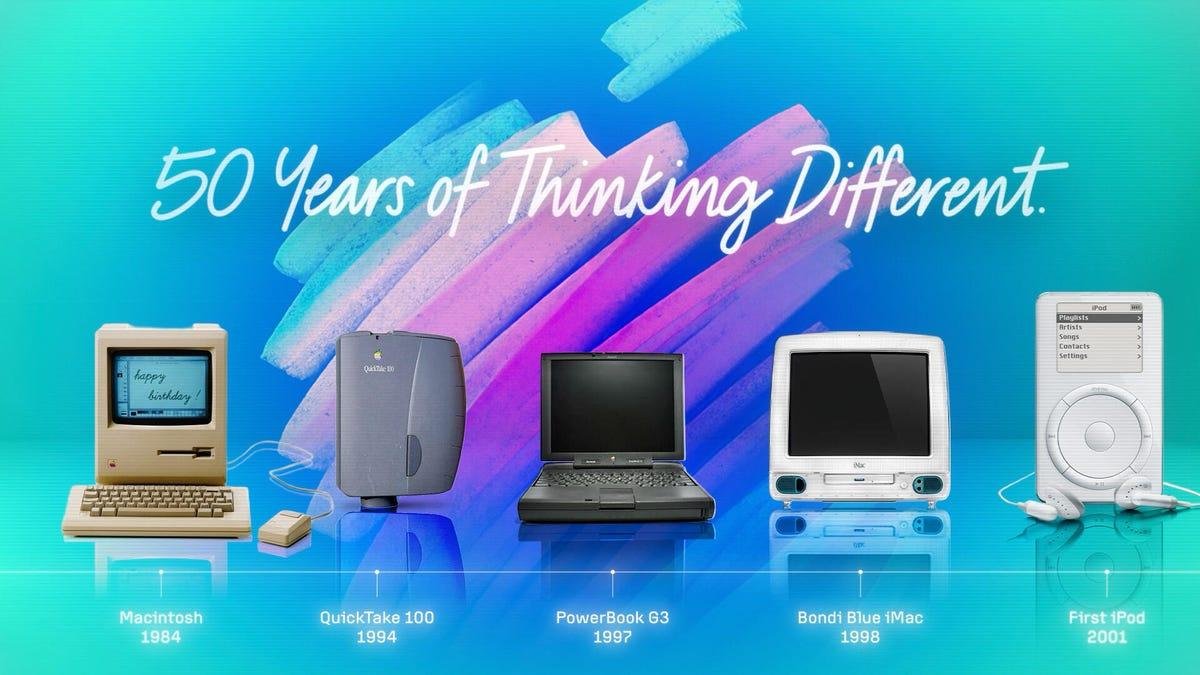


Approaching a retrospective of Apple's first 50 years is like looking up at a waterfall. You can see its shape and where it begins and ends, but if you stand under the cascade, you risk being washed away by the water's force and volume.
When I began assembling a list of notable Apple products to commemorate the company's 50th anniversary, it kept growing. There's the original Apple II and Macintosh, but also Quadras and Power Macintoshes from the 1990s with barely remembered number designations. And those were all before Steve Jobs returned to the company and reinvigorated it with the iMac, iPod, iPhone and iPad.
Instead of touching on every model and revision -- heck, or even entire product families, apologies to my beloved StyleWriter II -- I've put together a list of 13 Apple products that CNET has reviewed and featured over the years. Although Apple was incorporated on April 1, 1976, and CNET didn't come around until 1992, our story archives contain a large swathe of Apple's history.
This Apple-1 personal computer launched in 1976 and sold for $387,750 in a Christie's online auction in 2013.
Christie'sI was repeatedly struck by Apple's milestones on its path to success, as well as by how the company changed the computing industry. Though computers existed before the Apple II, that chunky beige wedge found its way into homes and sparked interest among the same kids who later grew up to design successive waves of products.
And though portable music players had existed before Apple's iPod, the combination of its small size and huge storage (and amazing advertising) meant it wasn't long before people everywhere were dangling those signature white earbuds from their ears.
Apple has created massively successful products, and instead of coasting on its success, the company looked for the next thing, again and again, for over 50 years.
Bearing fruit: The early Apple foundations
A working Apple-1 shown in 2013.
Daniel Terdiman/CNETIn 1976, when Steve Wozniak invented the Apple-1 computer (later referred to as Apple I) and Steve Jobs saw the potential to sell it, that homebrew personal computer would be the foundation of everything the Apple Computer Company has achieved since.
Steve Wozniak with his famed creation, the Apple II computer, at the Computer History Museum in Mountain View.
Scott Ard/CNETIt was replaced in 1977 with the Apple II, which was the company's first real push into the market. Celebrating its 35th anniversary in 2012, CNET's Rafe Needleman shared how the first electronic spreadsheet program for personal computers, VisiCalc, saved his job selling Apple II computers at a computer store. Once VisiCalc appeared on the shelves, the Apple II became a legit business tool.
"It took next to no time to show financial guys how this little app could make their tedious number-crunching jobs easier and faster," Needleman wrote. VisiCalc developer Dan Bricklin reminded Needleman how small the program was, capable of fitting in "dozens of K," which is less data than even a GIF screenshot of it now.
Original Macintosh (1984)
The original Macintosh was deliberately friendly.
AppleThe original Macintosh was unlike any computer you could buy at the time. You moved a mouse to interact with pictures of objects on the screen instead of typing commands, and its display was built into the computer itself. It even had a handle!
Although the first Macintosh predated CNET by almost a decade, Los Angeles Times journalist Larry Magid reviewed it in 1984 following a preview by "Apple's young chairman" Steve Jobs. "The Macintosh is as innovative today as the Apple II was in 1977," he wrote. "It's one of the few computers introduced in the last 18 months that makes no attempt to imitate the IBM PC."
You can read CNET's coverage of the Macintosh turning 30 for more stories about its origins, including conversations with the design team that made it all possible.
PowerBook (1991)
Apple cofounder Steve Wozniak leads children, all carrying PowerBook laptops.
Acey Harper/Getty ImagesTechnically, the original 1984 Macintosh was a portable computer, but at 16.5 pounds, it wasn't convenient. Weighing in slightly less at 16 pounds, the svelte 1989 Macintosh Portable was a better attempt.
But it was really the PowerBook line of laptops, which debuted in 1991, that unhooked people from their desks. With its innovative keyboard pushed toward the screen to make way for palm rests and a trackball (later a trackpad), you really did have the Macintosh experience wherever you went.
The monochrome PowerBook 140 and 170 were the workhorses of the line, while the PowerBook 100 (actually manufactured by Sony) was thin and light (5.1 pounds) for its time. Apple experimented with even lighter designs in the PowerBook Duo line, which lacked most ports but could slide into a Duo Dock at home or the office, turning it into a desktop Macintosh.
The PowerBook G4 was the laptop design that arguably put the largest aesthetic gap between Apple and its Windows-based competition. Where the rest of the market was mired in a seemingly random selection of dark-colored plastics, Apple's aluminum- and titanium-clad PowerBook G4 turned the laptop into a fetish object when it was introduced on Jan. 9, 2001.
CNETThose models predated CNET, though in the years that followed, we covered software and hardware updates (and had lots of coverage of the hardware faults of the stunning PowerBook G4 Titanium).
The earliest CNET PowerBook review was for the giant 17-inch PowerBook G4 in 2003, which had an aluminum body.
iMac (1998)
The 1998 iMac G3 looked like nothing out there.
AppleApple today would probably not exist if it weren't for the iMac. Now that Apple is worth $4 trillion, it's hard to imagine that, in the late 1990s, the company was on the brink of bankruptcy.
After leaving Apple in 1995 when John Scully was CEO, Steve Jobs struggled with his new computer company, NeXT. In 1997, Jobs returned to a financially troubled Apple as "Interim CEO" and slashed programs (such as the Newton) to get the company back on track. But Apple still needed a hit.
The iMac was different: a gumdrop-shaped all-in-one personal computer with translucent white and Bondi blue panels. It connected to the internet easily and had a new type of port, USB. In a world of boring beige computers -- including Apple's own Macintosh models -- the iMac was something new.
More importantly, it was a new story for Apple. The company embraced creativity, color, fun and cool.
A quirky novelty at first, the iMac line is today nearly unrecognizable from its original versions, like the iMac G4 shown here. Each generation evolved, shifting the design and features. The current look helped make the all-in-one desktop category the default for almost anyone not buying a laptop.
AppleThe iMac went on to adopt more colors and floral patterns, and even flirted with a flat-screen-on-an-arm design. It finally settled into the current design of a flat display panel that contains the entire computer.
iPod (2001)
Chunky by today's standards, the first iPod was a small marvel that held 1,000 songs.
Connie Guglielmo/CNETThe iMac was Apple's most popular product in years, but it was still a computer. Apple's giant hit was born out of an early-2000s product niche that the company turned into a lifestyle brand: the iPod.
The portable music player brought together Steve Jobs's love of music and the expertise of Apple's designers and engineers during a time when the business of legally purchasing digital music was just beginning. The original iPod was about the size of a deck of cards and could hold 1,000 songs (unbelievable at the time).
Robert DeLaurentis wrote in his 2001 iPod review for CNET: "It is so unobtrusive that it seemed to disappear in my pocket. I would not have noticed the earbuds in my ears had they not been cranking out Mark Knopfler guitar riffs. The 'physical interface' of the iPod is practically transparent; it is one of the few gadgets you can wear and nearly forget."
One of the screenless iPod shuffles.
Josh Miller/CNETWithin weeks of its release, I saw more people in public grooving with Apple's signature white earbuds. You didn't even have to see the product to know it was Apple's little music player; those distinctive earbuds did all the marketing.
The iPod went through multiple iterations and expanded into multiple product lines before being discontinued in 2022. By then, the iPhone had taken up all that pocket space and become our primary portable music source.
iMac Core Duo (2006)
The modern era of the Mac officially began in January 2006, when Apple introduced its first Intel-based computer. The iMac (Intel) was essentially the same design as the iMac G5, which dropped the flexible arm from the iMac G4 in favor of an all-in-one design with the circuitry placed directly behind the display.
CNETHere's another Mac that looks like earlier Macs on the outside, but was monumental when it came out in 2006. All previous Macintosh computers ran on PowerPC chips produced by an alliance with Apple, IBM and Motorola. But in the early 2000s, PowerPC chips lagged in performance compared to those from rival chipmaker Intel.
After years of being hamstrung by its chip choice, Apple pulled off an audacious switch to Intel Core Duo processors, starting with the iMac Core Duo.
This wasn't a matter of slotting in one chip instead of the other. Software and hardware communicated with PowerPC and Intel processors in entirely different ways. It could have meant doom, but Apple pulled off the transition with the help of software it wrote that made running PowerPC software possible on Intel-based Macs. For its laptops, Apple retired the name PowerBook in favor of MacBook.
Apple would go through the same processor drama in 2020 for many of the same reasons.
Original iPhone (2007)
The original iPhone was released in 2007.
Sarah Tew/CNETIn 2007, Steve Jobs unveiled something that changed Apple forever… again. A phone, a music player and an internet communicator. Of course, those weren't three separate products; they were combined in the original iPhone.
Jobs threw off the crowd. During the keynote, we all expected Apple to announce a phone, but Jobs had said, "three products." It built suspense for the reveal and added to the novelty of this new all-screen, no-keyboard, touch-interactive iPhone.
Kent German and Donald Bell wrote in their 2007 iPhone review, "Is the iPhone pretty? Absolutely. Is it easy to use? Certainly. Does it live up to the stratospheric hype? Not so much." Then they acknowledged, "If you want an iPhone badly, you probably already have one."
Steve Jobs introduced the iPhone in 2007.
James Martin/CNETIt's hard to remember now that the iPhone was not expected to be an instant success. Jobs even said it would be great if Apple could get just 1% of the market, or about 10 million units, in 2008. Only one wireless carrier, Cingular, carried the iPhone.
Apple's quest to build a smartphone led to one of the best competitive quotes in business, from Palm CEO Ed Colligan: "PC guys are not going to just figure this out. They're not going to just walk in."
They did. And the iPhone sent Apple into the stratosphere.
Currently, there are over 1.5 billion active iPhone owners.
Apple TV (2007)
The first Apple TV resembled a Mac mini.
AppleThe Apple TV has never been one of the company's most exciting products. In 2007, everyone thought Apple would introduce a smart television; instead, it delivered a set-top box that streams video and plays games. It was (and still is) massively more expensive than competing products.
The original version maxed out at 720p resolution, prompting then-CNETer John Falcone to write in his Apple TV (2007) review: "Perhaps one day we'll have a broadband infrastructure that can support reasonable download times on such fat file sizes. In the meantime, videophiles will be able to see that Apple TV high-def falls well short of the best Blu-ray movies. The large majority of less critical viewers, however, will be suitably impressed."
The new Apple TV is smaller than ever and comes with a very simple, very thin remote control.
Donald Bell/CNETFormer CNET writer Eli Blumenthal, reviewing the redesigned Apple TV HD (2021), summed up in his headline: "Why is this still a $149 thing?"
MacBook Air (2008)
The 11-inch MacBook Air debuted in 2012, four years after the original MacBook Air.
CNETFamously introduced in 2008 inside an interoffice envelope (itself a relic even then), Apple's slimmest computer started as a luxury item at $1,800. In a commentary at the time, Molly Wood wrote for CNET that "the new MacBook Air is just like the G4 Cube: fetishist sexy, underfeatured, overdesigned, and doomed to commercial failure."
"As we've come to expect from Apple, the design and engineering that went into the MacBook Air is extraordinary," says CNET's 2008 review, "but it's certainly a much more specialized product than the standard 13-inch MacBook and won't be as universally useful as that popular system."
A MacBook Air sits on top of a MacBook Pro.
CNETThen, a surprise: The MacBook Air evolved over time into Apple's entry-level laptop, hovering around the $1,000 mark for years (dethroned only this year by the MacBook Neo). It wasn't Apple's thinnest portable -- the singularly named MacBook in 2015 was a hair slimmer -- but it pushed PC competitors to create their own thin-and-light laptops that appealed to travelers and students alike.
Apple Watch (2015)
The Apple Watch Edition in 18K gold cost $17,000 in 2015.
James Martin/CNETRumors about an "iWatch" were frenetic leading up to Apple's 2014 announcement event, but I don't think anyone expected the direction Apple took. As expected, the Apple Watch (released in April 2015) had a touchscreen display, ran apps and communicated with your iPhone. It was also encased in aluminum, steel or an Apple-formulated 18-karat gold alloy, which raised the Apple Watch's price to $17,000.
CNET's Scott Stein reviewed the original Apple Watch and was struck by its initial limitations. "You don't need an Apple Watch," he wrote. "In many ways, it's a toy: an amazing little do-it-all, a clever invention, a possibly time-saving companion, a wrist-worn assistant."
Here are the front and back views of the first Apple Watch.
CNETSince then, Apple has run (ha, exercise pun) with the Apple Watch's health-monitoring and fitness features, but I still use mine (currently an Ultra 3) mostly for viewing notifications, tracking how well I sleep and paying for groceries wirelessly.
AirPods (2016)
This photo of CNET's Scott Stein wearing the original AirPods went viral in 2016.
Sarah Tew/CNETAirPods are probably the best example of a product that I found easy to dismiss when they came out, only to find myself relying on them later. In 2016, AirPods were Apple's first wireless earbuds and debuted alongside the iPhone 7, which lacked a headphone jack. AirPods originally started at $159. With their downward-facing posts, they did look a little silly when Scott Stein reviewed the AirPods at the time.
Subsequent updates, especially AirPods Pro with active noise cancellation and hearing test, have made them even more indispensable. I recently went to a busy coffee shop to get some work done, and had accidentally left my AirPods at home, realizing just how much I rely on noise cancellation to drown out loud conversations.
AirPods charged in their own case, so when you reached their battery limits, a short nap in the case would revive them.
CNETMacBook M1, MacBook Air M1, Mac mini M1 (2020)
None of these 2020 Macs looked like they'd upend the computer industry (again), but it wasn't the products themselves that were significant. In Apple's second full transition to a new Mac processor, the company dropped Intel's chips in favor of its own M-series silicon. The M1 chip was a huge leap forward -- one that the rest of the industry is still trying to catch up to.
Apple's 2020 13-inch MacBook Air was one of the first crop of computers to be powered by the company's M1 processor.
Stephen Shankland/CNETOne unheralded technical achievement at the time was Rosetta 2, a low-level software translation layer that converted instructions meant for Intel processors into those the M1 chip can use. That's deep computing magic, made even more impressive because, for most tasks, it was invisible. Even on today's M5 processors, Rosetta 2 still works within MacOS to run applications that never gave up their Intel code.
Read our review of the MacBook Air M1, plus our impressions of testing out the entire Mac M1 lineup.
Honorable mentions
Plenty of products are worth mentioning for being quirky, ambitious swings or historically significant. Here are my honorable mentions:
- Newton MessagePad (1993): Apple's early precursor to its phone and tablet future was the Newton MessagePad, a chunky handheld that was impressive for its time but derided for its error-prone handwriting recognition. When the cheaper, smaller, good-enough PalmPilot came out, the Newton's days were numbered. As Peter Glaskowsky wrote for CNET when the iPhone was released in 2007, "Apple sold fewer Newtons over the whole life of the product than it sold iPhones the evening of June 29."
The tablet market had been around for decades before the iPad showed up. Even Apple had flopped at it before.
Apple- Power Mac G4 Cube (2000): This relatively compact block of metal and polycarbonate plastic was Apple's "pro" design answer to the gumdrop-shaped iMac. It crammed a powerful computer into a small space and ran without a fan; its design meant to funnel heat through the middle of the machine out a top vent. It lacked performance, however, but the cool design was its ultimate undoing, with cracks and micro-fissures in the case ruining its visual appeal.
One of Apple's few major flops of the decade, the G4 Cube was a real dud, discontinued after only about a year. It was a beautiful-looking desktop computer, but it was overpriced and quirky (i.e., it didn't take standard full-length graphics cards) and didn't find a market.
Apple- iMac Pro (2017): After it introduced the cylindrical black Mac Pro in 2013 and seeing it fail, Apple was left without a competitive top-line Mac. The iMac Pro dusted the Mac Pro's specs and, for a while, became the top-performing Mac you could buy. It was eventually retired in favor of the Mac Studio, which, just last month, outlived Apple's last-ever Mac Pro.
- Apple Pro Display XDR (2019): After exiting the monitor business in 2016, leaving Mac owners wanting a high-quality display, the company released the Apple Pro Display XDR in 2020. It was a ridiculous overcompensation. A 32-inch screen with a 6K resolution inside a sharp aluminum design. It cost $5,000, which didn't include the optional nanotexture screen ($1,000 more) or a tilt stand (also $1,000 more).
- AirTag (2021): This tiny Bluetooth tracker seemed like an odd add-on for Apple. No interface, no interactivity, just a small puck you threw into a bag. But the power isn't the device. It's the Find My network that securely relays tracking information through the billions of Apple devices around the world to help you find your keys in the other room. The recent second-generation AirTag came out and looks almost identical to the original.
- Apple Vision Pro (2024): Wait, Apple's newest innovative product is in the honorable mention category? Yep. Though the "spatial computing" headset packs amazing technologies (like hand-tracking and gestures), we don't yet know whether the Vision Pro will be the next iPhone or tomorrow's Pippin, Apple's short-lived multimedia gaming Mac.
Longevity and legacy
When most companies hit milestones like 50 years (or 150 years, as in AT&T's recent anniversary of the first phone call), the emphasis is on longevity.
Looking at the list of hit products -- and equally dismal failures -- that Apple has produced, it's amazing to think it's only been 50 years since Wozniak sold his HP calculator and Jobs sold his van to put up the money for their company's first product. If anything, Apple's legacy is more demanding than complacent as it keeps building the future.