Fake Australian, Chinese and Brazilian police stations: BBC goes inside a seized scam compound
Jonathan Head,South East Asia Correspondent, Lulu Luoand Thanyarat Doksone,O Smach, Cambodia
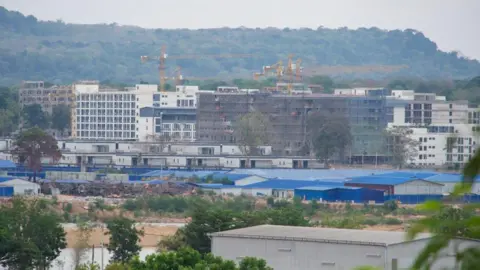
Wandering down the unlit corridors of a six-storey building behind the Royal Hill casino, each door opens onto a different world.
In one there is a perfect replica of a Vietnamese bank. In another, you're in an Australian police station. A Chinese police officer's shirt hangs in one corner.
Motivational messages have been painted on the walls. "Money Coming From Everywhere", read the Chinese characters on one sign. Discarded fake hundred dollar bills are lying all over the floor.
This was a massive scam compound, just inside Cambodia in a border town called O Smach. Thousands of people from different countries worked here, under a harsh regime which strictly regimented their lives, defrauding thousands of others across the world of their savings.
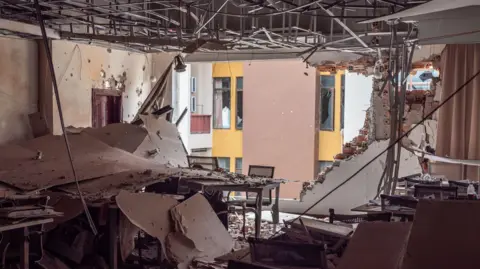
In December Royal Hill was bombed by the Thai air force during the brief border war between the two countries – the Thais say Cambodian drones were being launched from the casino. The workers fled, leaving behind uneaten bowls of noodles, half-drunk cans of coke and a pungent smell.
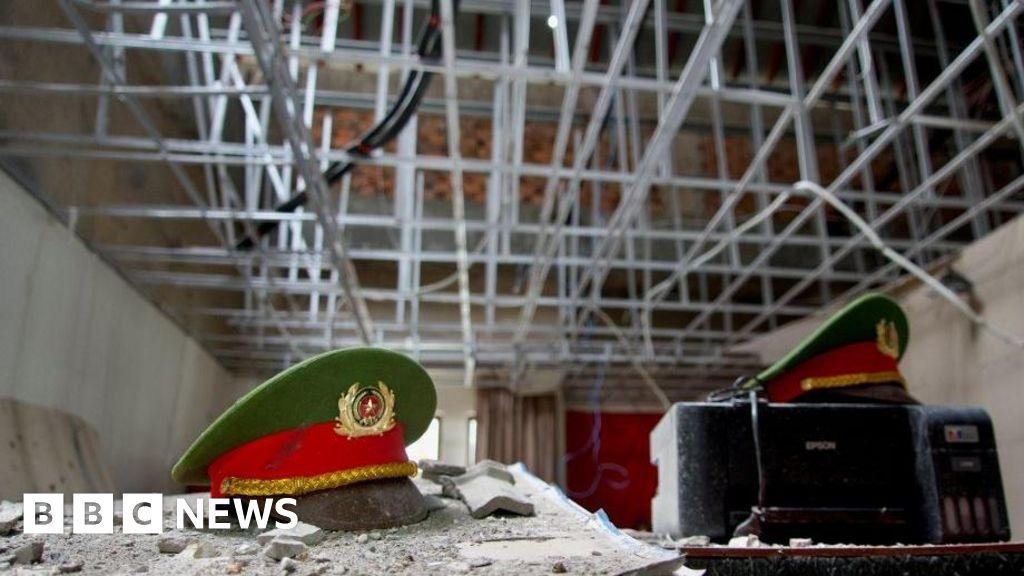
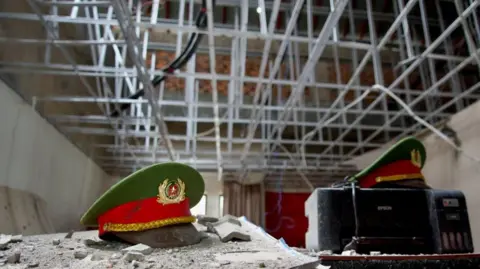
Today, Royal Hill is empty, aside from the Thai soldiers occupying it. The windows have been shattered by the bombardment, and in places gaping holes have been blown through the walls and roof, coating everything with dust.

 Lulu Luo/BBC
The Thai military brought us there because they said they wanted the world to see just how big the scam industry had become in Cambodia. We need international help in shutting this scourge down, they told us; but it also serves as a secondary justification for the Thai air attacks on Cambodian targets in December.
The Cambodian government has protested against the Thai occupation of its territory, but the Thais argue that under their ceasefire both sides have agreed to keep their forces where they were when the fighting stopped.
What is remarkable about Royal Hill is not just its size, but the fact that almost nothing was known about it until the Thais took control of it.
The O Smach Casino, a complex across the road, has featured in news reports about fleeing scam workers complaining of abuses.
Its owner, Ly Yong Phat, is one of Cambodia's most famous tycoons, known for his close relationship with the ruling Hun clan, headed by former prime minister Hun Sen. Ly Yong Phat has been sanctioned by the US and other countries for his alleged role in human trafficking and online fraud.
But Royal Hill's owner Lim Heng keeps a much lower profile. He has never featured on international sanctions lists, although like Ly Yong Phat he has also been awarded the prestigious title of Neak Oknha by Hun Sen - for which he would have been required to donate at least $500,000 (£300,000) - making him part of a Cambodian elite of just a few hundred.
The only somewhat unusual thing that is known about him is his habit of paying respect to the cremation site of the notorious Khmer Rouge leader Pol Pot, which lies close to another of his casinos on the northern border with Thailand.
 Lulu Luo/BBC
Most of Cambodia's tycoons got rich by acquiring huge parcels of land in the years after the end of the Cambodian civil war in 1991 through their ties to the ruling family.
At first they made money from illegal logging and plantations, later benefitting from a speculative property boom in the cities fuelled by Chinese investors.
But in border regions like O Smach casinos were the most profitable business, taking advantage of gambling bans in neighbouring countries like Thailand and China. The Cambodian government has issued around 200 casino licences over the past three decades.
These attracted Chinese crime syndicates, who also ran lucrative online gambling businesses from the casinos. But in 2019, under pressure from China, Hun Sen banned online gambling. That was followed by the Covid pandemic, which stopped cross-border travel.
So, the syndicates switched to online fraud instead, luring young workers from around the world with attractive salary offers.
Some knew they would be carrying out scams. Others believed they would be doing clerical work or computer programming. Few realised until they got to the compounds how harsh the conditions would be.
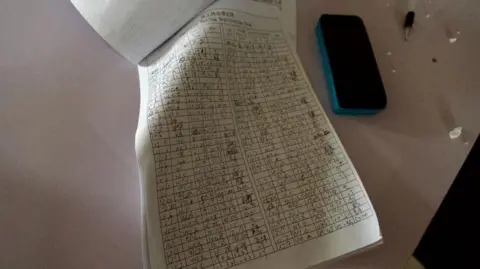
At Royal Hill we saw documents in Chinese, recovered from the rubble, detailing the punishments for failing to meet targets. Failure to get a "lead" – to start building an online relationship with a victim – by the end of a day got five strokes of the cane.
A worker who failed to get any leads after three days received a minimum of 10 strokes. Casual conversation with colleagues, or a failure to share intimate personal items like photos to build trust with victims, resulted in similar punishment.
 Jonathan Head/ BBC
"Some people were electrocuted. Some were put into the black room. They have a room called The Black Room where terrible torture went on," said Wilson, a young Ugandan man who was recruited to work in Royal Hill in August.
He says he was told he would be doing a digital marketing job in Malaysia. We spoke to him from the Cambodian capital Phnom Penh, where he is now being sheltered by a charity and trying to find a way to get back to Uganda.
He described being forced to work 15 or 16 hours a day, following scripts laid out by their Chinese bosses, and using AI to transform their voices and appearance.
"You are supposed to portray the character of a woman, who is 37 years old, rich, and who wants a husband. You chat to these older Americans with the intention of making them think you have fallen in love with them. So, in the script, there's a point where you break them emotionally. You build trust, and then later on you can lure them into buying the products."
He says they were forced to keep working, even during the Thai bombardment. "Every time we would hear a bomb - the building would sometimes shake – we would run out. We were scared. But then we had to come back in and work again."
We saw documents outlining similar scam scenarios, in multiple languages, to build trust with the victims and reassure them about prospective "investments". There were also rules listed for all the employees. There was a range of fines for lateness.
Workers needed to ask permission to use the toilet, and we saw a sheet of paper titled "Employee Outing Registration Form", recording every toilet break taken by each worker on the days before the Thai attack, even recording how much time they took in the bathroom.
 Lulu Luo/BBC
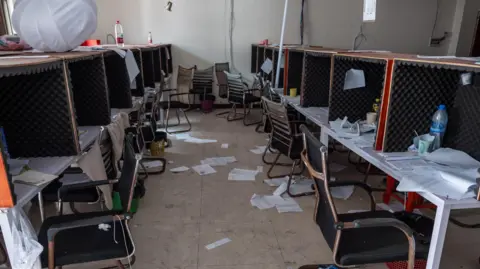
Then there were the scams themselves. Next to a replica Brazilian police station, rows of booths lined with sound-proof foam had been built. On the desks were hand-written notes in Portuguese, reminding the scammers of the tips they were to use to win over their targets.
There was a fake but convincing summons from the Sao Paolo police apparently charging one individual with money-laundering, typically used to scare victims into transferring funds or information about bank accounts.
For years the Cambodian government ignored the growing international concern over the scam industry and the crimes linked to it.
The 2025 US State Department Report on human trafficking accused the government of failing to make significant efforts to eliminate it, never arresting or prosecuting a suspected scam compound operator or owner.
When the US imposed sanctions on Ly Yong Phat in September 2024 over his links to scams and forced labour, the ruling Cambodian People's Party, in which the tycoon is a senior figure, demanded that they be withdrawn, accusing the US of violating Cambodian sovereignty.
 Jonathan Head/BBC
But this year the government abruptly changed tack, after sustained pressure from the US, China and other countries to act against the scams.
Police teams have raided dozens of suspected scam compounds, and Prime Minister Hun Manet announced that the industry would be completely shut down by the end of April, saying it was destroying Cambodia's economy and reputation.
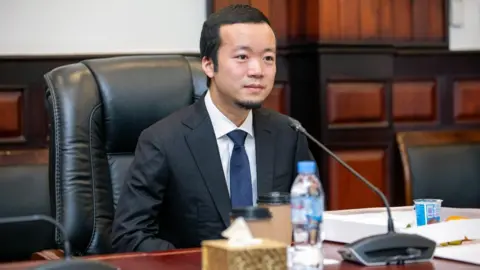
Chen Zhi had bought Cambodian citizenship and risen to become one of the most influential figures in the country, as a personal adviser to Hun Sen. His Prince Group owned a national bank, an airline and extensive property developments.
For years he had seemed untouchable. Yet following his arrest, video was published of him being dragged, hooded and handcuffed, off the plane that had whisked him away to China, where he now awaits trial on charges of operating a cross-border gambling and fraud syndicate.
His humiliating treatment sent a signal that high-profile figures in the scam industry might be sacrificed to save Cambodia's reputation.
The authorities followed that with the recent extradition of Li Xiong, chairman of Huione Pay, an online payment system accused of laundering the profits from scam compounds.
 Prince Holding Group
Many of the scam compounds now lie empty. The police say more than 10,000 foreign workers have been repatriated. Others, like Wilson, are still trying to find a way home. However, there are good reasons for scepticism over the government's claim that this marks the end of the scams in Cambodia.
Raiding scam compounds has been described as playing whack-a-mole. It is all too easy to move the workers to new, lower-profile compounds, and many thousands are believed to have chosen to stay in Cambodia.
And apart from Chen Zhi, none of the tycoons accused of hosting the compounds behind their casinos has yet been touched. Ly Yong Phat, Try Pheap and Kok An are all wealthy and powerful figures who have been sanctioned overseas, yet continue to live comfortably in Cambodia.
In a supreme irony, as senators Ly Young Phat and Kok An took part in voting for a new law, which the Cambodian government says will harshly punish those involved in scamming.
As for Lim Heng, the tycoon who built Royal Hill – until the Thai army moved over the border and captured his casino, his name had never figured anywhere in all the reporting and investigations of the scam business.
More on the the scam industry