Colombia's rogue hippos could find refuge in India
Colombia's rogue hippos could find refuge in India
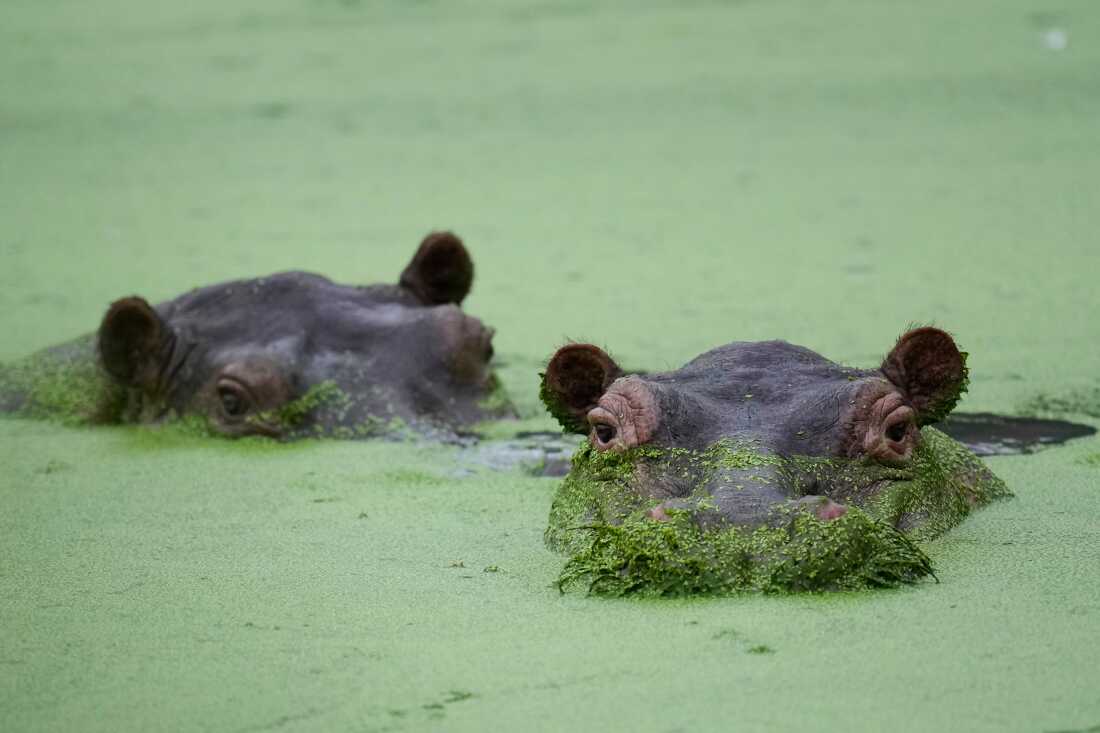
Hippos wallow at a lagoon in the Hacienda Napoles Park, once the private estate of drug kingpin Pablo Escobar, in Puerto Triunfo, Colombia. Fernando Vergara/AP hide caption
toggle caption
Fernando Vergara/AP
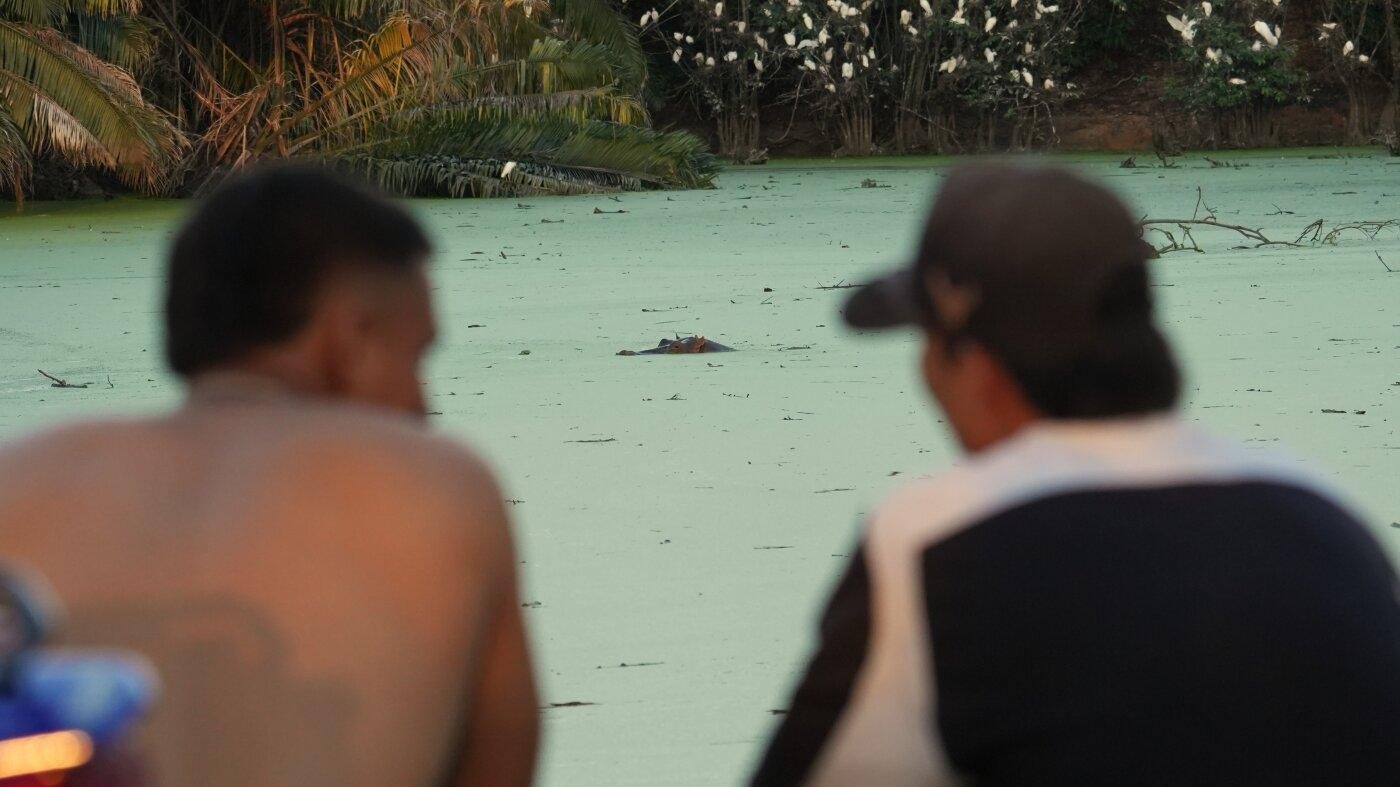
DORADAL, Colombia—In a small town in central Colombia, the grunt of hippos has become part of the soundscape. Every afternoon in Doradal, locals and tourists hang out at a lake on the edge of town. They chat and drink beers as they watch the giant beasts floating on the water.
"This is one of the main attractions in town," says Lina Morales, a local hotel worker.
The hippos are the descendants of four animals brought illegally to Colombia in the 1980's by Pablo Escobar. The notorious drug lord owned a private zoo on a ranch near Doradal, where he also had elephants, giraffes, and zebras.
But no one captured the hippos after the Colombian government seized Escobar's properties in 1993.
And because of the lack of natural predators, their population exploded. Scientists estimate there are now 200 hippos roaming freely around Doradal—a town surrounded by lush forests and big rivers.
Some say the time has come to cull them. Biologist Nataly Castelblanco-Martinez explains that the hippos deposit large amounts of waste in lakes and riverbeds, which can lead to drastic changes in water chemistry.
"Including changes in the pH and also less oxygen. So, then all the plants that need oxygen in the water are going to collapse because of this," Castelblanco-Martinez says.
With fewer underwater plants, the local food chain suffers. "The hippos have a transversal impact on the ecosystem," Castelblanco-Martinez adds.
In mid-April, Colombia's government announced a plan to control the country's hippo population, including culling up to 80 animals this year.
In Doradal, the hippos have become a tourist attraction—statues of the animals are displayed throughout the town.

A stack of three hippo statues stands at Hacienda Nápoles Park, once the private estate of drug kingpin Pablo Escobar, in Puerto Triunfo, Colombia. Fernando Vergara/AP hide caption
toggle caption
Fernando Vergara/AP
"They are part of our community now," says business owner Tania Galindo. "There's no other place outside of Africa with wild hippos."
Some locals now take visitors on hippo safaris, while others sell keyrings, T-shirts, and other souvenirs featuring the semi-aquatic mammals. "Their population should be controlled," Galindo says. "But in a peaceful manner that respects their life, and the appreciation we have for them."
Colombia initially tried to curb the hippo population through sterilization—first with surgeries, then contraceptive injections. But biologist Castelblanco-Martinez says the procedures are costly and risky, making large-scale sterilization difficult. She says culling is the most effective solution.
"And we do it with lionfish, you see it with camels in Australia," she says.
Now, Colombia's hippos may have been thrown a lifeline. Indian billionaire Anant Ambani has offered to relocate 80 hippos to his Vantara wildlife reserve in Gujarat, India.
"It would be a major undertaking for sure," says Sergio Estrada, a biology professor at Bogotá's Rosario University. He is skeptical of the billionaire's proposal.

Locals relax as they watch hippos floating in a lake near Doradal, Colombia, April 23 Manue Rueda/NPR hide caption
toggle caption
Manue Rueda/NPR
"Depending on where they are, when they lure them and catch them, they would have to drive them in huge trucks and lorries to the Rio Negro airport near Medellin. And that is about 150 km. So that, in itself, is no easy task," he says.
Then the hippos would have to be put on planes to India—a long flight that requires a stopover. "And so, imagine what you would need to do to keep these animals safe and relaxed during this trip?" Estrada adds.
There are also questions about how these wild animals would fare in Ambani's reserve.
"I don't see these animals living and roaming freely in this area, in this location in India," Estrada says.
Colombia's Environment Ministry warns that if drastic measures are not taken, the hippo population could double over the next five years. That might lure more hippo lovers to Doradal—but it also leaves Colombian officials with difficult choices about how to manage a growing and unpredictable population.
Sponsored
Sponsored
Sponsored
Sponsored
Ads
Categories
Read More
I’m CNET’s Fitness Expert. I Swear by These Versatile Earbuds for Every Run and Gym Session I'm picky about my workout gear. These are the only wireless earbuds I trust to handle my sweaty workouts, stay in place and deliver crystal-clear sound for all my activities. Article updated on March 16, 2026 at 6:00 AM PDT Our Experts Our expert, award-winning staff...

Today's NYT Mini Crossword Answers for Friday, May 8Looking for the most recent Mini Crossword answer? Click here for today's Mini Crossword hints, as well as our daily answers and hints for The New York Times Wordle, Strands, Connections and Connections: Sports Edition puzzles. It isn't often that the NYT Mini Crossword stumps me right away, but 1-Across threw me off. I was sure...

Today's Wordle Hints, Answer and Help for May 12, #1788Looking for the most recent Wordle answer? Click here for today's Wordle hints, as well as our daily answers and hints for The New York Times Mini Crossword, Connections, Connections: Sports Edition and Strands puzzles. Today's Wordle puzzle is a common word, but the repeated letter may throw you off. If you need a new...

Google Details the New Magic Pointer Features Coming to GooglebooksShortly after its Android Show announcements on Tuesday, Google's DeepMind, the company's artificial intelligence lab, detailed the upcoming Magic Pointer, a feature that reimagines the mouse pointer with AI capabilities. The feature will be available in Googlebooks, Google's new AI-focused laptops, later this...

The Blood Cancer Treatment Market is expected to witness robust growth as the global healthcare industry continues to advance precision oncology and personalized cancer therapies. According to Future Market Insights (FMI), the market is projected to grow from USD 7.7 billion in 2026 to USD 18.4 billion by 2036, registering a 9.1% CAGR during the forecast period. Rising incidence of...