Clawdmeter turns your Claude Code usage stats into a tiny desktop dashboard
Clawdmeter turns your Claude Code usage stats into a tiny desktop dashboard
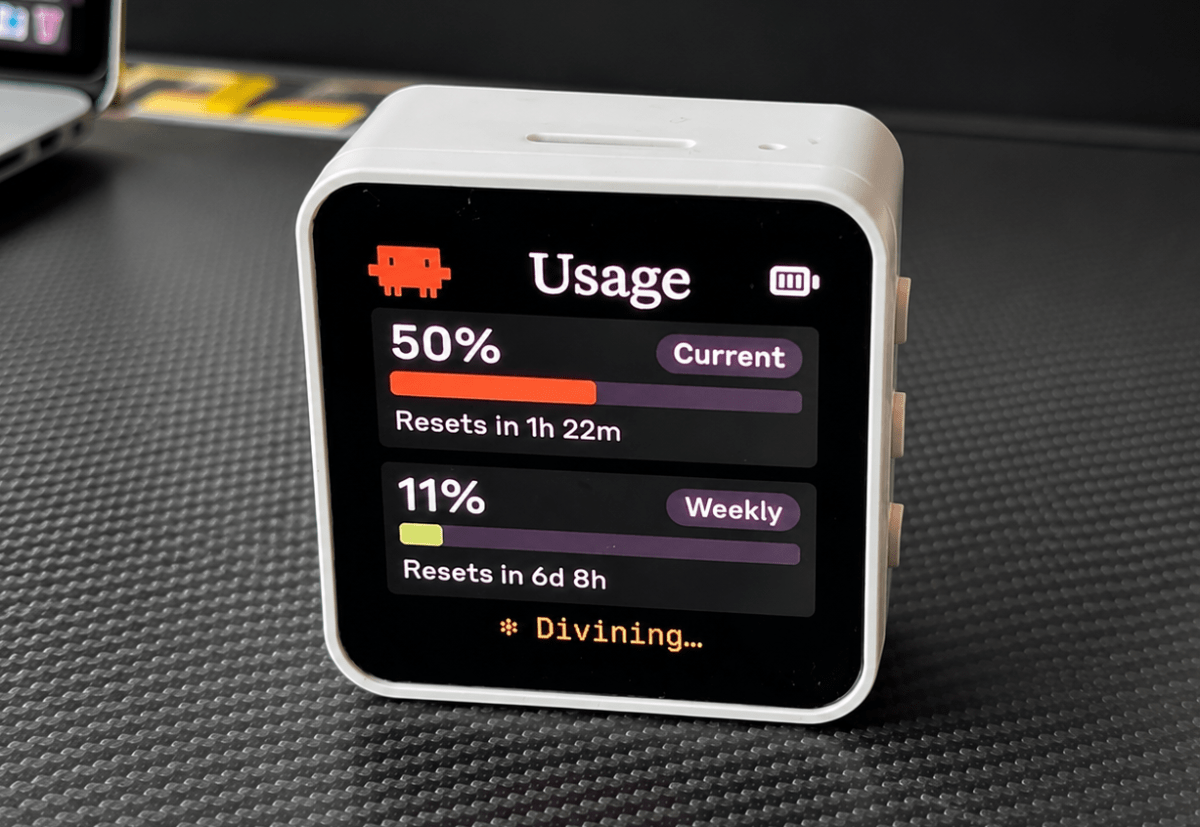
Silicon Valley’s tokenmaxxing era now has its own hardware. A new open source project brings your Claude Code utilization stats into a tiny desktop dashboard, allowing AI power users to keep an eye on their usage.
Sure, you can track Claude Code usage directly in the terminal using commands or other external tools and apps, but that’s not as fun as seeing a pixel-art version of the Clawd sprite dance on a screen before showing at-a-glance token usage info, is it?
The “Clawdmeter,” as the device is called, is both a fun side project for AI power users and a timely indication of how thoroughly Anthropic’s Claude has infiltrated the developer community and the growing interest in tokenmaxxing. This new “productivity” trend sees software engineers at various tech companies maximizing the number of AI tokens consumed at work as a measure of how much they’ve embraced AI.
As one Reddit user joked when seeing the project for the first time: “At this point, Anthropic should just mail these to us for free.”
Another suggested adding a button to increase capacity or top up more tokens using your card on file. (Ha, that could be dangerous!)
The idea for the project comes from Reykjavik, Iceland-based software developer Hermann Haraldsson, who says he had always wanted to play around with embedded devices, but never before had the time.
“I’m not an embedded developer or anything like that,” Haraldsson told TechCrunch in a call. But Claude was able to walk him through the project in just a few days, he said. “It’s really democratized access to programming, so that anyone can now do what developers used to do. I think that’s really positive, actually.”
Most of the time he spent building the device was focused on design, making sure to get the font, colors, and little animations just right.
To build your own dashboard, you can use a small lithium-ion battery-powered display like the Waveshare ESP32-S3-Touch-AMOLED-2.16, which pairs with your laptop over Bluetooth. When the device is turned on, the splash screen plays pixel-art Clawd animations that get busier as your usage rate climbs. You can also push the middle button to cycle through different types of animations if you choose.
“I like it when I’m working, and I see it going crazy — it’s like a little dopamine loop,” notes Haraldsson.
The animation remains on the screen until you press the middle button, which then displays your session and weekly Claude utilization data in simple charts.
You can press this button again to cycle to the Bluetooth screen, which displays the connection status and offers a reset feature. From there, you can tap the screen to return to the original splash screen animation.

Meanwhile, two other side buttons send Space and Shift+Tab over Bluetooth for Claude Code’s voice mode and mode-toggle shortcuts. The latter lets you move between the default Normal mode, “Accept Edits” mode, Plan Mode, and Auto Mode.
Haraldsson says the device keeps up with your usage limits because it reads your Claude Code OAuth token to make an API call, which then pulls the usage numbers from the response headers directly.
Because Clawdmeter is an open source project, anyone can fork it to add their own features, animations, screens, and more, based on their particular interests and needs.
Haraldsson says he was surprised to see that over 800 people have starred it on GitHub since its May 10 launch, and 50 have already forked the project for their own development. He suspects the device appeals to them because it has a nostalgic feel.
“There’s a kind of nostalgia for when you used to have a hardware device for everything — like a Walkman to play music, or an iPod,” says Haraldsson. (Or, as one Redditor put it, the Clawdmeter is like a “hardware Tamagotchi for my context window.”)
“I know it’s not replacing anything — like, you could have this on your computer — but it’s just fun,” Haraldsson says.
When you purchase through links in our articles, we may earn a small commission. This doesn’t affect our editorial independence.
Sarah has worked as a reporter for TechCrunch since August 2011. She joined the company after having previously spent over three years at ReadWriteWeb. Prior to her work as a reporter, Sarah worked in I.T. across a number of industries, including banking, retail and software.
You can contact or verify outreach from Sarah by emailing sarahp@techcrunch.com or via encrypted message at sarahperez.01 on Signal.
Sponsored
Ads
Ads
Ads
Categories
Read More
You'd think getting a save in MLB The Show 26 means you have to use your closer in the ninth with a slim lead, right? Not even close. The game actually gives you way more control than that-you can earn the stat through different entry points, longer outings, or even by walking batters to create a qualifying situation. It's all about knowing the rules, not just following the old-school baseball...

A16z VC wants founders to stop stressing over insane ARR numbers The AI investing boom (or perhaps bubble) is something Silicon Valley has seen many times before: a gold rush of VC money thrown at the Big New Thing. But one aspect of it is completely unique to these times: startups rocketing from $0 to as much as $100 million in annual recurring revenue, sometimes in a matter of...

iPhone 18 Pro ‘drop test’ leaks get yanked from XA data breach at a supplier reportedly leaked iPhone 18 Pro pictures and videos.A data breach at a supplier reportedly leaked iPhone 18 Pro pictures and videos.by Emma RothJun 30, 2026, 1:57 PM UTCEmma Roth is a news writer who covers the streaming wars, consumer tech, crypto, social media, and much more. Previously, she was a writer and editor...

These camera-free smart glasses made me feel like Tony StarkXgimi, the Chinese company known for its all-in-one smart projectors, is expanding its portfolio with a new line of screen-equipped smart glasses that first debuted at CES 2026. Unlike AR glasses from companies like Meta and Snap, Xgimi’s new privacy-focused MemoMind One skip cameras for a lighter and more discreet design that helps...
As war rages, Israel and Lebanon hold first direct talks since 19937 hours agoBernd Debusmann Jr,at the White HouseandNada Tawfik,at the State DepartmentGetty ImagesSecretary of State Marco Rubio said the talks were a 'historic' opportunity to end Hezbollah influence in the region. Lebanon and Israel have held their first diplomatic talks in over three decades, a rare encounter aimed at ending...