When Mozilla announced that its Firefox browser would have a built-in artificial intelligence kill switch, it separated itself from the crowd of tech giants eagerly adding an onslaught of AI features to every online experience.
Mozilla CEO Anthony Enzor-DeMeo says it became apparent to him when he stepped into the role in December that the Firefox community was demanding the ability to turn off the browser's AI features entirely.
"Our community was pretty vocal, especially during the CEO announcement, that not everyone wanted [AI]," he told me in an interview. "At its core, we want to listen to our users, and they were vocal. ... It was honestly on the roadmap, but I expedited it, given the community feedback."
But the AI kill switch, which is now available on mobile as well as desktop, has been flipped by just 1% of Firefox users to turn off AI completely. And it's being partially used by just 3% to turn off some AI features in the browser.
Enzor-DeMeo notes that tools including AI translations have value that people want to keep. The important differentiator in Firefox is that there's a choice, he says, pointing to Microsoft defaulting to Copilot when you search on a Windows desktop and Google installing large AI models on people's computers without notifying them.
"I think there's a general user sentiment of, 'hey, I didn't ask for that, and I didn't choose that.' The great thing about Firefox is ... we offer choice," he says.
Enzor-DeMeo also spoke to me about Firefox's new Smart Window, its built-in VPN, privacy concerns in the age of AI and the browser's fresh redesign launching in the fall with an aim of keeping the internet open and fair.
Firefox Smart Window: BYO AI
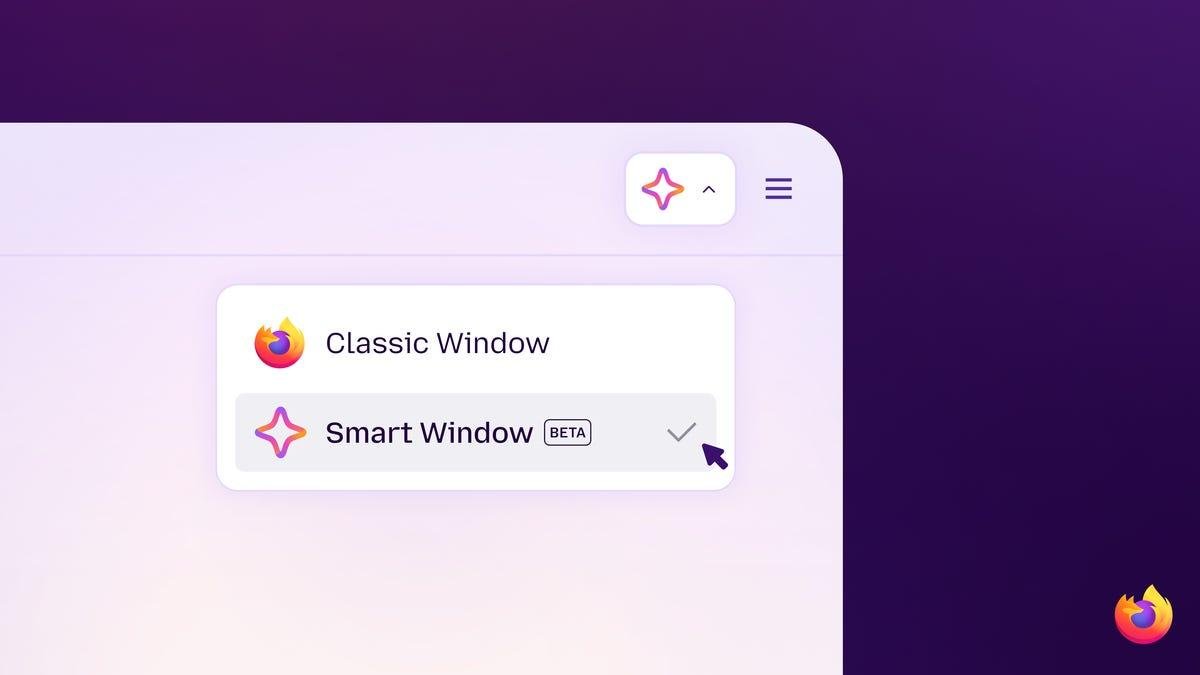
Switch from a classic browser window to an AI-powered Smart Window on Firefox in beta.
MozillaSmart Window, which is available in beta now, allows you to choose which AI model to use on Firefox, as well as enabling you to bring your own AI models to use in the browser.
"If you want to use ChatGPT, great. If you want to use Gemini, great. ... Our sidebar allows you to use all of them," Enzor-DeMeo said. "They all excel at different things; why do I need to be forced into one of them?"
The team at Firefox is hoping other browsers take this more AI-agnostic approach, and to use privately hosted open-source AI models, too.
Mozilla also touts the privacy of your chats in Smart Window. It says it doesn't use any of your information to train models and automatically filters out sensitive and private data. You can then choose which data the AI model does remember about you and delete anything you don't want it to know or turn off its memory completely.
Enzor-DeMeo noted that not only are there skeptics of AI, but that a majority of the world who cannot access it. According to some stats, around 83% of the world's population has not used AI, and in the US, only around 3% are paying for it. He called AI "largely non-profitable," and predicted that we'll start seeing a lot more ads in AI services soon.
"Sometimes, especially in the tech bubble, I think we get a little bit of tunnel vision or an echo chamber of AI, AI, AI, but I think when you look at it from a global scale, there's not a ton of access," he told me. "If we actually go the route that AI becomes more centered in the browser, and that's how people access the internet, you run the risk of the internet becoming more closed off."
AI tools need a lot of information about you to provide an optimal experience -- "that's just the brutal truth." But he said Firefox focuses on active consent.
"I think there's an inflection point in the market with lack of trust in Big Tech," Enzor-DeMeo said. "There's an inflection point in what is AI doing to society, and I think people crave control, autonomy, choice and essentially, privacy."
Firefox's built-in VPN: 1.5 million signups
Firefox has a built-in VPN.
MozillaTo help maintain this privacy, Firefox introduced a free in-browser VPN last month. Enzor-DeMeo said one of his top priorities when he took over as chief executive in December was to create a built-in VPN product, because it's a lot easier for people to just click a button in the browser than it is to open another app and log in -- "a subpar experience," he noted.
While many VPNs offer browser extensions to simplify the process, keep in mind that a browser-based VPN generally only encrypts your activity within that browser, not in other apps across your device. You need VPN apps for more robust privacy protections.
Firefox's VPN now has 1.5 million signups, with Mozilla currently offering an Unlimited VPN package from June 9 through Aug. 31 that lets you select your geolocation. And with around 800,000 active users already, Enzor-DeMeo said it's a nod of approval that Firefox did the right thing, especially in the age of AI running rampant, when the privacy enabled by using a VPN is incredibly important.
"What we're seeing is an increase in surveillance. There's a lot of different challenges, depending on your geolocation, going on with AI," he told me. "We've always been a firm believer in VPN. I think people have a right to privacy. I think that people need to look up information on medical issues or things like that, and remain hyper private. So for me, it was ethos-led."
The new Firefox: "Keep the internet an equal playing field"
The Firefox redesign has vertical tabs and rounded icons.
MozillaProject Nova, which will simply be called Firefox when it launches later this year, is centered around making Mozilla's browser speedier (page load times are up to 9% faster than they were previously, Mozilla says), more secure and customizable. Firefox has around 200 million monthly users. (It's estimated that Firefox has just over 2% of the browser market share, compared to Google Chrome's 70% and Apple's Safari's 16%.)
It's slated to release in the fall, around September or October, although new features are slowly rolling out in Nightly. Mozilla has been seeking input from its community of developers and other users via its own forums and AMA posts on Reddit.
One new AI feature is tab groups, in which artificial intelligence will automatically group together similar tabs you have open to make them easier to find. Enzor-DeMeo said his AI approach is to find efficiency features that people would actually benefit from.
Beyond AI, the new Firefox will get visual upgrades including compact mode; a round shape for panels, menus, settings and browser controls; a glow around your active tab; and accessibility features built in.
"What we're trying to do is keep the web open, safe and competition fair," Enzor-DeMeo said. "Our objective is not to be the biggest browser; it's to keep the internet an equal playing field."