I have a list of the Best Power Banks for iPhones and Android devices, and most of the innovation in recent years has come in the form of slimmer, higher-wattage wireless charging batteries that magnetically stick to your phone to charge it faster and without heating up too much. But eco-sensitive Nimble went in a different direction to create something novel in the portable battery realm: Its new $80 Sharepower power bank splits in half, so you can generously lend one half to that stressed person in your life whose battery is low and failed to travel without a backup power option.
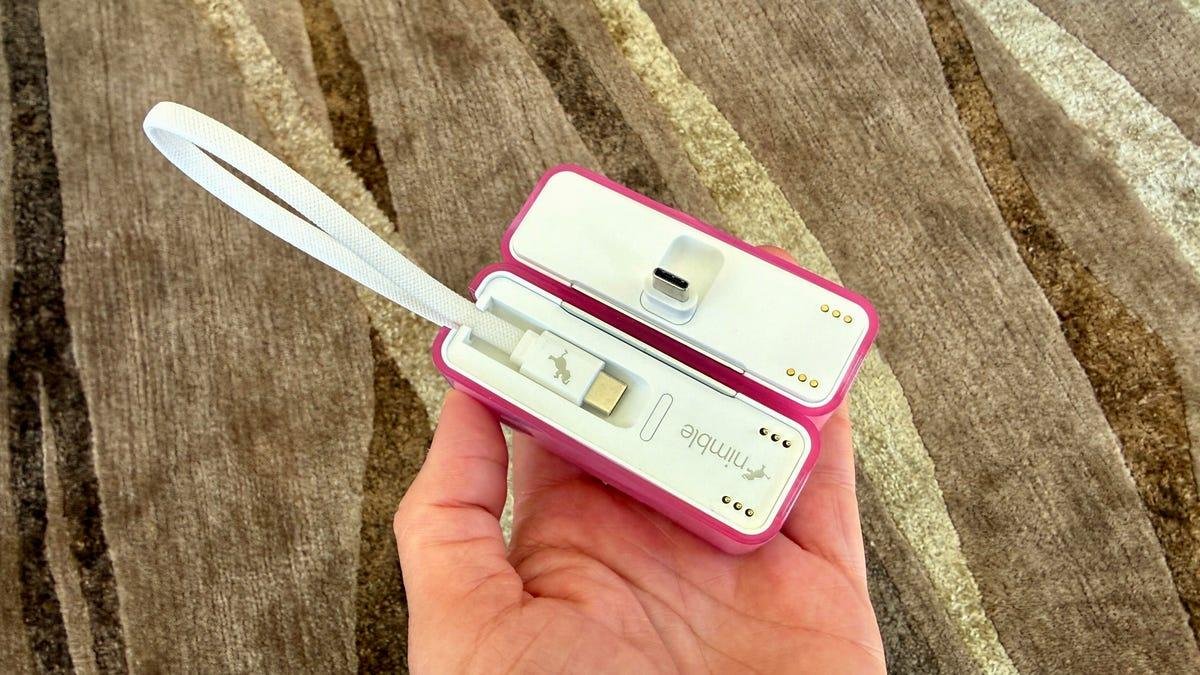
The Sharepower isn't a wireless charger. Rather, it's two, 5,000-milliampere-hour batteries magnetically attached to each other. Each has a USB-C connector to supply power with a fast 20-watt wired connection. The 5,000-mAh battery capacity is enough to fully charge most phones once.
The two batteries joined up.
David Carnoy/CNETWhen split, both batteries are designed to work as independent batteries, so you can charge them separately if need be. When you join them back up, the batteries immediately begin to balance their power load, evenly distributing the power across the batteries.
As a single 10,000-mAh battery, the Sharepower is a little beefy. It weighs 7.6 ounces (216 grams), with each battery weighing about 3.8 ounces or 108 grams. But other 10,000-mAh batteries don't weigh that much less. For example, Baseus' new slim $50 PicoGo AM52 Qi2.2 Magnetic Power Bank 10,000-mAh 25W weighs in at 196 grams (it offers 45-watt wired charging while the Sharepower offers 35 watts of total power when joined).
Both batteries have USB-C connectors for fast 20-watt wired charging.
David Carnoy/CNETAt launch, Sharepower is available in white, but Nimble is offering it in "limited-edition" blue and pink color options that are the white version skinned with silicone covers that provide some grip and protection, which is nice (the covers can be removed if you wish).
While pricier than your typical 10,000-mAh power banks, this is a tricky battery to design, so I can understand why it costs more. It may be worth paying the premium for the Sharepower, though, to avoid family squabbles over low batteries and who gets to use a single power bank and for how long. I'm usually nice and allow my kids to get up to 25%, sacrificing my own full charge. But I can't say I'm happy about it.
Charging a Google Pixel phone low on battery.
David Carnoy/CNET