Study Abroad Exams: A Complete Guide for Indian Students
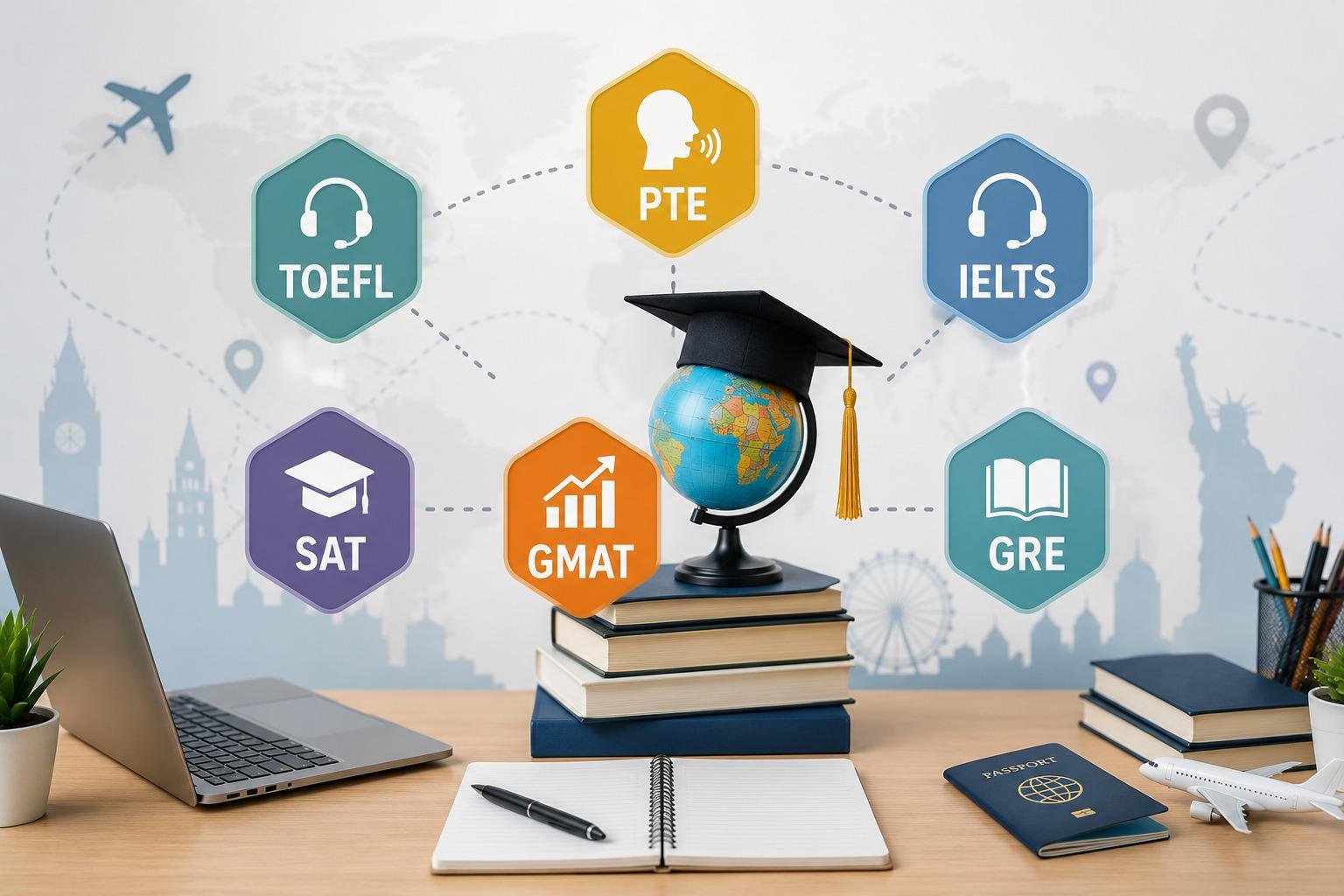
For Indian students planning to study abroad, entrance exams are often the first real hurdle in a long and detailed application process. Between English proficiency tests, standardized aptitude exams, and country-specific requirements, it's easy to feel unsure about where to even begin. This guide breaks down the major exams Indian students typically encounter, what each one involves, and how to plan your preparation strategically.
Why Exams Matter So Much for Indian Applicants
Indian students face intense competition, both domestically and internationally, which makes strong exam scores an important way to stand out in a crowded applicant pool. Universities abroad use these scores to evaluate academic readiness, English communication skills, and, in many cases, aptitude for specific fields like business, law, or medicine. Since most Indian students haven't grown up in an English-medium academic system exactly like the one they're applying into, English proficiency exams in particular carry significant weight in the admissions process.
Beyond admissions, many of these same exam scores are also used by universities to determine scholarship eligibility, making strong preparation doubly important for students hoping to reduce their overall cost of studying abroad.
English Proficiency Exams: IELTS, TOEFL, and PTE
IELTS is one of the most commonly taken exams among Indian students, largely because of its widespread acceptance across the UK, Australia, Canada, and Ireland, as well as its use in visa applications for several of these countries. Its face-to-face speaking component tends to suit students who are more comfortable with live conversation than recorded responses.
TOEFL is the preferred exam for most students applying to the United States. It's fully computer-based and leans academic in style, closely resembling the kind of reading, listening, and writing tasks students will face once they're actually in a university classroom. One detail that often comes up during preparation is understanding the toefl exam total marks, since knowing the full scoring scale — and how each section contributes to it — helps students set realistic target scores based on their university's specific cutoff requirements.
PTE Academic has also become increasingly popular among Indian applicants, largely due to its quick turnaround time, with results often available within 48 hours, and its fully AI-scored format, which some students find more predictable than a live speaking interview.
SAT: For Undergraduate Applications to the US
Indian students applying to undergraduate programs in the United States often need to take the SAT, even though a growing number of universities have adopted test-optional policies. A strong SAT score can still meaningfully boost an application, especially for students targeting competitive universities or applying for merit-based scholarships.
Before diving into preparation, it's worth spending real time understanding the sat exam pattern, since the test is divided into distinct sections covering reading, writing and language, and math, each contributing differently to the final composite score. Knowing exactly how the test is structured helps students allocate their study time more effectively, rather than spreading preparation too thin across areas that may need less attention.
GRE and GMAT: For Graduate Programs
For Indian students pursuing a master's degree, particularly in engineering, sciences, or the humanities, the GRE remains one of the most commonly required entrance exams. It tests verbal reasoning, quantitative reasoning, and analytical writing, and is accepted by thousands of graduate programs worldwide. That said, an increasing number of programs, particularly outside the US, have started making the GRE optional, so it's worth confirming your specific program's requirements before committing to months of preparation.
For those applying to MBA and other business programs, the GMAT continues to be the standard entrance exam, especially for top-ranked international business schools. It evaluates quantitative and verbal reasoning, along with analytical writing and integrated reasoning, and is designed specifically to predict success in graduate-level business coursework. Given how competitive MBA admissions have become, many Indian applicants start GMAT preparation six months to a year in advance.
Country-Specific and Field-Specific Exams
Beyond these widely known tests, Indian students should also be aware of exams tied to specific countries or fields of study. Medical aspirants heading to the US may need to take the MCAT, while those applying to the UK often need the UCAT. Some countries also run their own national-level entrance exams for international applicants, so it's important to check requirements on a country-by-country and program-by-program basis rather than assuming a single exam covers every destination.
Building a Realistic Preparation Timeline
Given how many exams may be involved — often two or three for a single application cycle — Indian students benefit enormously from building a clear, realistic preparation timeline well in advance. This typically starts with shortlisting target universities and countries, then identifying exactly which exams each program requires, since requirements can differ even between similar programs at the same university.
From there, working backward from application deadlines helps determine when each exam needs to be completed, factoring in time for at least one retake if the first attempt doesn't hit the target score. Many Indian students juggle exam preparation alongside board exams, college coursework, or even early work experience, so starting early — ideally eight to twelve months before application deadlines — makes the entire process significantly less stressful.
Choosing the Right Support
Coaching institutes, online prep platforms, and study abroad consultants are widely used by Indian students to structure their exam preparation, and each comes with its own advantages. Coaching institutes offer structured, classroom-style learning, online platforms provide flexibility for students juggling other commitments, and consultants can help connect exam strategy with the bigger picture of university and country selection. The right choice often depends on a student's learning style, schedule, and how much personalized guidance they feel they need.
Final Thoughts
For Indian students, navigating the world of study abroad exams can feel like a project in itself, but breaking it down exam by exam makes the process far more manageable. Understand exactly which tests your target universities require, learn the structure and scoring of each one early, and build a preparation timeline that gives you enough room for a strong first attempt — and a second one, if needed. With the right planning, these exams become a clear, achievable checkpoint on the way to studying abroad, rather than an overwhelming obstacle.
Sponsored
Sponsored
Sponsored
Sponsored
Ads
Categories
Read More
Instagram Expands Its PG-13-Inspired Content Guidelines for Teen Accounts to EuropeIn the wake of two massive US court losses around child safety online, Meta is expanding its teen safety programs. The company said on Thursday that it is expanding the use of its PG-13 movie rating-inspired standard to teen accounts internationally, particularly to Europe.The PG-13 rating, as we...

U.S. military bombs Kharg Island, Iran's main oil export hub, Trump says This picture, taken a position in northern Israel, shows an Israeli Air Force fighter jet flying over the border area with southern Lebanon on March 13, 2026....

Lego has announced an exciting new collection to celebrate the upcoming 2026 World Cup, featuring famous soccer players like Cristiano Ronaldo, Lionel Messi, Kylian Mbappé, and Vini Jr. This collection allows fans to show their love for the sport and their favorite players through fun and creative Lego sets. If you're eager to get your hands on these special Lego sets, they are available for...

Cuba says it killed 4 people aboard a Florida-registered speedboat who fired on soldiers HAVANA — Cuba's government said Wednesday that its soldiers killed four people aboard a speed boat registered in Florida that opened fire on officers in Cuban waters. Cuba's Interior Ministry issued a statement that provided few details about the shooting, but noted that the boat was roughly 1 mile...

SpaceXAI releases Grok 4.5, which Elon describes as an ‘Opus-class model’ SpaceXAI has released its latest model, Grok 4.5 — the first since the company went public several weeks ago. In a blog post published Wednesday, SpaceXAI characterized its new release as a workhorse that can tackle all of the typical tasks that the AI industry has sought to automate: coding and app-building, office and...