Electric Vehicle Battery Testing Equipment Market Positioned for Robust Growth with 10.8% CAGR During 2026–2036 | HORIBA, Arbin Instruments, Chroma ATE
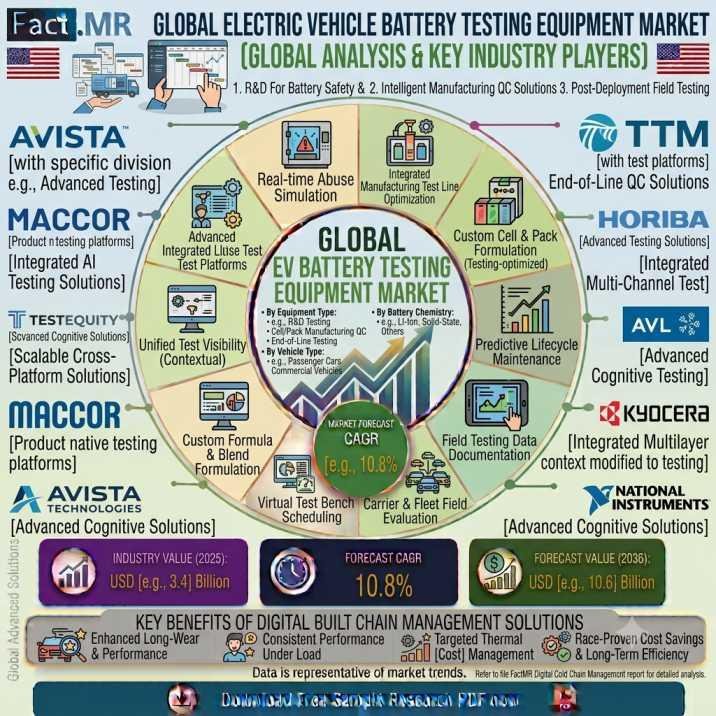
The global Electric Vehicle Battery Testing Equipment Market reached USD 3.4 billion in 2025 and is projected to expand from USD 3.8 billion in 2026 to USD 10.6 billion by 2036, registering a compound annual growth rate (CAGR) of 10.8% during the forecast period, according to Fact.MR. The market is expected to create an absolute opportunity of USD 6.8 billion between 2026 and 2036, supported by increasing electric vehicle adoption, expanding battery manufacturing, and growing requirements for battery performance, safety, reliability, and quality testing.
Get Detailed Market Forecasts, Competitive Benchmarking, and Pricing Trends: https://www.factmr.com/connectus/sample?flag=S&rep_id=15946
Electric vehicle batteries are becoming increasingly sophisticated as manufacturers pursue higher energy density, faster charging, longer driving ranges, and improved durability. Testing equipment plays a critical role in validating battery cells, modules, and packs across electrical, thermal, mechanical, safety, and performance parameters.
The expansion of EV production is consequently increasing demand for advanced testing equipment across battery development laboratories, manufacturing facilities, automotive testing centers, and research institutions.
Why Is the Electric Vehicle Battery Testing Equipment Market Growing?
According to Fact.MR, several factors are supporting market expansion:
- Increasing adoption of electric vehicles.
- Expanding EV battery manufacturing capacity.
- Growing complexity of battery technologies.
- Rising emphasis on battery safety and reliability.
- Increasing requirements for quality control during battery production.
- Growing investment in EV research, development, and testing infrastructure.
Battery manufacturers and automotive companies require sophisticated testing systems to identify defects, validate performance, and ensure batteries meet specified safety and durability requirements. Testing throughout the battery development and manufacturing lifecycle also helps manufacturers improve consistency and reduce quality-related risks.
The market is further supported by advances in battery chemistry, cell design, automation, data acquisition, thermal testing, and battery management technologies.
Key Market Numbers
According to Fact.MR:
- Market value in 2025: USD 3.4 billion
- Market value in 2026: USD 3.8 billion
- Forecast market value by 2036: USD 10.6 billion
- Forecast period: 2026–2036
- CAGR: 10.8%
- Absolute opportunity from 2026 to 2036: USD 6.8 billion
Market Overview
The Electric Vehicle Battery Testing Equipment Market is expected to experience strong growth as automotive manufacturers and battery producers scale EV production and invest in advanced quality-control infrastructure. Testing equipment enables manufacturers to evaluate battery performance and identify potential issues throughout cell, module, and pack development.
Battery testing systems can support evaluation of electrical characteristics, thermal behavior, charging and discharging performance, durability, and safety. As battery technologies evolve, manufacturers are increasingly requiring precise and automated testing capabilities to maintain production quality.
The growing emphasis on EV battery safety and reliability is expected to make testing infrastructure an increasingly important component of the electric vehicle value chain.
Growth Opportunities for Testing Equipment Manufacturers
Industry participants can capitalize on growing demand through several strategic initiatives:
- Developing automated EV battery testing platforms.
- Expanding electrical, thermal, mechanical, and safety testing capabilities.
- Supporting testing requirements across cells, modules, and battery packs.
- Integrating advanced data acquisition and analytics technologies.
- Developing scalable testing systems for high-volume battery manufacturing.
- Building partnerships with EV manufacturers, battery producers, research institutions, and automotive testing facilities.
Companies delivering accurate, automated, scalable, and reliable battery testing solutions are expected to strengthen their competitive position as EV battery production continues expanding.
Market Segmentation
By Testing Type:
The market includes electrical performance testing, thermal testing, safety testing, durability testing, charging and discharging evaluation, and other battery validation procedures.
By Battery Level:
Testing equipment is used for battery cells, modules, and complete battery packs.
By End User:
Demand is driven by electric vehicle manufacturers, battery manufacturers, automotive component suppliers, battery research laboratories, testing facilities, and research institutions.
Competitive Landscape
The Electric Vehicle Battery Testing Equipment Market is becoming increasingly competitive as testing equipment manufacturers, automotive technology companies, battery testing specialists, and laboratory equipment providers develop advanced solutions for EV battery validation. Market participants are focusing on testing accuracy, automation, scalability, safety validation, and integration with battery manufacturing workflows.
Key competitive strategies include:
- Developing automated battery testing systems for high-volume manufacturing.
- Expanding electrical, thermal, mechanical, and safety testing capabilities.
- Developing advanced systems for cell, module, and battery pack testing.
- Integrating data acquisition, analytics, and automated reporting capabilities.
- Improving testing speed, accuracy, repeatability, and energy efficiency.
- Strengthening partnerships with EV manufacturers, battery producers, automotive suppliers, and research institutions.
Manufacturers are also focusing on flexible testing platforms capable of supporting evolving battery chemistries, cell formats, and battery architectures. As electric vehicle production expands and battery technologies become more complex, suppliers offering scalable and technically advanced testing equipment are expected to strengthen their market position.
Read Full Research Report Insights on Electric Vehicle Battery Testing Equipment Market
Frequently Asked Questions
What was the Electric Vehicle Battery Testing Equipment Market size in 2025?
According to Fact.MR, the global Electric Vehicle Battery Testing Equipment Market reached USD 3.4 billion in 2025.
What will the market be worth by 2036?
The market is projected to reach USD 10.6 billion by 2036.
What is the expected growth rate of the market?
The Electric Vehicle Battery Testing Equipment Market is forecast to expand at a 10.8% CAGR during the 2026 to 2036 forecast period.
What is the absolute opportunity in the market?
According to Fact.MR, the market is expected to create an absolute opportunity of USD 6.8 billion between 2026 and 2036.
What is driving demand for EV battery testing equipment?
Market growth is driven by increasing electric vehicle adoption, expanding battery manufacturing capacity, rising battery technology complexity, and growing requirements for battery performance, safety, durability, reliability, and quality control.
Fact.MR is a global market research and consulting company providing market intelligence, industry forecasts, competitive benchmarking, and strategic insights across automotive, electric mobility, batteries, technology, healthcare, industrial, manufacturing, and consumer markets. Its research helps organizations, investors, and business leaders identify emerging opportunities and make informed strategic decisions.
Related Reports:
https://blog.naver.com/prashilfactmr/224370486261
https://blog.naver.com/prashilfactmr/224370487844
https://blog.naver.com/prashilfactmr/224370489369
About Fact.MR
Fact.MR is a global market research and consulting company providing market intelligence, industry forecasts, competitive benchmarking, and strategic insights across automotive, electric mobility, batteries, energy, technology, industrial, and manufacturing sectors. Its research helps organizations, investors, and business leaders identify emerging opportunities and make informed strategic decisions.
Sponsored
Sponsored
Sponsored
Sponsored
Ads
Categories
Read More
Pope says 'tyrants' speech was not aimed at TrumpEPA/ShutterstockThe Pope arrived in Angola on Saturday as he continued his tour of AfricaPope Leo has said he was not seeking to debate Donald Trump when he criticised "tyrants" for spending billions on wars in a speech earlier this week.The pontiff said the remarks, which he delivered days after a high-profile spat with Trump, had been written a...

Palestinians drop bid for a senior U.N. role after U.S. pressure Palestinian ambassador to the U.N. Riyad Mansour, right, attends the 80th session of the United Nations General Assembly, Tuesday, Sept. 23, 2025, at UN headquarters...

The global Exhaust Manifolds and Downpipes Market is expected to maintain stable growth as automakers continue improving engine efficiency, reducing vehicle emissions, and optimizing exhaust system performance. According to FactMR, the market is projected to reach USD 14.8 billion in 2026 and expand to USD 18.3 billion by 2036, registering a compound annual growth...

How memory tools can make AI models worse One of the biggest selling points for modern AI systems is their ability to adapt to users. Every time an AI assistant takes on a task for you, it’s also adapting to your style and preferences, which are incorporated as context for future tasks. With more context and a better understanding of the user, the model can get better every time you use it — or...

Ecuador deploys 75,000 soldiers and police to combat drug gangsVanessa BuschschlüterLatin America editor, News OnlineMARCOS PIN/AFP via Getty ImageThe Ecuadorean government has deployed more than 75,000 police officers and soldiers to four of the country's most violence-wracked provinces, the interior minister says.The authorities have also declared a night-time curfew in these areas as part of...