How Much Does Crypto KOL Marketing Cost and What Factors Determine the Price of a KOL Campaign?
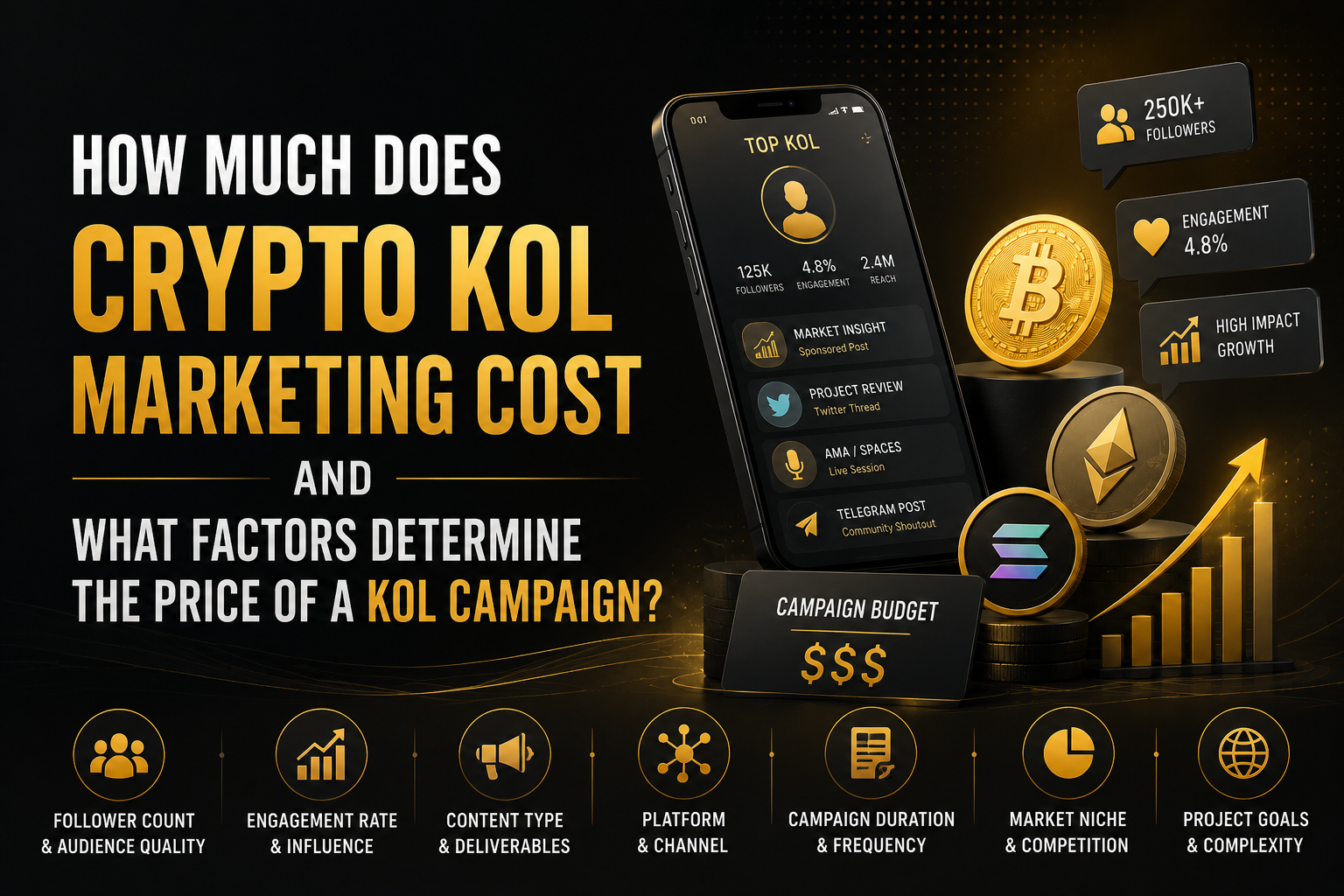
Crypto KOL marketing can cost a few hundred dollars for a niche creator promotion or hundreds of thousands of dollars for a major campaign involving large creators and multiple platforms.
That huge range can make pricing confusing for Web3 projects.
Why would one KOL charge $500 while another asks for $20,000 for what appears to be a similar post?
The answer is that crypto KOL pricing isn't determined by follower count alone. Audience quality, engagement, platform, content format, campaign timing, exclusivity, reputation, and the overall deal structure can all influence the final price.
Current 2026 industry benchmarks show just how wide the market can be. For example, published estimates place nano and micro KOL campaigns in the hundreds or low thousands of dollars, while larger creators can command tens of thousands or more.
So, how much should a Web3 project actually budget?
How Much Does Crypto KOL Marketing Cost?
There is no universal rate card for crypto KOLs.
Unlike traditional advertising, most crypto creators negotiate their pricing privately. Two creators with similar follower counts can quote completely different prices based on their reputation, audience, platform, and demand.
As a broad 2026 benchmark, published industry estimates suggest ranges such as:
| KOL Tier | Approx. Audience | Typical X/Post Range | Typical Campaign Range |
|---|---|---|---|
| Nano | 5K–25K | $200–$800 | $500–$2,000 |
| Micro | 25K–100K | $800–$3,000 | $2,000–$8,000 |
| Mid-tier | 100K–500K | $3,000–$10,000 | $8,000–$25,000 |
| Macro | 500K–1M | $10,000–$30,000 | $25,000–$75,000 |
| Mega | 1M+ | $30,000–$100,000+ | $75,000–$250,000+ |
These should be treated as market benchmarks, not fixed prices. Actual quotes can vary significantly depending on the creator and campaign.
Other 2026 industry sources report somewhat different ranges, which reinforces an important point: there isn't a standardized crypto KOL price list.
Why Is Crypto KOL Pricing So Difficult to Compare?
Imagine two KOLs:
KOL A
- 150,000 followers
- 0.8% engagement
- General crypto audience
- Mostly promotional posts
KOL B
- 45,000 followers
- Highly active DeFi audience
- Strong engagement
- Regularly publishes detailed research
KOL A might have a higher asking price.
But if you're launching a DeFi protocol, KOL B could potentially provide greater value because the audience is much more relevant.
This is why looking at the price alone isn't enough.
You need to evaluate what you're actually getting for that price.
1. Audience Size
Follower count is one of the most obvious pricing factors.
Generally, larger creators can charge more because they can potentially provide greater reach.
However, follower count should be treated as a starting point rather than the final measure of value.
A creator with 30,000 highly relevant followers may be more valuable to a niche Web3 project than a general crypto account with 300,000 followers.
That's why experienced KOL marketing services typically evaluate audience quality alongside audience size.
2. Engagement Rate and Engagement Quality
Engagement can significantly affect pricing.
But don't simply look at the percentage shown by a third-party tool.
Look at the actual conversations.
For example:
- Are people asking questions?
- Are followers discussing the project?
- Are replies relevant?
- Does the creator respond to their community?
- Are people sharing or quoting the content?
- Does the audience appear genuinely interested?
A smaller account with an active community can potentially command a premium compared with a larger account with passive followers.
3. Platform
The platform can dramatically change the price.
A sponsored X post is very different from a dedicated YouTube review.
For example, published 2026 benchmarks show that YouTube sponsorships can cost substantially more than simple social posts because of the additional production effort and longer-form content involved.
Common platforms include:
X
Often used for:
- Sponsored posts
- Threads
- Campaign announcements
- Spaces
- Product discussions
YouTube
Often used for:
- Project reviews
- Tutorials
- Dedicated videos
- Interviews
- Sponsored integrations
Telegram
Often used for:
- Community announcements
- Sponsored posts
- Trading-related promotions
- Campaign distribution
TikTok and Instagram
Can be useful for:
- Short-form educational content
- Awareness campaigns
- Younger audiences
- Visual storytelling
The same creator may charge completely different amounts depending on the deliverable and platform.
4. Content Format
A simple post and a 15-minute video shouldn't have the same price.
The amount of work involved matters.
A campaign could include:
- One X post
- X thread
- X Space
- Telegram post
- Short-form video
- YouTube integration
- Dedicated YouTube video
- Newsletter feature
- Podcast appearance
- Multi-platform content
Longer and more production-heavy formats generally cost more.
For example, current market estimates place dedicated YouTube content considerably above basic social posts because of production time and the additional value of long-form content.
5. KOL Reputation
Not all followers have the same value.
Some creators have built strong reputations over years of research, analysis, trading, development, or community participation.
Their audience may trust their opinions more than those of a creator who started promoting crypto projects recently.
That reputation can command a premium.
In other words:
You're not only paying for reach. You're paying for access to an existing relationship between the creator and their audience.
6. Niche Relevance
A specialist KOL may charge more because their audience is highly relevant.
Consider a project building:
- A DeFi protocol
- A crypto exchange
- A blockchain infrastructure product
- A Web3 game
- An AI x crypto platform
- A DePIN project
A general crypto creator may provide broad awareness.
A specialist creator may provide fewer impressions but much stronger audience relevance.
That difference can have a major impact on campaign performance.
7. Campaign Timing
Crypto KOL pricing can change depending on market conditions and campaign timing.
A major token launch, TGE, exchange listing, or major announcement can create significant demand for influencer placements.
When many projects compete for the same creators during a launch window, prices can increase.
Some 2026 industry estimates suggest TGE timing can command significant premiums because projects are competing for attention during a highly concentrated period.
This is one reason why planning your KOL campaign early can be useful.
8. Exclusivity
Suppose you ask a KOL not to promote competing projects for 30, 60, or 90 days.
That restriction has value.
The creator is potentially giving up other sponsorship opportunities during that period.
As a result, exclusivity clauses can increase campaign costs.
Before agreeing to exclusivity, ask:
Do we actually need it?
If your project doesn't need category exclusivity, removing the clause could reduce the overall cost.
9. Usage Rights
Another factor that projects sometimes overlook is content usage.
There is a difference between paying a KOL to publish content and paying for the right to reuse that content.
For example, you might want to:
- Repost the video on your website
- Use the content in paid advertising
- Publish it on your social channels
- Include it in marketing materials
- Edit it into shorter clips
Those additional rights may increase the fee.
Always clarify usage rights before signing the agreement.
10. Campaign Duration
A one-off post and a three-month partnership are very different arrangements.
A long-term campaign might include:
- Monthly posts
- Regular product updates
- Community appearances
- X Spaces
- Educational content
- Product feedback
- Launch support
Some creators may offer better rates for longer commitments.
Industry pricing guidance also notes that longer retainers and bundled deliverables can sometimes reduce the effective cost compared with repeatedly purchasing individual placements.
Don't Judge KOL Pricing by Follower Count Alone
This is probably the most important takeaway.
Imagine a creator charges $5,000.
That number by itself tells you almost nothing.
Instead, ask:
What am I receiving for $5,000?
You should evaluate:
- Expected reach
- Audience relevance
- Engagement quality
- Content format
- Platform
- Geographic audience
- Historical campaign performance
- Deliverables
- Usage rights
- Exclusivity
- Tracking and attribution
This changes the conversation from:
"Is $5,000 expensive?"
to:
"Is this creator worth $5,000 for our specific objective?"
That's a much better way to evaluate a KOL deal.
Final Thoughts
There is no universal answer to how much crypto KOL marketing costs.
A campaign could cost hundreds of dollars, several thousand dollars, or hundreds of thousands depending on the creators, platforms, content, timing, audience, and campaign scope.
The biggest mistake is treating KOL pricing like a simple follower-based rate card.
The better approach is to evaluate value, relevance, credibility, and measurable outcomes.
A smaller KOL with a highly targeted audience may outperform a much larger creator. A $2,000 campaign that generates qualified users can be more valuable than a $20,000 campaign that generates millions of empty impressions.
For Web3 projects, the goal shouldn't be to find the cheapest KOL or even the biggest KOL.
It should be to find the right KOL at a price that makes sense for the expected outcome.
That's what turns KOL marketing from an expensive promotional exercise into a measurable part of a broader Web3 marketing strategy.
Patrocinado
Anúncios
Anúncios
Anúncios
Categorias
Leia mais
Tensions flare near Strait of Hormuz as a ship is seized and another is sunk Map showing where a vessel was seized off the UAE coast. Digital Embed/AP hide caption...

What's New on HBO Max in July 2026? 'Stuart Fails to Save the Universe,' 'Lee Cronin's The Mummy' and More Why You Can Trust CNET Our expert, award-winning staff selects the products we cover and rigorously researches and tests our top picks. If you buy through our links, we may get a commission. Reviews ethics statement Oh, and don't forget about the return of Shark Week....

The Real Cost of Ozempic, Wegovy and Other GLP-1 Drugs — With and Without Insurance We research all brands listed and may earn a fee from our partners. Research and financial considerations may influence how brands are displayed. Not all brands are included. Learn more. Ozempic, Wegovy and other GLP-1 drugs have become hot commodities, but...

PSA: Apple’s Private Relay can leak your real IP address Image Credits:Pavlo Gonchar/SOPA Images/LightRocket / Getty Images 9:52 AM PDT · August 5, 2026 Apple’s Private Relay, an opt-in feature designed to hide a user’s IP address when they browse the internet with Safari, can be circumvented to reveal the supposedly hidden IP address due to a series of...
在數位時代,博弈遊戲已成為許多人在閒暇之餘追求刺激與娛樂的首選方式。市場上平台眾多,但能夠真正脫穎而出,為玩家提供高品質、穩定且充滿驚喜體驗的選擇卻不多見。Gam Queen 正是這樣一個引人注目的名字,它不僅僅是一個遊戲平台,更是一個精心打造的娛樂生態系統,旨在滿足現代玩家對於遊戲多樣性、視覺享受以及公平競技的所有渴望。 當我們談論優質的博弈娛樂時,核心往往離不開遊戲內容的豐富度。Gam Queen 在這一點上展現了極高的專業水準。平台彙集了來自全球頂尖遊戲開發商的熱門大作,從傳統的桌面遊戲到現代感十足的視訊老虎機,每一個細節都經過嚴格的篩選與測試。對於喜愛追求高爆發力與震撼視聽效果的玩家來說,這裡的老虎機種類繁多,每一款主題設計都獨具匠心,融合了神話、探險、奇幻等多種文化元素,讓玩家在轉動轉軸的瞬間,彷彿置身於不同的世界之中。 除了老虎機,桌上遊戲的表現同樣精彩。Gam...