


External Chatbot Builder: How Businesses Can Automate Customer Support and Engagement
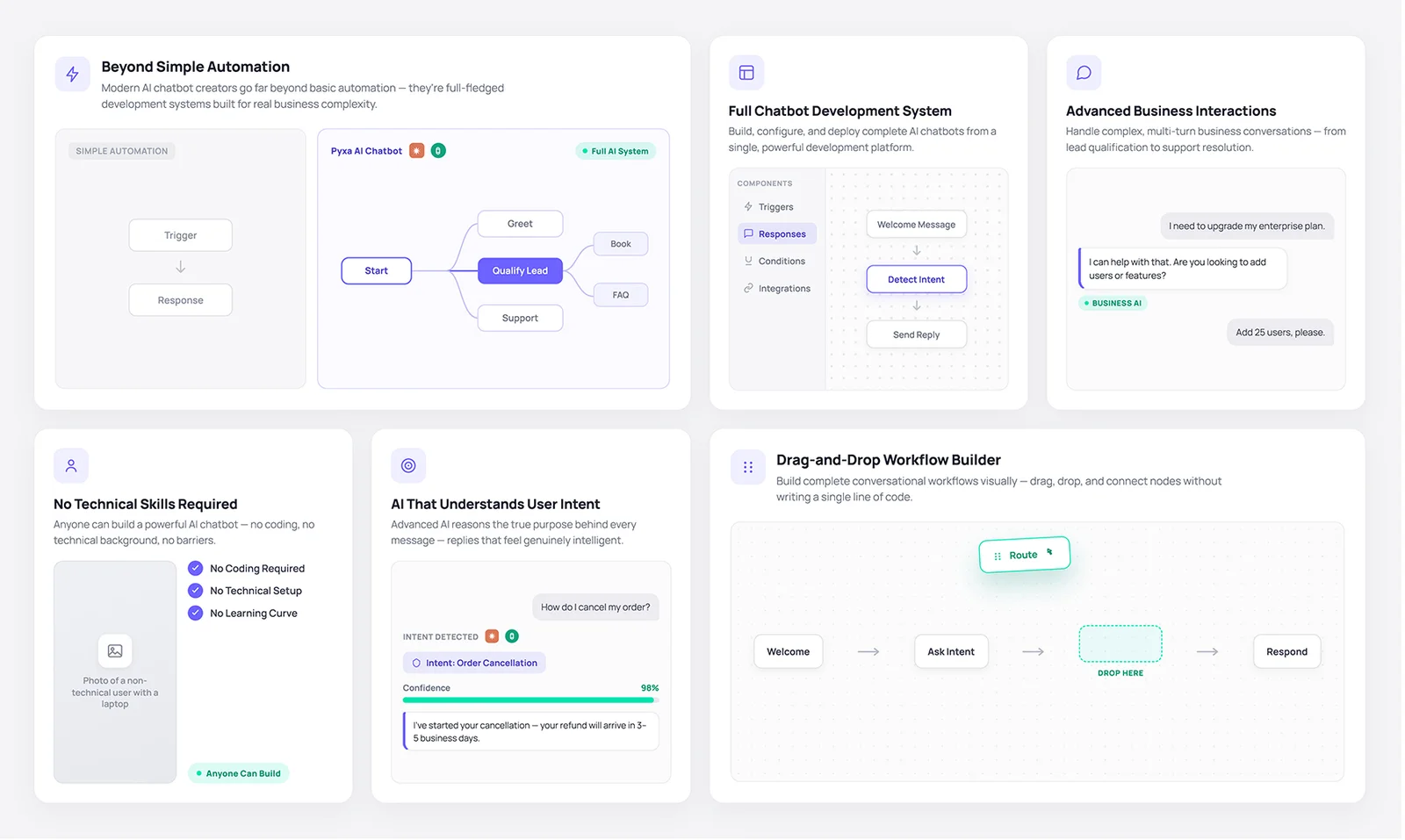
Businesses today need to respond to customers quickly, consistently, and across multiple channels. Whether a visitor wants to know about a product, asks about pricing, needs help with an order, or wants to understand a service, slow responses can result in lost opportunities.
An external chatbot builder gives businesses a practical way to automate these conversations without building an AI system from scratch. Instead of relying entirely on human support teams, companies can train an AI chatbot with their own business information and allow it to answer customer questions around the clock.
What Is an External Chatbot Builder?
An external chatbot builder is a platform that allows businesses to create, train, customize, and deploy AI-powered chatbots outside of traditional development environments.
Modern chatbot builders can use information from websites, PDFs, FAQs, and custom text to create a business-specific knowledge base. This allows the chatbot to provide responses based on the information supplied by the business rather than relying only on generic AI knowledge.
For example, an e-commerce company could train its chatbot using product information, shipping policies, return policies, and frequently asked questions. A service company could provide its service descriptions, pricing information, policies, and appointment information.
Pyxa AI's External Chatbot Builder is designed around this approach, offering website, PDF, and custom-text training, customization, analytics, multilingual capabilities, website deployment, and human-agent handoff.
Why Are Businesses Using AI Chatbot Builders?
Customer expectations have changed. People increasingly expect immediate answers rather than waiting hours for an email response.
An AI chatbot can handle repetitive questions automatically while allowing human employees to focus on conversations that require judgment or personal attention.
Some common applications include:
-
Customer support
-
Lead generation
-
Product questions
-
E-commerce assistance
-
Appointment inquiries
-
SaaS onboarding
-
Internal employee support
-
FAQ automation
-
Sales qualification
-
Order-related questions
This makes chatbot automation useful for both small businesses and larger organizations.
No-Code Chatbot Development Makes AI More Accessible
One of the biggest advantages of a modern chatbot builder is that businesses do not necessarily need a developer to create a useful chatbot.
A no-code chatbot builder can provide visual tools for creating conversational experiences. Instead of programming every response manually, businesses can provide their information, configure the chatbot, customize its behavior, and deploy it.
Pyxa AI describes its chatbot builder as a zero-code solution that can be trained using websites, PDFs, or custom text and then embedded on a website.
This can reduce the time and technical resources required to launch a customer-facing AI assistant.
Train Your Chatbot With Your Own Business Information
A generic chatbot may not know the specific information that makes your company different.
That is why chatbot training is an important part of business AI implementation.
With Pyxa's chatbot training functionality, businesses can provide:
Website Content
A website can act as a knowledge source for the chatbot. This can include service pages, product pages, FAQs, policies, and other important information.
PDF Documents
Companies can upload documents such as manuals, guides, catalogs, or other reference material.
Custom Text
Businesses can also provide their own written information to help establish the chatbot's knowledge base.
The goal is to create responses that are more closely aligned with the company's actual information and terminology.
Customize the Chatbot to Match Your Brand
A chatbot should feel like part of a company's digital experience rather than an unrelated widget.
Customization can include elements such as:
-
Bot name
-
Avatar
-
Brand colors
-
Greeting messages
-
Tone of voice
-
Response style
-
Conversation flows
-
Widget appearance
This type of customization can make AI customer support feel more consistent with the rest of a company's branding.
Multilingual Customer Support
Businesses that serve international customers may need to communicate in multiple languages.
Pyxa AI's chatbot builder includes multilingual support, allowing businesses to use AI conversations for audiences across different markets.
For global e-commerce stores, SaaS companies, agencies, and online service providers, multilingual chatbot capabilities can help reduce communication barriers without requiring separate support teams for every language.
Human Agent Handoff Is Still Important
AI should not necessarily handle every customer conversation.
Some questions are too complicated, sensitive, or valuable to leave entirely to automation. A good chatbot strategy therefore combines AI automation with human support.
Pyxa's Human Agent Hand-Off feature is designed to transfer conversations to human agents when AI reaches its limits. The system can transfer conversation context and chat history, while agents can receive escalations through Telegram.
This creates a hybrid customer service model:
AI handles routine questions → AI identifies complex situations → Human agent takes over.
The result can be a more efficient support process without eliminating human expertise.
How an External Chatbot Can Help E-Commerce Businesses
E-commerce companies receive many repetitive questions.
Customers may ask:
-
Is this product available?
-
What are the shipping options?
-
What is the return policy?
-
How long does delivery take?
-
What are the product specifications?
-
How can I place an order?
-
What payment methods are accepted?
A trained chatbot can provide immediate answers to many of these questions.
This can help reduce repetitive support requests and give customers information while they are still considering a purchase.
Chatbots Can Also Support Lead Generation
An AI chatbot isn't limited to customer service.
It can also become part of a company's lead-generation strategy.
For example, a service business could use a chatbot to:
-
Welcome website visitors.
-
Ask what service they need.
-
Identify their requirements.
-
Answer common questions.
-
Collect relevant lead information.
-
Encourage the visitor to contact the sales team.
This turns a passive website into a more interactive customer acquisition channel.
Use Conversation Data to Improve Your Customer Experience
A chatbot should not simply be launched and forgotten.
Conversation analytics can reveal what customers are asking, where the chatbot performs well, and where additional training may be required.
Pyxa's chatbot functionality includes analytics and reporting features intended to help businesses evaluate conversations, response performance, escalation patterns, engagement, and automation savings.
Businesses can use these insights to identify recurring questions and improve their knowledge base.
External Chatbot Builder vs. Traditional Chatbot Development
Traditional chatbot development can involve developers, API integrations, custom infrastructure, testing, and ongoing maintenance.
An external chatbot builder can simplify much of this process.
| Factor | Traditional Development | External Chatbot Builder |
|---|---|---|
| Technical expertise | Often required | Often minimal |
| Development time | Can be extensive | Faster deployment |
| Training | Custom development | Upload business information |
| Branding | Custom-coded | Built-in customization |
| Deployment | Technical implementation | Simplified embedding |
| Updates | Development work may be required | Update knowledge base |
| Human handoff | Custom integration | Built-in options may be available |
| Analytics | Often requires configuration | Built-in dashboards may be available |
The right option depends on the complexity of the business and its technical requirements. However, businesses that need to launch quickly may find a no-code solution more practical.
How to Choose the Right External Chatbot Builder
Before choosing a platform, consider several factors.
1. Training Options
Can you train the chatbot using your website, PDFs, FAQs, and custom information?
2. Customization
Can you make the chatbot match your company's branding and communication style?
3. Deployment
Can you easily embed it on your website and other channels?
4. Human Handoff
Can customers be transferred to a real person when necessary?
5. Analytics
Can you understand how customers are interacting with the chatbot?
6. Multilingual Support
Can the chatbot communicate with your target audiences in multiple languages?
7. Pricing
Compare recurring subscription costs with the features and usage you actually need.
Final Thoughts
An external chatbot builder can give businesses a practical way to introduce AI-powered customer communication without developing an entire chatbot infrastructure from the ground up.
By combining business-specific training, no-code deployment, customization, multilingual communication, analytics, and human-agent escalation, companies can automate repetitive conversations while maintaining a path to human support.
For businesses looking to improve customer response times, automate FAQs, generate leads, and provide 24/7 assistance, an AI chatbot can become an important part of their digital strategy.
Pyxa AI's External Chatbot Builder brings these capabilities together in a single platform, with a lifetime access option currently promoted at $49.99 on its website.
Ready to build a business-specific AI chatbot? Explore Pyxa AI's External Chatbot Builder and train your chatbot with your own business information.
Sponsored
Ads
Ads
Ads
Categories
Read More
Finding bed bugs in your home can be upsetting. These tiny pests hide in beds, furniture, and small cracks, making it hard to sleep and relax. Hello Pest Control provides trusted Bed Bug Exterminator in AJAX services to help homeowners remove infestations safely and quickly. With experienced professionals and effective treatment methods, your home can become clean, comfortable, and pest-free...

Supreme Court Weighs Arguments Over How Police Request Location Data to Solve Crimes "Geofence warrants," sometimes known as reverse location searches, are increasingly controversial for sweeping up information on any device that happened to be in the vicinity of a crime. The way police seek location information and data from tech companies to investigate crimes is under a microscope...

Four years into its full-scale war in Ukraine, Russia is feeling the effectsSteve RosenbergRussia editor, in LipetskBBCPosters offering large sums of money for joining the army are everywhere in RussiaAt first glance, Yelets in winter looks like something from a Russian fairy tale.From the embankment I spy the golden domes of Orthodox churches and, down below, ice fishermen dotted along the...

Blast kills dozens in village in rebel-held region of Myanmar27 minutes agoPatrick JacksonandBBC BurmeseShwe Phee Myay/BBCAn explosion has killed at least 55 people and wounded dozens more in a village in a region of Myanmar, formerly known as Burma, under insurgent control, the BBC has been told.A source familiar with the situation on the ground in Kaung Tat, a village in Namkham Township in...

Deezer says 44% of songs uploaded to its platform daily are AI-generated Deezer announced on Monday that AI-generated tracks now represent 44% of all new music uploaded to its platform. The company said it’s receiving almost 75,000 AI-generated tracks per day and more than two million per month. The consumption of AI-generated music on the platform is still very low, at 1-3% of total streams,...

