BeamO is more than a thermometer.
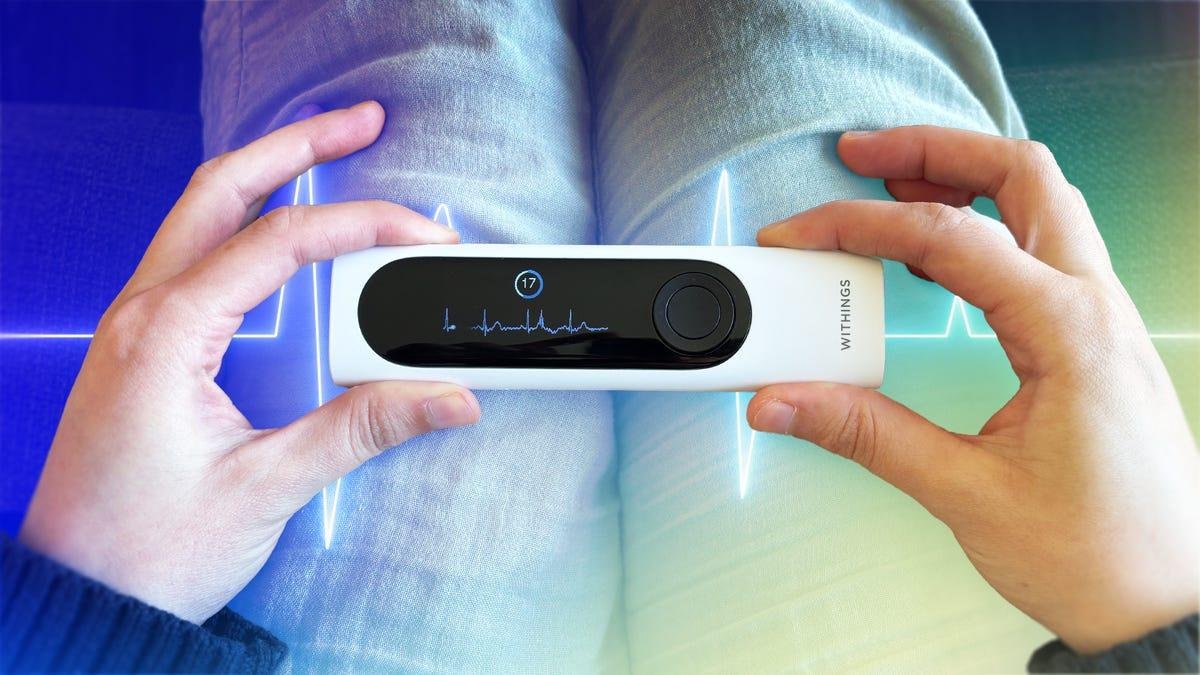
Cole Kan/Anna Gragert/CNET/Getty ImagesA thermometer is a staple in medicine cabinets, and its task is simple: measure the body’s temperature. But will its simplicity stand the test of time? Health technology company Withings has given the modest thermometer a massive overhaul with BeamO. Dubbed the “thermometer of the future,” BeamO is a stethoscope, an electrocardiogram (ECG) and, yes, a thermometer, all in one device.
I reported on BeamO’s launch and FDA clearance back in November, and since then, Withings sent me the device so I could do my own testing. Over the last several weeks of trying BeamO and the connected Withings app, it has become clear to me what the company thinks the future of health care will look like.
BeamO’s one-button design makes it surprisingly simple to use
Similar to a traditional thermometer, the handheld BeamO is incredibly simple to use, despite its multiple functions. It has a single button with four scrolling directions and an LED screen. The contactless thermometer is on top, the digital stethoscope sits on the bottom, and the two electrodes for the electrocardiogram and SpO2 sensor (pulse oximeter) are on the right. The SpO2 for measuring blood oxygen isn’t available in the US.
On the left side of the device is the USB-C port for charging and plugging in headphones. BeamO has an 8-month battery life and a one-hour charging time.
BeamO comes with its own travel case, which is great for keeping it scratch-free.
Anna Gragert/CNETOnce it’s on, you’ll see your name at the top, the option to use BeamO as a guest, settings (for device information, resetting and updating) and the option to turn off the device. When you click on your name or “guest,” you’ll have the choice to take an ECG, your temperature or use the stethoscope to listen to your heart and lungs.
BeamO works with both iOS and Android and syncs data with both Wi-Fi and Bluetooth -- though Wi-Fi is recommended.
The stethoscope recordings are fun, but a doctor is needed for analysis
Within the stethoscope feature, you can record your heart in four positions on the chest, your lungs in eight positions on the chest and back and “wide,” which captures both cardiac and respiratory sounds in a single position on the center of your chest. The company recommends using the stethoscope in a quiet room while sitting with your hands supported, and placing it directly on bare skin or over just one thin layer of clothing. It also advises briefly holding your breath while recording your heart sounds. Since lung recordings are also taken on your back, you’ll need someone to help.
What it looks like when BeamO is recording.
Anna Gragert/CNETOnce you select which organ to record, a body diagram appears to help you choose the exact placement, checking off each spot as you go. Each recording takes 15 seconds and ends with two vibrations to let you know it’s complete. You can pause at any time. If you have a USB-C headphone adapter, you can listen to the sounds during the recording. I didn’t have one, though, so I could only listen after the results were uploaded to the Withings app.
The diagrams BeamO displays to help you take your recordings.
Anna Gragert/CNETThe only issue I ran into with the stethoscope was that it kept warning me that my environment was “too noisy,” even when I was in the quietest room in my home. I’m not sure how much this affected the recording, as I’d need a doctor to review it.
Because a doctor would need to interpret the recordings, I couldn’t really judge how accurate they were on my own. However, the app does mention what the recordings should sound like in each area. For instance, for the left lower part of the lungs, they’re “louder and more hollow, like a tube, heard with each breath,” while the left upper part “sounds are soft, like gentle rustling.” I did notice these differences, and it was cool to hear these sounds myself, but, again, I would need a doctor to confirm their accuracy and point out any abnormalities.
The Withings app showing heart sounds for the mitral area of my heart.
Withings/Anna Gragert/CNETYou can send your ECG off for a cardiologist’s review
When you click ECG, BeamO displays an instructional image and prompts you to rest your fingers on the device’s two electrodes. Then, it records your heart’s electrical activity using a medical-grade, 1-lead ECG for 30 seconds. In Europe only, this feature can be used to detect atrial fibrillation or an irregular heartbeat (arrhythmia).
What it looks like when an ECG is being performed with BeamO.
Anna Gragert/CNETIf you live in the US, you'll need to unlock this feature by having your first ECG reviewed by a board-certified cardiologist, which is free and automatic in the Withings app, and only takes 24 to 48 hours. I appreciated that I didn’t have to go through my own doctor or deal with health insurance just to activate this feature.
The Cardio Check-Up is a unique feature
With a Withings Plus subscription, you can send your ECG to a board-certified cardiologist for review within 24 hours. According to Withings, they can detect over 10 signs of arrhythmias. The three main results are green for normal sinus rhythm, yellow for bradycardia (slow heart rate) or tachycardia (fast heart rate) and red for AFib (atrial fibrillation), an irregular heartbeat.
You can have a cardio check-up performed for free four times per year with the yearly subscription ($100/year) or one time per quarter with the monthly subscription ($10/month). One cardio check-up is also available during your free, 1-month Withings Plus trial, in case you want to test it out before committing.
I struggled to find how to access the check-up in the app, but a quick search turned up these instructions. When I clicked my ECG in the Withings app, I found the cardio check-up option, agreed to share the data with a clinician and sent it off.
I got my evaluation back within six hours (way faster than I expected), and the clinician concluded that my sinus rhythm was normal, indicating a regular heartbeat. Below that, information was provided about what a normal sinus rhythm is, what it means for my health and its signs. At the very bottom was a disclaimer reminding me that this is for self-monitoring purposes only, it’s not a medical diagnosis and that I should see my doctor if I have any concerns.
What my Cardio Check-Up results looked like.
Withings/Anna Gragert/CNETI appreciated having a doctor confirm that I used this feature correctly and evaluate it for any abnormalities, which I could then bring to my own doctor for an actual diagnosis. However, as someone with health anxiety, I will acknowledge that I would have freaked out had I received results that weren’t normal, so that’s something you should be prepared for and ready to address with this kind of at-home check-up.
The thermometer could be improved with adult profiles
Back to basics, the thermometer reminds me of others I’ve used. It takes your temperature without making contact when you slowly move the device from the middle of your forehead to the top of your ear. Then, BeamO displays your temperature with a colored icon: green for normal, yellow for elevated and red for high.
However, normal, elevated and high temperatures can vary by age, which is why BeamO’s product guide includes a reference chart. For children under 3 months old, it also recommends taking three measurements and using the highest result.
For children under age 16, you can add their own user profile to your Withings account. You can do this for up to seven users under that age. However, with BeamO specifically, I’d like the ability to add adult profiles. I share my home with my partner, and we use the same thermometer, so it would be helpful to keep our BeamO measurements separate in the app.
Within the app, you can also use a beta version of its AI-powered Withings Intelligence. I asked if it noticed anything abnormal from my results, but didn’t expect an answer since a doctor has to review the ECG and stethoscope recordings. As expected, it only mentioned that I had a higher temperature one day (this was actually a measurement I took for my partner), and then asked me to share any symptoms I experienced.
Withings Intelligence's response to my question about my BeamO results.
Withings/Anna Gragert/CNETSharing your health data is built into the app
For all the measurements you take with BeamO, you can share them with a doctor in two ways: as a PDF or via a HealthLink report, which is available for seven days and can be deleted at any time. You can also choose to share individual results or a complete health report for a specific timeframe. Adults can also choose to share certain data with a relative.
The different ways you can share your BeamO data.
Withings/Anna Gragert/CNETThis can all be done by clicking each individual measurement on the Home tab or in the app’s Share tab, where you can set up a child’s profile. Under the latter tab, you can also choose to connect to the following apps: Apple Health, Strava, MyFitnessPal and Fitbit.
When you sign on to the Withings app, where your results are displayed, you have to agree to Withings' privacy policy and terms. You also have to agree to share your data when a cardiologist from Withings’ partner Heartbeat Health, a virtual-first cardiology company, reviews your ECG. However, you can revoke your consent and data sharing at any time.
My final verdict: What does BeamO’s future look like?
After several weeks with BeamO, it's clear that the makers of this "thermometer of the future" envision a world where at-home health tracking and telehealth are essential.
Aside from the cardio check-up feature, which requires a cardiologist, and the thermometer, you’re not able to decipher the stethoscope’s heart and lung recordings as a layperson. Those require a doctor’s expertise; during a telehealth consultation, a doctor can also help you figure out where to place BeamO for the best recordings.
The Withings app homepage showing my BeamO recordings.
Withings/Anna Gragert/CNETAs BeamO is not intended to be used for medical diagnosis or treatment on its own, it makes sense that it would be ideal for a consumer who often uses telehealth. I could see BeamO being helpful for a person with a disability, an individual with a contagious illness who needs to quarantine or someone who doesn’t have reliable transportation or funds for in-person doctor's appointments. The device could also be useful for someone with cardiac or pulmonary issues who benefits from tracking their heart and lungs at home for later analysis by their doctor.
BeamO isn’t cheap at $250, and to access Withings Plus for the cardio check-up, it costs $10/month or $100/year. What’s helpful is that it is FSA/HSA-eligible, includes a free one-month trial of Withings Plus, and has a 30-day trial and a two-year warranty.
If you’re a dedicated telehealth user, your doctor wants you to record your heart or lungs at home or you use other Withings products and want a complete health picture on the app, then BeamO could be worth the price. Otherwise, if you’re simply looking for a basic thermometer, you’d probably be better off with a more affordable device.
Overall, I think BeamO is a cool device that opens up the possibilities of what an ordinary thermometer can do. It’s also on trend with fitness trackers and other health tech devices that aim to arm consumers with in-the-moment knowledge about how every single part of their body is functioning.