There has been a resurgence of interest in lengthy, character-driven Japanese RPGs. Square Enix, the originator of the subgenre, has leaned fully into that momentum through remakes of the franchise that helped define it, Dragon Quest. After remakes of the first three entries from the series' classic NES era, the company has turned its attention to a fan favorite originally released for the PlayStation in 2000, Dragon Quest 7.
Dragon Quest 7: Reimagined is Square Enix's latest remake of the Dragon Quest series, following 2024's Dragon Quest 3 remake and last year's Dragon Quest 1-2 remake. If you're wondering why the publisher skipped ahead to the seventh game, it could be because DQ7 was remade back in 2016 for the 3DS, possibly making it an easier lift following the success of the earlier remakes.
DQ7 marks an interesting time for the franchise, as the first six games are split between two different story arc trilogies. With the seventh game, developer Enix (before it merged with Square) took a different approach by making a game that would stand on its own. Since then, the franchise entries that followed have had no narrative ties to the others. For that reason, DQ7 is often viewed as being more in the middle of the pack when ranking the Dragon Quest games. Still, it's one of the better entries in a legendary JRPG franchise.
This quest is not dragging on and on
Right off the bat, what I and others who played the original version of DQ7 when it launched in 2000 will want to know is: Does it take three hours to reach the first battle in Dragon Quest 7: Reimagined?
The answer is no. When DQ7 first came out, many players were turned off by the game's sheer audacity of clicking through so much storyline before they really got to do anything other than talk to someone. This time around, you're looking at about an hour of prologue before you'll first swing your sword, which is an improvement over the Nintendo DS version released in the U.S. in 2016, where it took closer to two hours. Keep in mind, waiting a whole hour before the first fight is still a long time for any game, but there is a lot of story and character setup to get through.
This reduction in time before the first battle is one of many quality-of-life upgrades that have become standard for the Dragon Quest remakes. Other improvements include the ability to quickly defeat enemies without starting a battle if your party is at a higher level than they are, teleporting to previous locations directly from the map and quest markers that clearly indicate where to go. These are welcome additions for newcomers and players with less time to spend grinding, though some DQ7 diehard fans may take issue with how streamlined the game has become.
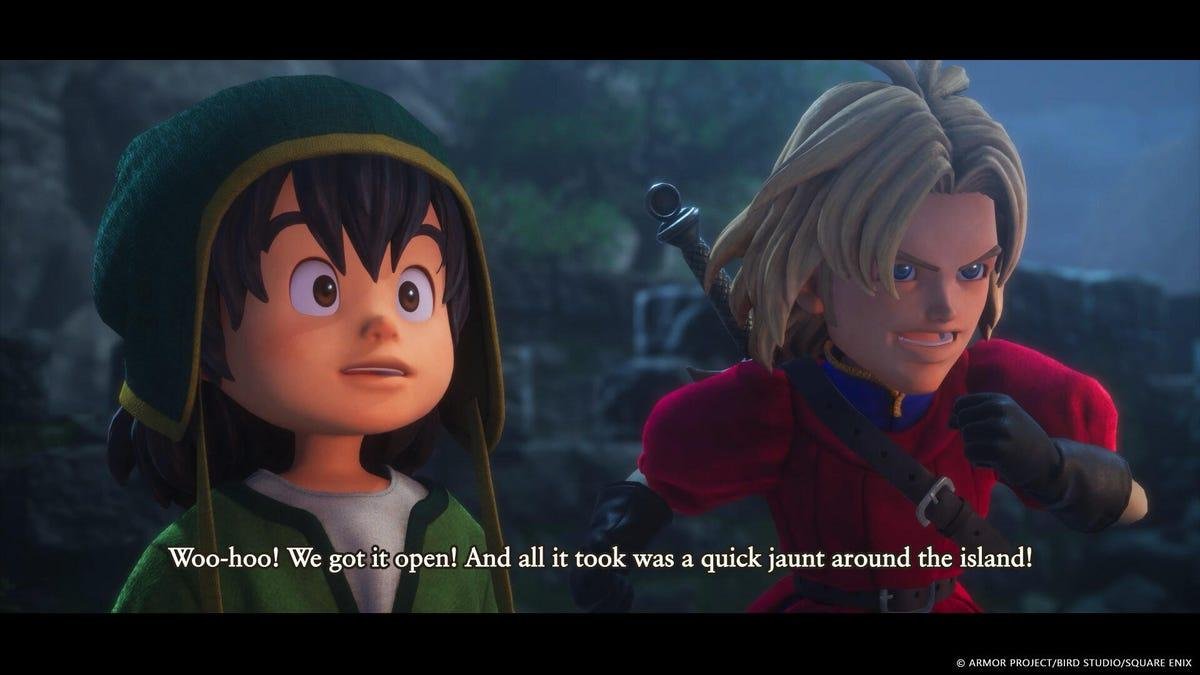
Like the other Dragon Quest remakes, the visuals have improved significantly. The character designs remain faithful to the original PSX version and the 3DS remake. Square Enix took the 3D models from the 3DS remake and added much more detail. The areas have also been improved to give a more open-world feel. Characters are fully animated and display a wider range of emotions during cutscenes. While the cinematics will not make your jaw drop, they are still effective in delivering the Dragon Quest charm the series is known for. Add the melodies that date back to the first game released in 1986, and you have a treat for both the eyes and ears.
Imagining more of a story
If there is a downside to the streamlining, it's that it makes the game's lack of a strong story more apparent.
DQ7, like others in the franchise, follows the JRPG trope of a hero who starts from humble beginnings and eventually rises to defeat a god. In this case, the protagonist is the son of a fisherman. He is joined by Maribel, the mayor's daughter, and Kiefer, the prince of the Kingdom of Estard.
The group discovers a Shrine of Mysteries that transports them back in time to islands that no longer exist. Each island has its own dilemma, usually leading to a battle with a boss monster. Once resolved, the island reappears in the present, with townfolk recounting past horrors while living seemingly carefree lives. Each island also contains fragments from both past and present that must be collected to unlock a new island.
Kiefer, prince of the Kingdom of Estard, has a big sword and isn't afraid to use it.
Square EnixOnce all the islands are discovered, an evil power reemerges and the group of young people who only recently learned to fight must defeat it to save the world.
In a way, DQ7's story isn't that dissimilar to previous games, where every time a hero visits a new town, trouble arises that must be dealt with. Here, it's islands instead of towns. Because these islands are small and the dilemmas are confined, DQ7 lacks a grand narrative buildup. Instead, it presents smaller side stories, some more dramatic than others. One early island has players investigating a strange tradition surrounding a volcano, leading to a fight with a Fire Spirit. Another island features townfolk transformed into animals, and vice versa, due to a monster's curse.
The story serves the game, but it isn't particularly compelling. Still, there's charm in a game where the son of a fisherman is destined to kill a god.
Get a job, hero
One of the most interesting aspects of DQ7 is the vocations system, its version of the franchise's class mechanics. Every character starts with a job, and as they progress, they can change jobs. Each job has its own stats, abilities and a "Let Loose!" move, a special ability that charges after a certain number of attacks or damage received. For example, the hero's special move at the start of the game creates a barrier to protect the party from a single attack.
There are more than 20 vocations, each divided into tiers. Beyond the starting job, there are beginner, intermediate and advanced classes. Beginner examples include Martial Artist, Mage and Warrior. As you level up a class, more abilities unlock, and once it maxes out, it's time to pick another.
The gang's all here.
Square EnixIf you max out two beginner jobs, like Thief and Sailor, you unlock the intermediate class Pirate. Mastering two or three intermediate vocations then unlocks advanced jobs, such as Hero and Champion.
If that sounds like a lot, it is. Fortunately, a new feature called Moonlighting lets a character start a new job while keeping skills from another. Considering that the game can take about 40 hours to finish, the ability to switch classes frequently and reward players for building up their characters is a smart move by Square Enix.
And yes, you read that right -- the game only takes around 40 hours to complete. Square Enix trimmed areas and dungeons, making this both an easier version to finish and one that isn't as faithful to the original, which could take more than 80 hours to finish. Fans of the original may grumble at these changes, but it cuts down on some of the more monotonous parts of the game.
Dragon Quest 7: Reimagined is easily recommended for JRPG fans, though everyone else may want to approach with caution. The drawn-out storyline keeps you playing but doesn't quite convince you of the game's greatness, which could be a turnoff for gamers who aren't happy grinding their way through side stories.
Dragon Quest 7: Reimagined is available now on PC, PS5, Nintendo Switch and Xbox Series X|S consoles for $60.