While big game nights with family or friends are nice, but they don’t offer the same focus as the best two-player games. I love to hang out with my wife and play simple games -- or not-so-simple ones if we have time -- that only require the two of us. She's my favorite person, so one-on-one gaming with her is the best. I've been a board game player for about 25 years now, and I've seen the landscape evolve into this complex, magnificent machine that seems infinitely creative.
"Board game" is a fairly generic term, so don't be surprised if there are a lot of card games thrown in for good measure. Two-player games tend to favor shorter, simpler experiences, so a giant board isn’t always necessary.
What's the best two-player game overall?
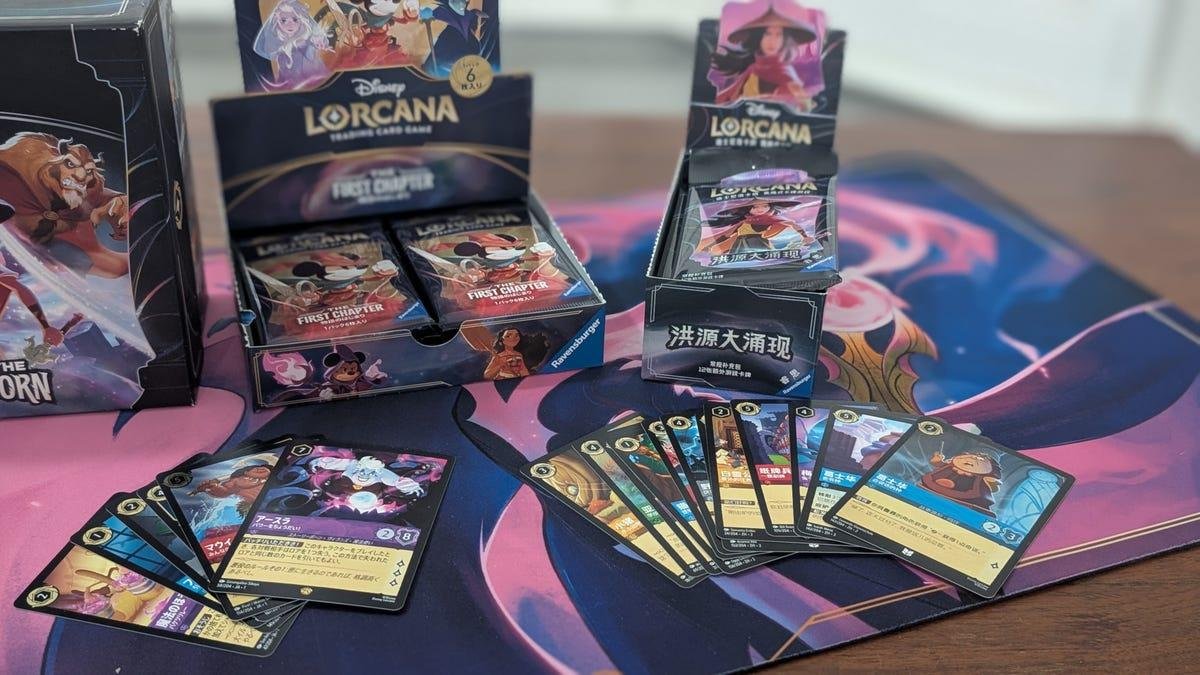
When it comes to quick and easy two-player games, I've become obsessed with Lorcana. While it can be played with more than two players, the duel nature of the game lends itself best to one-on-one.
The best two-player games
Pros
- Gorgeous Disney artwork
- Easy to learn
- More complex than it looks
Cons
- Rotation has introduced a disposability to the cards
Disney Lorcana is an almost perfect mix of Magic: The Gathering and everything Disney. You play as an artist, bringing the characters of the world of Disney to life using ink -- your currency in-game -- so they can quest for forgotten lore. It's clearly been worked on for a long time, as it feels like a game that's existed forever. It's so well-polished.
Pros
- Easy to pick up and play
- Fun scoring system
- Beautiful artwork
Cons
- Cards are a little flimsy
The Fox in the Forest is a simple trick-taking game with a few special cards mixed into the traditional format -- but unlike almost any other trick-taking game, it's built for two players.
What makes The Fox in the Forest a great game are the unique card powers and the scoring system. Rather than trying to take all the tricks to win the game, you're trying to take certain numbers of tricks for certain point values -- and if you narrowly miss those ranges, you often miss out on a big bonus.
In many ways, The Fox in the Forest is a fairly traditional, simple game. But it's well-balanced and the perfect length to pick up and play for 20 or 30 minutes.
Pros
- Infinitely replayable
- Beautiful artwork
- Community games available
Cons
- Can suck all of your money if you let it
No two-player game list is complete without Magic: The Gathering. Made by the same company that makes D&D, Magic is a dueling game where you buy booster packs to build a deck of 60 cards. You then battle your opponent using spells, monsters and artifacts. There is a massive variety of cards to choose from and new packs are released every few months.
Magic: The Gathering is not just a card game, it's a way of life, and while the starter kit is around 20 bucks, the game can run into the hundreds of dollars if you let it.
Pros
- Quirky and fun
- Fast and fun
Cons
- Maybe too simple for some
If you're in need of a simple puzzle game that's easy to learn and soothes your anxieties, look no further than Patchwork, a game in which you "sew" your own quilt and race your competitor to collect buttons. The game is fast-paced, the racing and patch-buying elements satisfy competitive spirits, and the Tetris-like quilt-sewing mechanism is as gratifying as finishing a puzzle.
Pros
- Easy setup
- Devious gameplay
Cons
- Can cause arguments!
If you want a little more bite in your competition, try playing 7 Wonders: Duel, a devious little card-drafting game. Both players are attempting to build civilizations across three eras, drafting various cards that help players pursue military or scientific dominance, grow their resources and build various Wonders. The competitive game moves more quickly than bigger strategy games like Twilight Struggle, and the card-drafting mechanism introduces surprising opportunities to block or trap your opponent. If you're looking for a well-balanced game with many game play sessions, this is one of the best out there.
Pros
- Tile placement is great for two players
- No direct conflict
Cons
- Sometimes the games are too short
Tile-placement games are a mainstay for many board game enthusiasts, in part because of the fun of building a unique board each time you play. Many people have played Carcassonne, one of the most popular entries of the genre, but it's actually not the best example of the game -- and certainly not the best for two players. For me, it's a toss-up between one of the best board games around in all categories, The Castles of Burgundy, and a solid game with killer two-player tile-laying action, Kingdomino.
In both games, players take tiles from a central space and add the tiles to their personal princedom or kingdom board (depending on the game). Both games perfectly balance the competition for tiles with the personal satisfaction of building your personal province without direct interference.
The two games seem similar but feel dramatically different. For the shorter, simpler game, go with Kingdomino. For playing a deeper, more complex game, opt for The Castles of Burgundy. Either way, you won't be sorry.
Pros
- Cool story hooks
- Clever opposing mechanic
Deception games are popular for parties, but tough to find for small crowds. Luckily, Mr. Jack is here to save you! In this fun game, one player takes on the role of Jack the Ripper, a murderer on the loose, while the other person takes on the role of the detective responsible for investigating his heinous crimes. Eight unique townspeople from the Sherlock Holmes universe -- any of whom could be the murderer -- wander the streets. Each round, players move townspeople toward or away from street lamps and use their special abilities. Both players can control any character on the board, with opposite goals in mind to win the game: helping Jack leave town or catching the murderer before they can get away.
Pros
- Tests your brain
- Great for couples
Cons
- Games can be a little short
Codenames is a super-popular small party game, but there's a two-player version of this great game that's just as fun -- if a little less satisfying, since you can't rub your victories in as many of the vanquished players' faces. The players set up a grid of cards, each with a single word on them. Then one player is tasked with using single-word clues to get the other player to guess a certain number of "correct" cards. It's a game of word association, shared knowledge and trust. It's fun, and as a bonus, it's good for couples because it teaches you to communicate very efficiently with your partner.
Pros
- Giant strategy game for two
- Complex and thoughtful
Cons
- Takes time to master
Twilight Struggle balances the strategic complexity of a "big" game with the simple mechanics of a traditional conquest game like Risk. One player takes the role of the United States, and the other person plays as the USSR as you struggle for presence, domination or complete control of various battleground regions around the world. Both sides race to put a man on the moon and degrade the DEFCON status through military operations, while carefully avoiding the devastation of nuclear war (an instant loss) and spreading their influence across the globe in a tug of war for global power.
Twilight Struggle won't be for everyone -- this strategy board game is a time investment and your brain may feel like mush after playing it the first time. But few games on this list feel as satisfying to play, win or lose.
As you can imagine, board game testing is a grueling and often stressful experience. I'm kidding; testing board games is awesome. It is, however, subjective in a lot of ways. I tend to look at certain criteria as to what makes a board game "good, however..."
- Is the board and piece quality good?
- Are the instructions clear?
- How long does it take different age groups to learn?
- How long does the game take to play?
- How fun is it? (This is incredibly important.)
- Can you replay it and it still feel fresh?
Because board gaming is a team sport, my family's opinions are used to help me average out testing. While I may like a 5-hour game with 1,000 pieces, my 17-year-old son may not. Getting a good spread of opinions helps me find the best overall games in each category.
Aren't all board games two-player?
While a lot of games are available for between two and five players, they don't always work well just with two people. When looking for two-player games, you should keep your eye out for those specifically designed for two people. That's not to say there aren't great games for lots of people that play well, just that they tend to alter the rules to make them work better.
What style of game is best for 2 players?
I've found that card games tend to work much better for two players than board or tile games. Cards are easier to set up and play, and games can normally be played in a smaller space than a large board game or sprawling tile game. There are exceptions to this rule; Magic: the Gathering, for example, can become a sprawling mess of cards as the game goes on.