
They were drawn to Korea with dreams of K-pop stardom - but then let down
Hyojung Kim,Seouland David Oh,Seoul

 Getty Images
As K-pop's popularity soars, South Korea has become a destination for young people around the world hoping to break into the industry.
And many take that chance each year to enroll in programmes promising a path to stardom.
That hope brought Miyu to South Korea in 2024. Her name has been changed to protect her identity.
Armed with big dreams, the teen paid 3m yen ($19,800; £14,500) to join a six-month programme at a K-pop training academy in Seoul. In return, she was to be given professional dance and vocal lessons and the opportunity to audition for major music agencies.
"There were supposed to be weekly auditions, but that never happened," Miyu told the BBC on a street in Hongdae, a neighbourhood in Seoul known for its music scene.
Lessons were few and far between, she said, and she also alleged she was sexually harassed by a senior staff member. The company, which we have not named for legal reasons, has denied all allegations.
Miyu's allegations - and those of others at the academy - shed light on an under-regulated industry where the promise of opportunity often comes with risk.
The BBC spoke to two other trainees who attended the same academy. One of them also alleged sexual harassment by the same staff member, while the third said she had witnessed inappropriate behaviour towards others, but she hadn't experienced it herself.
All of them said the programme had promised audition opportunities, which did not happen.
The company denied this, saying there were opportunities to audition, and added that nearly 200 foreign trainees had participated in its programmes since it opened in the late 2010s.
 Getty Images
K-pop training institutes are usually classified either as Hagwon, or private academies, which are regulated by the education department, or as entertainment agencies.
The company Miyu attended is registered as the latter, putting it outside South Korea's education laws. Instead, it is one of some 5,800 agencies overseen by the Ministry of Culture, whose regulatory powers are far more limited.
Their training programmes are not subject to regulation or inspection, a local official told the BBC.
An official from the Ministry of Education told the BBC that current regulations did not restrict travel and entertainment agencies from teaching language and dance to foreign nationals, so it was difficult to regulate such "academy-type agencies".
"I dreamed of becoming an idol - but what I went through felt more like a scam," Miyu, who is still a teen, said.
"[This is] where I pursued my dream, but it also brings back my trauma."
Miyu was drawn to K-pop in middle school.
It was Lisa - the Thai rapper-singer who arrived in Korea as a teen and shot to global fame with the K-pop girl group Blackpink - who inspired her journey.
Lisa is far from an anomaly in K-pop today. Twice has three Japanese members and one Taiwanese member, and NewJeans has a Vietnamese-Australian singer. Hearts2Heart, which debuted last year, includes the country's first Indonesian idol.
But making it to the top, like they have, is tough in what has become a cutthroat K-pop industry. A handful of powerful agencies run the show, which means they have to bet on an aspiring star for them to succeed in Korea.
Hybe, South Korea's largest entertainment company and the label behind big names like BTS, does not disclose how many trainees it has on board at any given point.
The industry average is estimated to be around 20. But Hybe did tell the Korea Herald newspaper in 2023 that nearly one in three of its trainees are foreign nationals.
SM Entertainment, another industry giant, has a dedicated academy for aspiring K-pop performers, and says the majority of its students come from overseas, but did not provide exact figures.
 Getty Images
But the number of trainees enrolling is shrinking, according to an industry report published in January.
In 2024, agencies reported 963 trainees, about half of the number they had signed on in 2020: 1,895. Although the number of foreign trainees reported by agencies doubled to 42 between 2022 and 2024, they are still a fraction of the total figure.
It's a highly competitive selection process, and firms weigh up costs to make the decision.
Typically it takes about two years for a trainee to debut, and even then only 60% of them make it, according to the report. For foreign trainees, the barriers are even higher - language, visa restrictions and industry connections, all of which possibly worsen already slim odds.
And yet the allure of fame draws so many like Miyu to take their shot. Miyu and the other two trainees the BBC spoke to said their academy catered almost exclusively to foreign students and that there were no Korean students enrolled.
It's hard to know how many foreigners travel to South Korea to enrol in these training programmes because they can do this on a tourist visa that allows them to stay up to three months at a time.
Soon after she got there, Miyu claimed, reality collided with what she was promised. She said the standard of the dance and voice training was not what she expected, given the cost of the programme.
She said a senior staff member also began constantly monitoring her whereabouts. After about three months into the programme, he took her out, she claimed.
"He took me to a convenience store alone saying he would buy me ice cream. While I was choosing, he put his hand on my waist and said, 'good body".
He called her on several occasions, according to Miyu. Once, he asked her to come to the office, saying they needed to discuss outfits for a photo shoot. "He told me to sit on his lap to discuss costumes. I managed to sit on the armrest instead. From that day onwards, I get scared just hearing a man's voice."

Another former foreign trainee Elin, whose name has been changed to protect her identity, also accused the same staff member of touching her inappropriately.
She said the staff member had called her into a meeting room and asked for them to be left alone. He then touched her waist while telling her the Korean word for "hip", saying he was teaching her Korean.
"I was so scared that I texted my friend and asked her to come quickly," Elin said.
She also alleged that the staff member would come into their dormitory room, an allegation repeated by Miyu and the third trainee the BBC interviewed.
"He would come… sometimes at two or three in the morning, saying he was fixing the lights. This one time he entered my room while I was asleep and just watched me," Elin said, adding she had woken up when she sensed someone entering the room.
He left the room without doing anything, but she said she "couldn't sleep properly after that because I was so scared".
When the BBC contacted the company for comment, their legal representative denied the claims, saying: "Our company strictly prohibits anyone from entering the female trainees' dormitory without being accompanied by a female staff member, as set forth in our internal regulations."
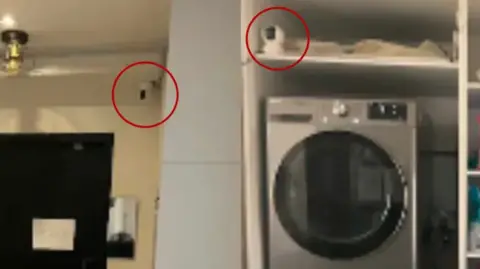
Elin also claimed that CCTV cameras recording both video and audio had been installed throughout the practice rooms and female dormitories - this allegation was also repeated by Miyu.
"The CCTV was live 24/7. They were picking up the audio as well... I didn't sign any consent to being filmed 24/7," said Elin, adding that the senior staff member "would watch us while we were dancing and make comments through the CCTV".
"At one point, he told the teacher, 'This isn't sexy enough — you need to teach the girls a sexier dance," she said.
The company, however, denied that the staff member entered the female dormitory, and said the cameras were installed only in common areas, such as entrances and kitchens, for "safety reasons", following past incidents involving intruders.
"The installation was announced in advance and intended entirely to safeguard the trainees," the legal representative told the BBC in a written response. Elin says she was never told of this.
 Supplied
Eventually, Elin dropped out of the programme and left Korea.
The three girls told the BBC that they didn't speak up immediately because they were worried that it could harm their chances in the K-pop industry. They said they also felt unable to tell their parents, who had paid large sums for them to train in Korea. And they faced other challenges, including the language barrier and an unfamiliar legal system.
Elin eventually went to the police and registered a case against the staff member, accusing him of sexual harassment and trespassing. But the police dropped the case, citing a lack of evidence. The staff member denied all the allegations. Her lawyers told the BBC that she was looking to appeal against the decision.
She has also registered a separate case against the company for breach of contract because of the alleged sexual harassment, trespassing in the dorms and CCTV surveillance.
Meanwhile, the company has continued recruiting students and still promotes its K-pop training programmes on social media. When Elin saw this, she was furious.
"K-pop has gained worldwide fame — and with that comes responsibility," she said. "At the very least, I hope the children who chase this dream can do so in a safer environment."
Miyu says she still dreams of becoming an idol.
"Whenever things were hard, I held on by listening to K-pop. I still want to become an idol, no matter what."