The retired Indian factory worker who built a library of two million books
Imran QureshiMandya district, Karnataka

 Alphonse Vimulraj
Two million books, housed across a sprawling building, free for anyone to borrow and read.
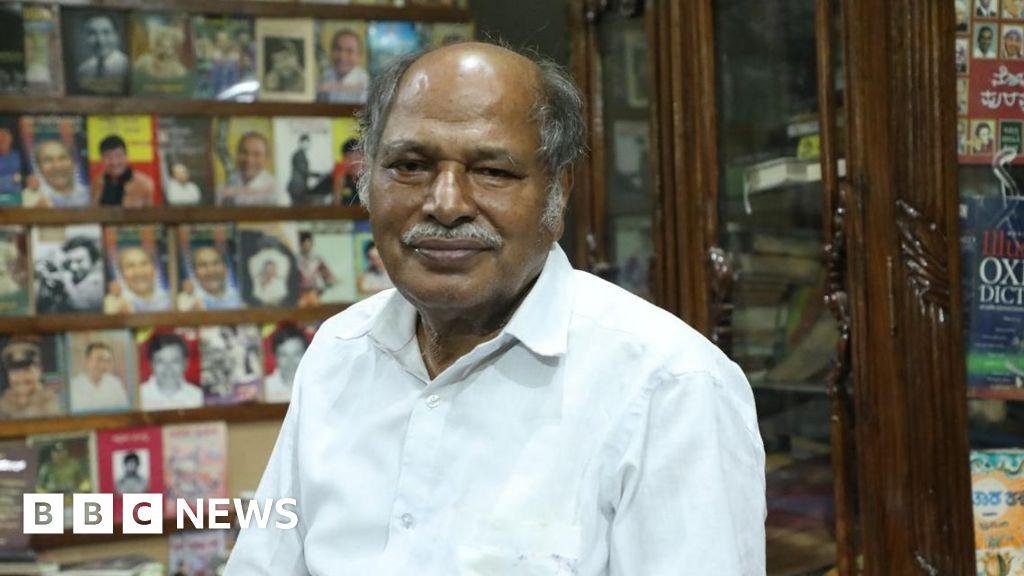
That's the wealth that Anke Gowda, a retired sugar factory worker from India's southern Karnataka state, has accumulated over the past five decades.
The 79-year-old made headlines last month when he received the Padma Shri - a civilian honour awarded by the federal government - for his extraordinary contribution to promoting literacy and learning.
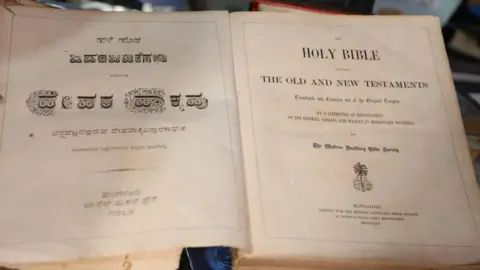
Gowda - whose eye-popping collection includes rare editions of the Bible, along with books on every subject imaginable - comes from a farming family where books were a luxury.
"I grew up in a village. We never got books to read, but I was always curious about them. I kept thinking that I should read, gather books and gain knowledge," he told the BBC.
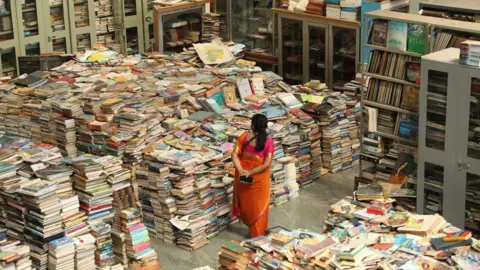
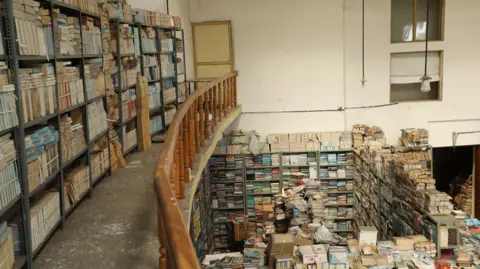
Gowda's library is located in Pandavapura, a small municipality in Karnataka's Mandya district. It lacks the rigid organisation usually associated with libraries. In fact, Gowda's collection doesn't have a librarian and books are stacked on shelves and piled on the floor in a haphazard manner.
Outside, under the library's awnings are sacks filled with an estimated 800,000 books, still waiting to be unpacked. The collection is still growing, through Gowda's purchases and donations from others.
The place is frequented by students, their parents, teachers and book lovers. Regular visitors seem to know their way around the library and find the books they need with ease. And even if they can't, they say, Gowda can find anything.
Gowda, his wife and son live in a corner of the library, which is open every day of the week - and for long hours.
 Alphonse Vimulraj
 Alphonse Vimulraj
Gowda spent his childhood juggling school and helping his father with farm work. He would often ask his parents and elder sister for money to buy books.
When he began reading books about Indian freedom fighters and spiritual leaders, he got hooked.
"They were like candy," he says.
Inspired by a teacher, he started building a small collection of books so that other students from rural areas could also read.
He often used the money his parents gave him for food to buy books instead.
Soon after finishing school, he started working as a bus conductor.
One day, about 10 months into the job, he bumped into a former teacher who was shocked to hear that he had quit studying. He insisted that Gowda resign and go to college.
Gowda followed his advice and went on to get a postgraduate degree in Kannada (the official language of Karnataka), before joining the Pandavapura sugar factory as a timekeeper.
He would spend two-thirds of his monthly salary on books, and use the remaining money for groceries and other necessities.
"Salaries were low then, but prices were also low," he says.
Over the 33 years he worked at the factory, Gowda attended dozens of conferences of the Kannada Sahitya Parishat - a non-profit dedicated to developing the local language and literature - and would often buy discounted books from them.
He also augmented his income by raising cows and selling milk, and working as an insurance agent.
His next hurdle would be familiar to book lovers everywhere - finding space to house his overflowing collection.
"I started keeping the books in trunks [large metal boxes]. Then I installed bookshelves in my house. But at one point, there was no place left," he says.
At the time, he had acquired around 50,000 books.
 Alphonse Vimulraj
Help came when some of his friends met Hari Khoday, the late liquor baron who was building a temple in Pandavapura.
Khoday, recalls Gowda, couldn't believe that one man could own so many books.
"He came and saw the books for himself. Then he asked me what I needed. I told him I didn't want any money for myself. My only request was that he build a library," Gowda says.
Khoday agreed and paid for the construction of a huge building, which is now part of Gowda's sprawling library which stretches across 15,800 sq ft (1,467 sq m).
Some years later, a local lawmaker brought then Chief Minister HD Kumaraswamy to see the library and he authorised money for the construction of two more structures attached to the first one.
Today, students and teachers from across the state visit the library. Among them is Ravi Bettaswami, an assistant professor at a private college who says that he has also been inspired to build a collection of thousands of books.
"I have used Gowda's library to study and have taken my students there so they could read and also help organise the books," he says.
Shilpashree Haranu, who teaches at a government college, says that the collection may look messy as it has not been organised by a professional librarian.
"But he [Gowda] knows exactly where each book is and can tell you in an instant," she says.
When asked why he never hired a librarian, Gowda says no-one ever suggested that to him.
As for the future of the library, Gowda strikes a philosophical note, suggesting that it is now up to others to take his legacy forward.
"I have fulfilled my responsibility. But I don't have the energy anymore. Maybe the government and the public can take over now?
"I have done my best, now it is up to others."