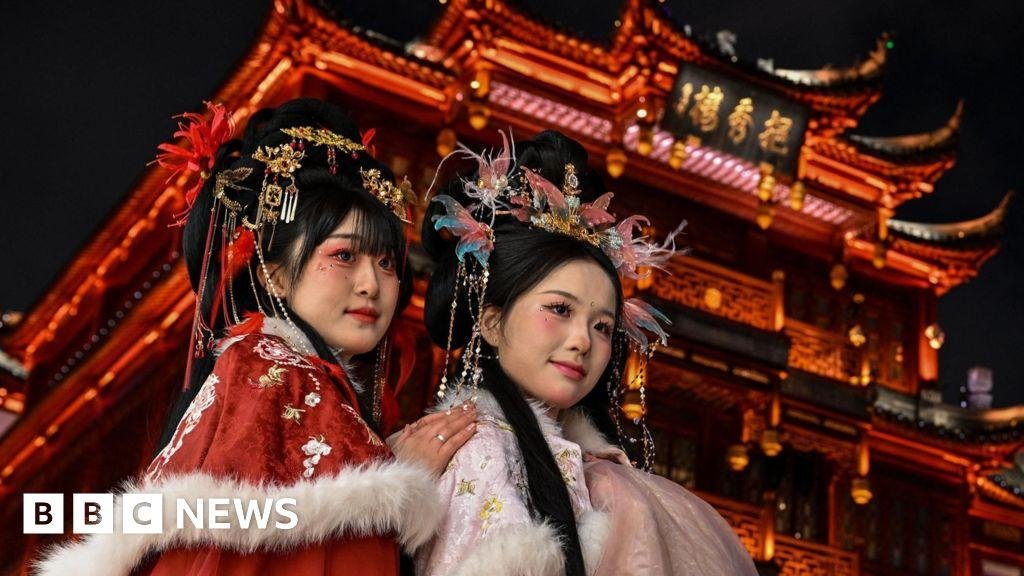
On TikTok, we're all Chinese – but the trend doesn't paint the full picture

 AFP via Getty Images
Ni hao, we're all Chinese now.
Or at least that's what they claim on TikTok, where a trend called "Chinamaxxing" has taken off in the West.
Chinese wellness practices, once associated with the tacky and geriatric, have suddenly found themselves in vogue, largely among Americans.
From warm apple-boiled water to indoor slippers and longevity exercises, people are sharing videos of themselves "learning to be Chinese". Many come with the Fight Club-inspired caption "you met me at a very Chinese time in my life", or the hashtag #newlychinese.
As Donald Trump shakes up the world order, the Chinese Communist Party has welcomed this boost to the country's image.
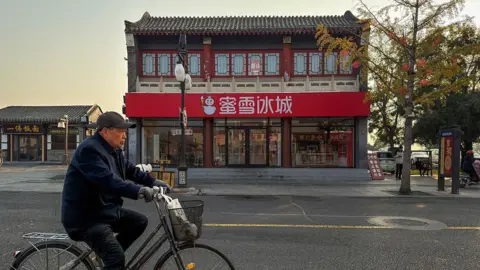
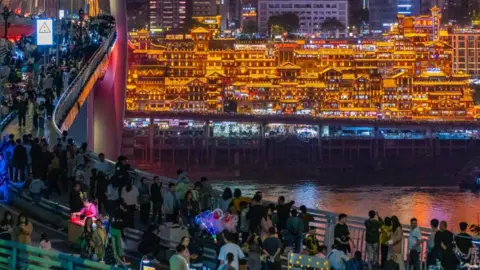
Chinamaxxing is certainly adding more gloss to the recent flourish of Chinese soft power. Over the past year we've seen the world clamour for Labubu dolls, wait in line at brand new stores to buy Mixue bubble tea and Luckin coffee, and scroll through their friends' holiday feeds in the "cyberpunk city" of Chongqing.
Some say Chinamaxxing stems from young Americans' disenchantment with their own country, although it's unclear how much that is really driving the trend.
But like so many internet trends, this one hardly paints the full picture. It's a celebration of memes and fleeting moments that make up just one slice of Chinese life. Beyond that are young people who, like their American counterparts, are also worried about their future in a sluggish economy and a fast-changing world.
A very Chinese time in our lives
Some Chinese youth may find it strange that parts of their culture - long seen as "uncool" in the Western imagination - are now the object of fascination. Some may find it offensive that Westerners on TikTok are facetiously claiming they've been "diagnosed as Chinese".
But others say Chinamaxxing strikes a different note from derogatory jokes like "bing chilling" - where the punchline is ex-wrestler John Cena's stilted Mandarin pronunciation - or the "social credit" meme that mocks the Chinese government's restrictions on personal freedoms.
This time, Chinese people are in on the joke - not the butt of it.
One of the most influential figures behind the Chinamaxxing meme is Sherry Zhu, a Chinese-American TikTok content creator who regularly shares traditional wellness tips with her "Chinese baddies".
"Tomorrow you're turning Chinese," she tells her 740,000 TikTok followers. "And I know that sounds intimidating, but there is no point in fighting it now."
 Getty Images
Few could have seen this coming.
Then a stunned world watched Beijing put its cities into hellish lockdowns. Reports emerged of residents running out of food and pleading for help from inside their sealed-off neighbourhoods. The restrictions ended only in early 2023 after rare protests. By then expats had left China in droves, many of them saying too much had changed.
There was also an exodus from Hong Kong, where Beijing's control was reshaping the city. This, along with China's growing power and assertiveness, strained the relationship with the West, even as the world's reliance on the Chinese economy became clear.
Meanwhile, China's investments in tech, infrastructure and exports began to pay off - and became more visible as it reopened post pandemic, relaxing visa rules to bring back tourists.
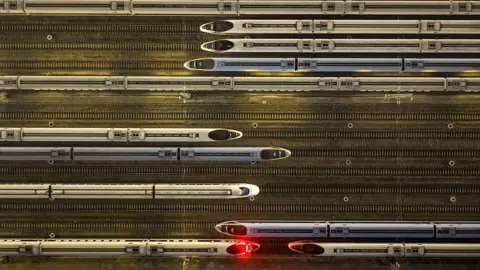
It was hard to miss: glitzy skyscrapers, a sprawling high-speed rail network, highways packed with electric vehicles, and a boom in green energy, robotics and artificial intelligence. Chongqing - a humid southwestern metropolis which once made global headlines for a corruption scandal and murder - turned popular and cool.
 NurPhoto via Getty Images
There have been other, smaller triumphs. Young people around the world are snatching Adidas Tang-style jackets off the shelves, bingeing on Chinese micro-dramas and experimenting with powdery make-up looks flaunted by Chinese girls and women on Douyin, China's version of TikTok.
"As a Chinese person who has been online throughout years and years of heavy Sinophobia, it felt refreshing to have the mainstream opinion finally shift regarding China," Claire, a Chinese-Canadian TikTok user, tells BBC Chinese.
The 22-year-old, who shares political content on TikTok and would only reveal her first name for that reason, says, for her, the "critical juncture" was last year.
That was when she noticed a shift in attitudes about China. A wave of Americans arrived on RedNote, a popular Chinese social media app, ahead of a TikTok ban in the US.
Within days memes became the currency of these American "TikTok refugees" as two worlds that rarely interact because of China's internet firewall were brought closer.
A dimming American Dream
"These young people have watched their physical reality remain frozen while China built entire cities," says Afra Wang, a tech writer and podcaster.
"When you can't build high-speed rail but you can scroll through videos of Chinese infrastructure, of course the future starts to look Chinese."
For observers like her, it's no coincidence that Chinamaxxing comes as the American Dream seems to be dimming.
Americans who came of age after the Iraq War, the 2008 global financial crisis or even the 6 January 2021 Capitol riot face a job market disrupted by globalisation and then AI, Wang says: "American exceptionalism was never something they lived."
 AFP via Getty Images
What do people in China think of Chinamaxxing? Not much, it seems. The trend has stirred limited reactions on Chinese social media.
Rather, in the eyes of Chinese people, America, once seen as a beacon of success, has lost its shimmer. Not least because tensions between the two sides have made it harder for Chinese students who want to study or work there.
"During America's Chinamaxxing moment, China is experiencing its own America-minimising moment," Wang says.
On parts of Chinese social media, there are dystopian references to the "US kill line", a Chinese gaming term that refers to the perilous descent into poverty in the US. The idea, which took root quickly among users and influencers, is that America is a tough place to survive because a single stroke of bad luck can derail your life.
The term's popularity on social media is helped by the fact that it has been embraced by Chinese state media and the government. They have sought to portray the US as a decaying superpower because of inequality, a weak social safety net and a broken healthcare system.
According to a commentary in state-owned Xinhua, the "kill line" meme "underscores how far the lived reality can drift from the ideals once broadcast to the world".
Beyond the memes
It's little wonder that Chinese authorities are pleased with Chinamaxxing.
"Chinese lifestyles increasingly gain global appeal, offer a steadier way of being," reads the headline of a Global Times piece about the trend.
When asked about it at a press briefing earlier this month, Chinese foreign ministry spokesperson Lin Jian said a "unique blend of history and modernity" is making China increasingly appealing to foreigners.
He was "happy" to see foreigners experiencing the "everyday life of ordinary Chinese people".
 Getty Images
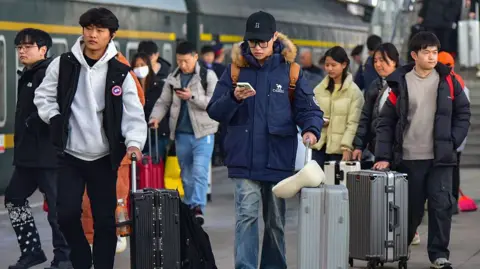
Propping up breakneck delivery speeds are gig workers scrambling to hit deadlines. Many can relate to the hustle: in 2023, Beijing courier Hu Anyan's memoir about the relentless nature of gig work became a national bestseller.
"When I think of my American friends and tech people wandering through Shenzhen in awe, I also think of my own experience in Shenzhen," Wang says. "Drinking a six yuan latte from Luckin Coffee, delivered on a scooter by someone like Hu Anyan, whose labour makes 'cool China' visible while remaining almost invisible themselves."
Perhaps, if the fascination with China's successes continues, more of Chinese life will surface. But for now apple tea seems to be where it's at.
"Ever since I started boiling apples in my tea water my period cramps have completely gone," reads a comment on RedNote from an American user - one of the TikTok refugees still lingering on the app.
"We have so much still left to learn being Chinese."
Additional reporting by Eunice Yang from BBC Chinese