Katya AdlerEurope editor

 BBC
BBC
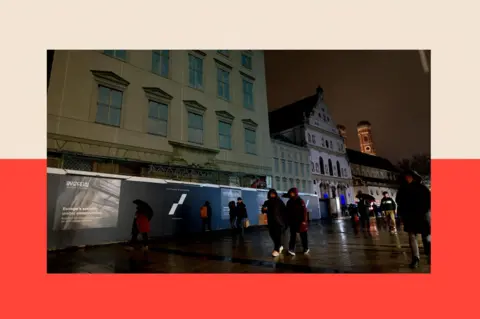
Downtown Munich is best-known for chic shops and flashy fast cars but right now its streets are bedecked with posters advertising next generation drones.
"Europe's security under construction" boasts the slogan on an eye-catching set of sleek black-and-white photographs, festooned across a scaffolding-clad church on one of this town's best known pedestrian boulevards.
Such an unapologetic public display of military muscle would have been unimaginable here just a few years ago, but the world outside Germany is changing fast, and taking this country with it.
The southern region of Bavaria has become Germany's leading defence technology hub, focusing on AI, drones and aerospace.
People here, like most other Europeans, say they feel increasingly exposed - squeezed between an expansionist Russia and an economically aggressive China to the east, and an increasingly unpredictable, former best pal, the United States, to the west.
According to a recent Eurobarometer poll, more than two-thirds of Europeans (68%) feel their country is under threat.
This autumn, Germany's Federal Office of Civil Protection and Disaster Assistance warned for the first time since the Cold War that war is no longer "unlikely". While emphasising that this is a safe country, it also recommends that Germans keep food supplies of three to ten days at home. Just in case.
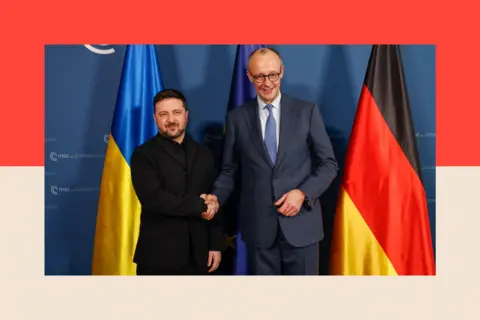
Germany is the number one single donor of military and other aid to Ukraine, now that the US has halted any new direct aid. Opinion polls suggest voters here want to feel better protected at home too.
 AFP via Getty Images
The question for this country, along with others in Europe is whether traditional alliances with the US, in Nato and the EU can suffice, or whether they should be diversifying into ad-hoc coalitions alongside other like-minded nations such as Australia, South Korea and Japan?
Precarious relations
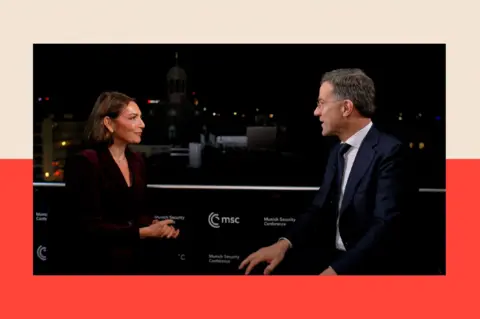
By 2029, the German defence budget will be higher than the UK and French equivalents combined, Nato's Secretary General Mark Rutte pointed out to me.
He described the €150bn they say they will spend on defence as "a staggering amount".
It's something the United States notices and appreciates, he said. Donald Trump is far from the first US president to insist that Europe do more for its own security, though his tone has been noticeably more threatening than that of his predecessors.
The precarious state of transatlantic relations was the main focus of the Munich Security Conference (MSC) this weekend. It's the world's biggest annual defence meeting, bringing leaders, security experts and defence industries together.
While it's easy to dismiss speech-heavy get-togethers like this as wind-baggy talking shops, in the turbulent times we live in, they can make a difference - especially the informal private huddles between global decision makers, far away from the glare of the cameras.
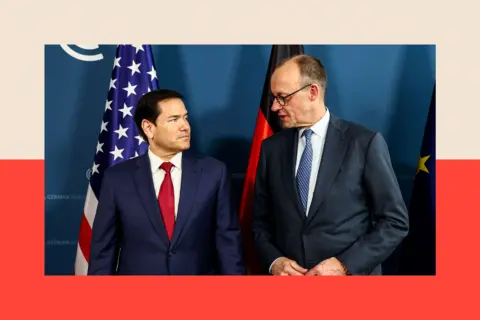
The most eagerly - and for some the most anxiously - anticipated speech at this year's conference was that of the US Secretary of State, Marco Rubio, who represented the Trump administration here.
European leaders and top diplomats were seriously on the edge of their seats. But why was a simple 30-minute address given so much importance?
It's because Europe-US relations have never been so frayed as they are now, over the last 80 years since World War Two. And this isn't a bust-up between buddies that will easily blow over.
Denmark still furious
In the just over 12 months since Trump returned to the White House, he has at times insulted and undermined European leaders, slapped big tariffs on their exports, and most shockingly of all to his allies in Nato, threatened Danish sovereignty over its territory, Greenland, refusing for a while to rule out taking the island by force.
Speaking at the MSC on Saturday, Denmark's still clearly furious prime minister, Mette Frederiksen, said Trump's designs on Greenland remained "the same" despite ongoing trilateral talks between representatives of Greenland, the US and Denmark.
Trump has ruled out taking Greenland by military force for now, and he's backed away (for the moment, at least) from slapping economic sanctions on allies, including the UK, France and Germany, that were getting in the way of the US acquiring the Arctic island. But transatlantic trust was severely damaged.
European powers see in Trump a truly transactional president who thinks nothing of leveraging security or economic relations with his closest allies to get what he wants. Just before being re-elected president, for example, he told Europeans that the US would not protect nations that didn't pay their way on defence.
It is true though, that Europe has been coasting on America's security blanket for decades. Critics in the US argue that European nations have been able to run generous welfare states for decades while Washington picked up the tab for security spending.
 AFP via Getty Images
Germany's defence minister, Boris Pistorius, told me on Saturday: "We got used to the strong support from the US; we got used to our comfort zone in which we used to live. This time is over, definitely over," he said. "Washington was right."
But the crisis over Greenland and other actions by the Trump administration - such as when it temporarily paused intelligence-sharing with Ukrainian forces last March, leaving them blind on the battlefield, in order to pressure Kyiv into engaging in peace talks with Moscow - have left deep scars and a troubling sense of transatlantic wariness.
Hence the trepidation in Munich before Rubio took the stage.
In the end, his words were laced with a sense of historic kinship. "We want Europe to be strong," he said. "The two great wars of the last century serve for us as a constant reminder that ultimately our destiny is, and will always be, intertwined with yours."
A loyal speech
I found it telling that so many European politicians and politicians in the audience jumped on the warmth of his words, rising to their feet to applaud the US Secretary of State. They were clearly relieved he hadn't threatened or berated Europe as the US Vice President JD Vance famously did at last year's MSC.
But for those listening closely, Rubio's speech was loyal to themes close to the heart of the Trump administration and hard for many European leaders to swallow: anti climate action, sceptical of globalisation, multilateralism, migration and pro the building of a new era of Christian western civilisation.
Rubio was clear: the US wasn't interested in allies clinging to the old status quo. It wanted to forge a new path, ideally alongside Europe, but only if it shared the same values.
This US offer of close partnership was conditional and absent of a sense of compromise.
"A bit like a (psychologically) abusive partner," said one European diplomat, speaking candidly on condition of anonymity. "He reminded Europe how wonderful the (transatlantic) relationship used to be, but he then switched to coercion: If you want things to be good between us in the future, you have to do as I say!"
Another diplomat pointed out that, while talking of shared values, it was telling, he said, that of all the European countries that Rubio could have gone to after making his speech in Germany, he chose to visit Slovakia and Hungary before heading back to the US.
They are viewed by Brussels as two of the EU's most problematic members, both with Eurosceptic nationalist prime ministers who oppose sending military aid to Ukraine and who are tough on migration.
A fragile new relationship
Rubio's softer tone also divided European leaders who had recently spoken as one, in defence of Denmark, at the height of the Greenland crisis last month.
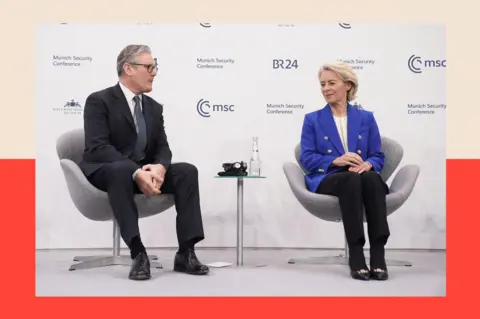
The President of the European Commission, Ursula von der Leyen, underlined a now fragile relationship with the US, despite Rubio's gentler rhetoric. "Some lines have been crossed that cannot be uncrossed anymore," she said. "Europeans have suffered shock therapy."
But will some countries in Europe grasp what warmness there was in Rubio's speech as an excuse not to rush to boost defence spending as promised? The coffers of most European governments are over stretched already and their voters tend to prioritise cost-of-living concerns over defence budgets.
 Reuters
Rachel Ellehuus, Director-General of defence think-tank RUSI told me she sees a rift opening up across the continent.
One the one hand, you have the Nordic and Baltic nations that are geographically close to Russia, and also Germany and the Netherlands, which are all big defence spenders, she says, whereas in southern Europe, there's Spain, for example, that is absolutely unapologetic about refusing to increase defence budgets to the levels demanded by Donald Trump.
France and Britain are both verbally committed to boosting defence spending, says Ellehuus, but are still looking for a "political band aid" to help them explain to voters the trade-offs that will involve - higher taxes, less welfare or more borrowing.
"Europeans need to get to work yesterday and to focus," she says. "They have 5-10 years to stand on their own two feet in terms of conventional defence capabilities."
Last week, U.S. Undersecretary of Defence Elbridge Colby couldn't have been more stark in his messaging at a meeting of Nato defence ministers he attended in Brussels: Europe was no longer a US priority, the Indo-Pacific was.
"Under President Trump's leadership, we are reprioritising the defence of our homeland and the protection of our interests in our Hemisphere," he said.
While he emphasised that the US remained committed to Nato's mutual defence clause, where an attack against one member is viewed as an attack against all, Colby insisted the US would be reducing its capabilities in Europe, becoming "a more limited and focused" presence.
Europe had to become a partner, rather than a dependent, he said, calling for a new "Nato 3.0". The old world order with the West at its core, has faded but the MSC this weekend made clear that what comes next for Europe and the US is still very much up in the air.
Marco Rubio called for a new century of western civilisation, Elbridge Colby wants a re-vamped Nato, while the UK's prime minister appealed in Munich for the western alliance to be re-made.
Starmer's nuanced approach
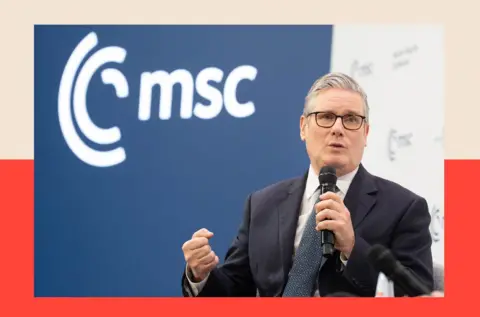
In stark contrast to Marco Rubio's insistence on greater national sovereignty, Sir Keir Starmer spoke in favour of greater integration between the UK and Europe on defence - to cut re-armament costs, though, he emphasised this did not mean the UK turning its back on the United States.
Sophia Gaston, national security expert at Kings College London, told me that in Munich, Starmer was able to better articulate the nuance of Britain's strategic outlook.
"Other allies in Europe may be more willing to speak of divergence from Washington", she says, "but for Britain it remains a strategic imperative to triangulate within the Transatlantic relationship. There will also be times when Britain will have to make hard choices, and Starmer appeared more confident in confronting that reality.
"The key is to have a really strong grasp of the national interest and our instruments of power and influence. This requires a much more competitive approach that has not always felt natural to Britain, which has typically pursued much of its diplomacy in elegant, consensus-focused and invisible ways."
 PA Media
In these fast-moving, unpredictable times, Europe's leaders are increasingly turning to a la carte coalitions, alongside traditional organisations like Nato or the EU, which are larger and therefore often slower to react. These groupings also include non-European nations.
Take, for example, the so-called Coalition of the Willing group of countries, led by the UK and France and formed to secure Ukrainian sovereignty in the case of an eventual peace deal with Russia. Turkey has attended coalition meetings, as have New Zealand and Australia.
Canada is increasingly working alongside Nordic and Baltic nations that share geopolitical challenges and common values, they say, and want to promote stability and deterrence from the edges of the Baltic Sea, through the Nordic and Baltic states, through the North Atlantic, Greenland and across the Canadian arctic.
One European policy-maker who asked not to be named joked to me that Canada was becoming "more and more European by the day". Japan and South Korea were increasingly seen as part of the "like-minded family" too, he said.
Not just defence
These ad hoc coalitions are not restricted to defence alone. France's President Macron has long called for Europe to increase what he calls its strategic autonomy, in traditional security terms but also energy security, supply chains and new technologies. In Munich he recommended Europe "de-risk" from all outside powers.
This weekend even saw the president of the European Commission admitting that if the EU failed to move fast enough on improving competitiveness, "a group of its member states would have to move forward alone".
Attempts by smaller pockets of European powers to work together to advance European strategic independence are by no means always successful. Take the current row between France and Germany over their joint attempt to come up with the next generation of fighter jet with the Future Combat Air System (FCAS).
You could also say that for all the talk of building European independence, this weekend's conference was also a reminder of just how dependent Europe remains on US security support - from its nuclear umbrella to intelligence sharing and command and control structures. It was also a reminder of how far Europe trails the US in high tech innovation.
But more than short-term mechanisms designed to 'survive' Donald Trump, the changes we are witnessing in Europe, including closer alliances outside the continent, are liable to be longer lasting. The world now seems to dance to the tune of big power politics. And even slow-moving Europe is having to adapt.
Top picture credit: AFP / Getty Images

BBC InDepth is the home on the website and app for the best analysis, with fresh perspectives that challenge assumptions and deep reporting on the biggest issues of the day. Emma Barnett and John Simpson bring their pick of the most thought-provoking deep reads and analysis, every Saturday. Sign up for the newsletter here