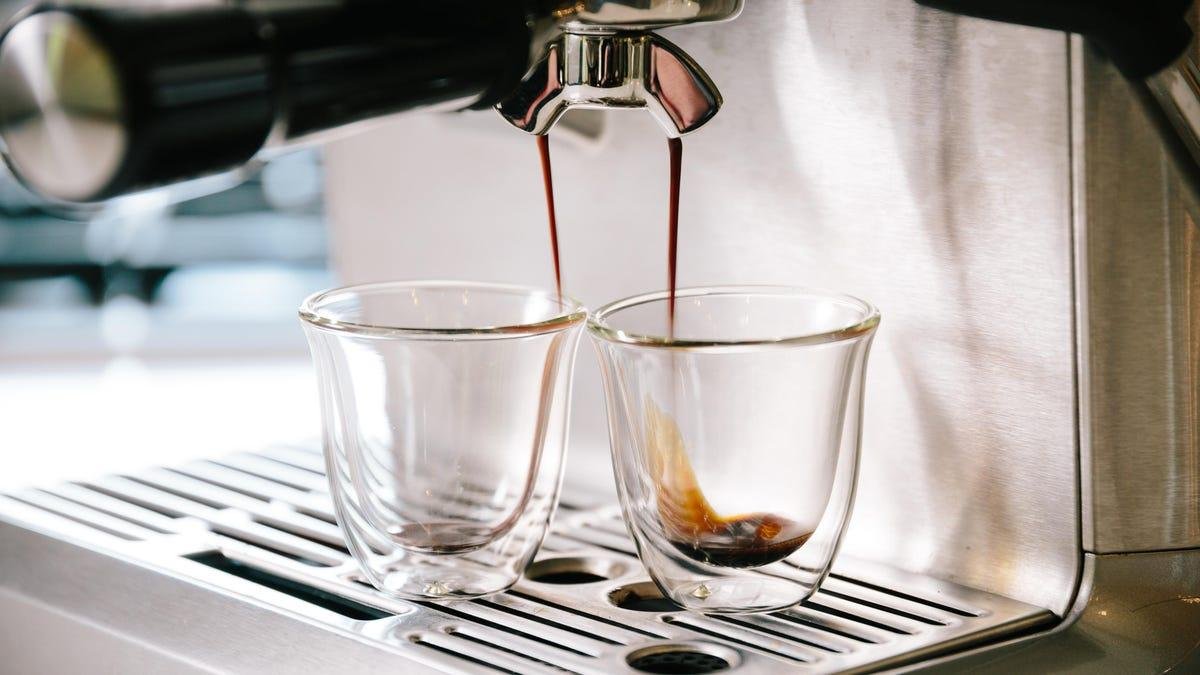
If you're a daily coffee drinker, having an espresso machine at home can help cut back on expensive cafe trips and make you feel like a professional barista right at home.
If you want true-blue espresso, you'll need some hardware as Moka pots and Turkish coffee pots only make something that resembles espresso. This concentrated coffee beverage is brewed by forcing hot water through finely ground beans under high pressure of 9 bars or more -- something only a machine can do properly.
Quality automatic espresso machines require an investment -- budget between $350 and $700 for one that can deliver genuine café-quality espresso drinks (or straight shots for purists). Consider it against what you'd otherwise spend on daily cappuccinos, lattes and double espressos at your local coffee shop.
CNET's experts have spent months testing espresso machines from top manufacturers, including Breville, Ninja, DeLonghi and Nespresso, to find the best of the best for at-home espresso making. From budget picks and compact models to the best espresso machine for most homes and one fully automated at-home system, we have picks for everyone.
After pulling shots from more than 20 models, these are the six best espresso machines in 2026.
Best espresso machines
Pros
- Has ample customization options
- Smart dosing technology for balanced espresso
- Powerful built-in burr grinder
- Includes premium dose trimmer and tamper
Cons
- A bit bulky
- Not cheap but offers good bang for the buck
The Breville Barista Express ticks the most boxes of any machine we tested, with solid performance, features and a reasonable price -- all from a brand with a proven track record in the at-home espresso category.
This manual espresso machine has a powerful burr grinder that pulverizes espresso beans and smart technology that doses grounds directly into its portafilter basket, while its sturdy frother steams milk well and makes thick foam. It's not among the cheapest of espresso machines, but you're getting a lot for the price.
The control panel may be a little intimidating at first, but once you get the hang of things, a delicious shot (or double shot) of espresso, latte or other freshly ground coffee drink of choice will be your reward. Made from stainless steel, the Barista Express is a cinch to clean as well. To seal the deal, Breville includes premium metal tools such as a handy-dose trimmer and tamper.
It's worth noting that this machine has heft, so you may want to look at the next machine on the list instead if counter space is at a premium
Pros
- Intuitive operation
- Makes quality of espresso and foam
- Weighted portafilter
- Narrow size fits in small spaces
- About as affordable as espresso machines get
Cons
- Plastic scoop and tamp
- Toggling between the steam and coffee operations
- It's a newer brand so long-term durability is in question
This compact and trendy espresso machine would look great on any countertop and the stainless steel version is currently on sale at Amazon for $119, which makes it the cheapest option on our list by far. Even at its full price, we like the Casabrews as a true budget buy that delivers reliable espresso shots.
The Casabrews is a compact 20-bar espresso machine made for beginners and small kitchens. It has a 34-ounce removable water tank (which makes refilling and cleaning pretty easy) and a steam milk frother for making your favorite espresso beverages. The machine also has straightforward controls for quick, at-home espresso drinks.
One of our coffee experts, Katherine Peach, tested it side by side with the more expensive Breville Bambino. Ultimately, the $300 Bambino was the more proficient machine, but for the price, the Casabrews impressed. That said, if you're making espresso regularly, a machine this inexpensive may not last more than a few years of consistent use.
Although it's small, it still has a nice-sized water tank, so you don't have to worry about refilling it often, and it pulled creamy, delicious shots during our testing. The Casabrews also comes in seven colors, a bonus for anyone interested in a less conventional appliance on the counter.
You can read our full review of Casabrews CM5418 here.
Pros
- The best small espresso machine we've tested
- 9 bars of extraction pressure, similar to commercial machines
- Easy operation
- Ideal for beginners
- Excellent steam wand
- Approachable price
Cons
- No built-in grinder
- The machine is light and a little tippy
- More plastic elements than higher-end machines
- The vibration pump is louder than those found in more expensive models.
If space is at a premium, the modest Bambino won't demand much of it. This compact model impressed us more than any espresso machine in its weight class.
One of the biggest draws of the Bambino is its three-second "ThermoJet" heating system with PID control and a digital thermostat that controls the water temperature for greater stability. (Large swings in temperature will affect the flavor of a shot.) The ThermoJet innovation is more than a marketing gimmick: a glass-ceramic enamel coating on the stainless steel heats faster, resulting in an impressively short wait time before you can steam milk or pull a piping-hot espresso shot.
Breville also found a sweet spot at 9 bars of extraction pressure, similar to most commercial machines. Additional benefits of the Breville Bambino include its 180-degree rotation, which makes it more comfortable to use.
In addition to being a great compact option, this is ideal for beginners. It's so simple to use and clean, and we found it pulled quality espresso shots on par with more expensive picks like Breville's Barista Express.
We especially appreciate how easy it is to froth milk with the Bambino. Just insert the steam wand into the stainless-steel milk pitcher that is included with the Breville Bambino Plus, then press one button. Less than a minute later, you'll have expertly steamed milk foam ready for lattes and cappuccinos.
Pros
- Has the most functionality of any manual espresso machine we tested
- Makes solid drip coffee in addition to espresso
- Removable bean hopper makes refilling easy
- Automatic steam/foam pitcher requires less cleanup than wand steaming
Cons
- Cold brew was too weak
- Not the best looking of the bunch
- Large and heavy
- Purists may snicker at the oversized portafilter
Ninja drops into a crowded space with a customer base known for its particularity, but it seeks to remove some of the snobbish stigma from at-home espresso-making and offer a more user-friendly experience.
The machine has an unusually large portafilter that can be converted into a traditional coffee filter, allowing you to make up to 18 ounces of drip coffee. There's also a cold brew function that turns out concentrated coffee mixed with water, for an instant chill on steamy summer days. Ninja's system also whisks milk and nut milk in addition to the more traditional steaming.
Despite the dozens of beverage-making options, we found the control panel easy to use. After three or four attempts, we had both a drip coffee setting and an espresso strength that we liked. The suggested grind size for particular styles was clear, as was the option to change it manually if we wanted to try something coarser or finer.
We appreciate the detachable bean hopper (something I'm still waiting for Breville to introduce in its machines), which lets you clean it thoroughly and swap beans without much trouble if you prefer a darker roast and someone else in the home prefers a lighter roast.
The machine has a sharp, modern look, although it's not the best-looking espresso machine in the middle price tier.
You can read our full review here.
Pros
- Requires almost no labor to make drip coffee, Americanos and other espresso drinks
- Built-in foam system is reliable
- No messy grinds to clean up and self-cleans after use
- Great for guests
Cons
- Expensive
- Takes up a significant amount of counter space
- Espresso is good, but we've had better
- Overheats occasionally so we recommend unplugging between uses
The TK-02 is an all-in-one automatic coffee maker, espresso machine and live-in barista (basically) that grinds beans and brews fresh coffee in seconds using filtered water. The TK-02 uses its in-machine frother to add frothy cow's milk or nut milk to Italian coffeehouse drinks.
The sleek machine brews shots of espresso, iced coffee and smooth Americanos, along with foamier coffee drinks, including lattes, flat whites, macchiatos and cappuccinos. If you prefer classic American drip coffee, it brews a piping-hot cup in about two minutes.
The built-in computer helps manage settings, including grind size and the amount of coffee the machine dispenses when you request a drip. If you want your lattes stronger, simply adjust the espresso-to-milk ratio and save the new settings. We found the digital controls perfectly intuitive with no excessive settings or features, and the navigation is clear and to the point -- exactly what you want in the morning.
The day-to-day maintenance is significantly less than that of a manual espresso machine or even most drip coffee makers. The TK-02 performs an automatic hot rinse after use and alerts you when it's time to run a descaling cycle. Its user-friendliness makes it perfect for guests -- and it has a sleek, expensive look. And that's because it is expensive.
You can read our full review here.
Pros
- Automatically grinds, doses and tamps
- Offers 45 grind settings
- Wi-fi enabled for system upgrades and remote control
- Professional-grade burr grinder
Cons
- Expensive
- One of the larger machines on our list
This pricey model has more functions and automation than the average espresso machine. You can fully program your own custom settings via the slick digital interface, including your preferred grind size, temperature and foam needs. It is tied for the most expensive on the list but it is considered a professional-grade espresso machine and is built to last.
Precision, automation and speed were the driving factors behind the Oracle Jet's upgraded technologies, which feature a fully integrated Baratza European Precision Burr that automatically grinds, doses and tamps by simply holding the portafilter in place under the grind and tamp outlet until the display technology clearly lets you know you're good to go. The system offers 45 grind settings, while factoring in the roast or expiration date of the beans you've selected.
For non-dairy foam fanatics, the Oracle Jet system now offers built-in settings for soy, almond and oat milk, which can be customized to your preferred temperature and foam quality. No more scalding hot Starbucks for you. The temperature and foam settings automatically adjust when you select different, non-dairy milks.
Keep in mind, too, that if you want one of the specialty colors, Sea Salt & Brass or Stainless Steel & Brass, it will cost an additional $300.
You can read our full review of the Breville Oracle Jet here.
Espresso machines compared
| Machine | Type | Dimensions (W x D x H) | Water tank capacity (fl oz) | Weight (lbs) | Built-in grinder | Colors available |
|---|---|---|---|---|---|---|
| Breville Barista Express | Manual | 13" x 15" x 16" | 67.6 | 24.03 lbs | Yes, 18 grind settings | 6 |
| CasaBrews CM5418 | Manual | 5.47" x 12.28" x 11.97" | 34 | 8 lbs | No | 6 |
| Breville Bambino Plus | Manual | 7.5” x 13.5” x 12” | 64 | 10.91 lbs | No | 8 |
| Ninja Luxe Cafe | Semi-automatic | 12.99" x 13.39" x 14.57" | 70 | 25 lbs | Yes, 25 grind settings | 2 |
| TK-02 | Automatic | 10.4” x 17.5” x 14.3” | 75 | 29.5 lbs | Yes, 5 grind settings | 2 |
| Breville Oracle Jet | Semi-automatic | 15” x 14.5” x 16.75” | 77 | 27.78 lbs | Yes, 45 grind settings | 7 |
Enlarge Image
A good espresso coffee is uniquely powerful and flavorful. It's the ultimate test for home brewers.
Lynn La/CNETDuring our first evaluation process, our reviewers began by hand-washing and drying all removable parts and accessories. For most espresso machines, that includes the filter basket, metal portafilter inserts, water tank and so on. Then it was time to grind the coffee beans to a fine, consistent grind, which is critical for proper espresso brewing.
Next, it's time to pull shots. We start with the suggested method outlined in a given machine's product manual. Usually, that covers the amount of coffee grounds expected per shot, along with any guidelines regarding coarseness level. Likewise, we follow tamping instructions (light, medium or hard tamp) if the manual provides them.
We make sure to record the weight of the grounds used, plus the weight of the espresso for each shot pulled. This data, along with readings from a portable refractometer, allows us to calculate two important percentages: total dissolved solids and extraction percentage.
Just as for any coffee brew, the ideal extraction percentage for espresso is a range between 18% and 22%. This yields a balanced cup, assuming you perform an even and efficient extraction of coffee compounds from your grounds (both flavor and caffeine).
Enlarge Image
Not all home espresso machines can brew quality shots. This one was pulled from the Breville Barista Express.
Tyler Lizenby/CNETIf you over-extract, you run the risk of leaching out unpleasant flavors (bitterness) after the good. On the opposite end of the scale, under-extracted brews tend to have undeveloped flavors. Lacking sugars and other caramelized organic chemicals, these shots will taste sour, weak and watery.
Unlike a cup of drip coffee, barista-quality espresso should be concentrated. Excellent drip typically has a TDS percentage of 1.3% or 1.4%, great espresso has a much higher percentage. The Breville Barista Express, for example, produced shots with TDS percentages as high as 12.4%.
The shots we pulled were balanced, with an extraction of 18.6%. The test coffee beans I use are the same variety I employ for standard coffee makers -- Costco Kirkland Colombian. It's a medium-dark roast suitable for brewing espresso as well.
Many espresso machines have steaming wands for frothing milk. The Breville Bambino makes steaming milk especially easy.
Brian Bennett/CNETLastly, we try our hand at milk frothing with each espresso machine equipped with a steam wand. I record the overall experience with the steam wand, whether the process is a snap, a tricky chore or somewhere in between.
You can use steamed milk to create cafe-style espresso drinks like lattes and cappuccinos.
Brian Bennett/CNET$2,000 is a hefty sum for any coffee maker but if you're going to splurge on one the automatic TK-02 packs a lot of bang for the buck.
David Watsky/CNETA good automatic espresso machine doesn't come cheap and you can expect to pay at least $500 for something that whips up a legit cafe-caliber espresso drink (or just an espresso shot, if that's your thing). When in doubt, try to remember how much you'll be saving on all the cappuccinos, lattes and double shots from the specialty coffee shop.
You can also drop as little as $100 if you're willing to settle for a mediocre espresso, but we'd urge you not to pounce on an espresso maker that costs less -- especially if you plan on drinking espresso regularly. Seemingly affordable espresso machines may look like a bargain at first but they're often a waste of money and counter space.
Compact models have come a long way since we first started testing espresso machines.
Katherine Peach/CNETFor the coffee lover on a budget, "espresso brewers" (in the $30 to $50 price range) typically lack motorized pumps and are powered by steam pressure alone. What they produce is technically equal to moka pot coffee, the sort of drink made by simple stovetop brewers; it won't taste quite like the espresso you're used to from the barista at your local coffee shop or cafe. That's not inherently bad... it's just not espresso.
In short, no. What you can do is make coffee drinks that come close. For instance, moka pots brew coffee under pressure that's very concentrated. Likewise, you use an AeroPress brewer to make strong, espresso-like joe.
Like any coffee maker, espresso machines require regular cleaning to ensure optimal operation. Espresso makers can be particularly sensitive to maintenance neglect. In addition to coffee brewing, some of these products have systems for steaming milk and grinding beans. Each subsystem calls for specific steps to keep them dirt and grime-free.
The portafilter, the main brewing chamber, should be hand-washed with soap and hot water daily. To make the task easier, run a water-only brewing cycle before and after each espresso shot you pull (brew). You'll likely have to clean the water shower screen weekly too. For more details, be sure to check your machine's manual (PDF) for cleaning instructions specific to your brewer.
If your espresso machine can also steam milk, then the list of drinks you can make is vast. Just to name a few, there are traditional Italian drinks like cappuccinos and lattes. The flat white is an Australian cross between those two. You serve these hot or over ice as well. If milk isn't your preference, there is the Americano, espresso diluted with hot water.
Answering this question depends on what you mean. If we're simply talking about taste, something similar to or better than a coffee shop is possible, although it'll take quality ingredients and practice.
If we're talking about price, you should be able to recoup your cost fairly quickly, even for a pricier machine. If you replace a $4 latte with one you make at home every workday, you'll save close to $20 in a week. You'll pay some for coffee beans and milk, but much less than a dollar. Take a tip for your barista into account, and you're likely saving more. If you're saving $20 each week, that's more than $1,000 a year. Even if you go to a coffee shop occasionally, you can easily pay for even our most expensive recommendation with your savings in the first year.
It depends. If you favor convenience and want a machine that can pump out great espresso at the touch of a button, an automatic machine is for you. However, if you want to dive deep into the hobby of making great espresso, a manual machine will give you a lot more control.