Bethany BellVienna correspondent

 www.foto-webcam.eu
More than a year after a 33-year-old woman froze to death on Austria's highest mountain, her boyfriend goes on trial on Thursday accused of gross negligent manslaughter.
Kerstin G died of hypothermia on a mountain climbing trip to the Grossglockner that went horribly wrong. Her boyfriend is accused of leaving her unprotected and exhausted close to the summit in stormy conditions in the early hours of 19 January 2025, while he went to get help.
The trial has sparked interest and debate, not just in Austria but in mountain climbing communities far beyond its borders.
Prosecutors say that, as the more experienced climber, the man on trial was "the responsible guide for the tour" and failed to turn back or call for support in time to help his girlfriend.
Identified by Austrian media as Thomas P, he denies the charges and his lawyer, Karl Jelinek, has described the woman's death as "a tragic accident."
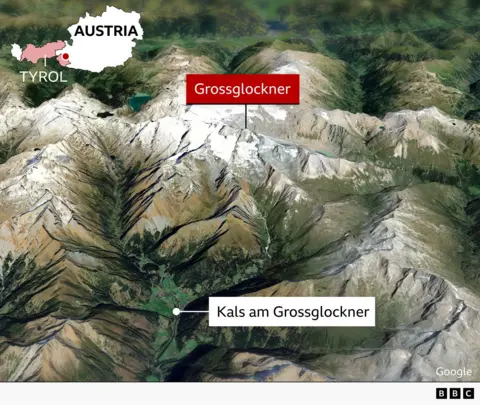
The tragedy unfolded after the couple began their climb of the 3,798m (12,460ft) Grossglockner.
Prosecutors accuse Thomas P of making mistakes from the outset and have published a list of 9 errors.
At stake is the question of when personal judgement and risk-taking become a matter of criminal liability. If the climber is found guilty it could mean "a paradigm shift for mountain sports", says Austria's Der Standard newspaper.
Key to the case is the charge by state prosecutors in Innsbruck that he was to be considered the "responsible guide for the tour", as "unlike his girlfriend [he was] already very experienced in high-altitude Alpine tours and had planned the tour".
They said he attempted the trip even though his girlfriend had "never undertaken an Alpine tour of this length, difficulty, and altitude, and despite the challenging winter conditions".
They also allege he started out two hours too late and had failed to take "enough emergency bivouac equipment".
He also "allowed his girlfriend to use... snowboard soft boots, equipment that is not suitable for a high-altitude tour in mixed terrain", say prosecutors.
The defendant disputes this. In a statement, his lawyer Karl Jelinek, said the couple had planned the tour together.
"Both considered themselves... to be sufficiently experienced, adequately prepared, and well equipped," he said. Both had "relevant Alpine experience" and were "in very good physical condition".
Once on the mountain, prosecutors say the man should have turned back, when it was still possible, because of strong winds of up to 74km/h (45mph), and the winter cold. It was -8C, with a windchill temperature of -20, they said.
The couple did not turn back.
Accounts of what happened next differ.
According to the defendant's lawyer, they reached a place called Frühstücksplatz at 13:30 on 18 January, the point of the tour after which there was no turning back before the summit.
As neither of them was "exhausted or overwhelmed, they continued on", Karl Jelinek said.
Prosecutors say the couple got stuck at about 20:50 and that the man failed to call the police and did not send any distress signals when a police helicopter flew overhead at around 22:50.
The boyfriend's lawyer said at that point his client and girlfriend still felt fine and did not call for help as they were close to the summit.
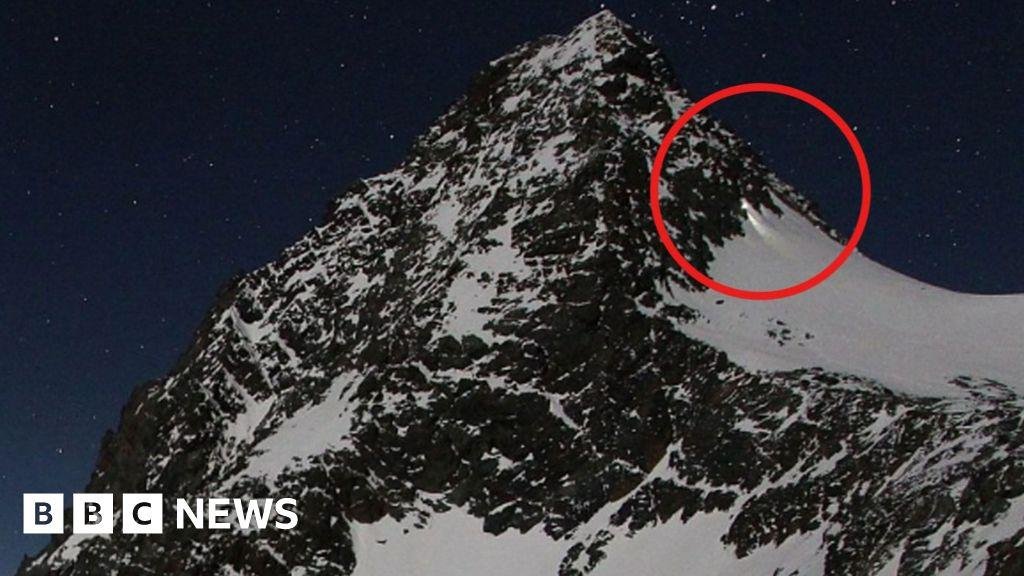
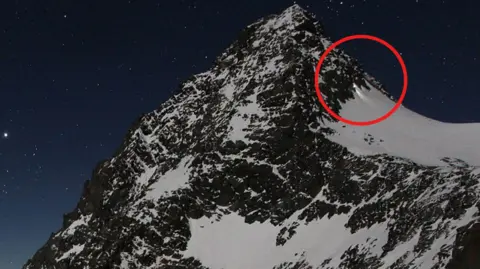
Webcam images show lights from their torches as they scaled the mountain.
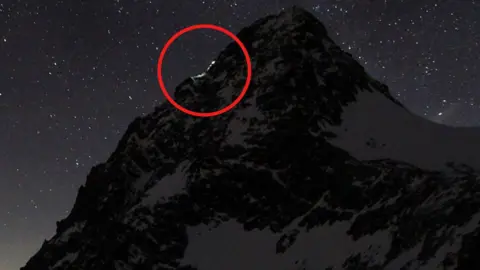 www.foto-webcam.eu
But shortly afterwards, Mr Jelinek said the situation changed dramatically. To the man's "complete surprise", the woman "suddenly showed increased signs of exhaustion", although by then turning back was too late.
At 00:35 on 19 January, he called mountain police. The content of the conversation is unclear but the lawyer says he asked for help and denies telling police that everything was fine. Police allege he then put his phone on silent and did not take any more calls.
Karl Jelinek says the couple managed to reach an area about 40m (130ft) below the cross marking the summit of the Grossglockner.
As the defendant's girlfriend was too exhausted to move, he left her to find help, scaling the summit and descending on the other side, he says. Prosecutors say he left her at 02:00am.
His torchlit figure is captured on webcam images as he descended from the summit.
Prosecutors say he did not use aluminium rescue blankets or other gear to protect her from the cold and waited until 03:30 before notifying emergency services.
By that point it was most probably too late. The strong winds meant that no helicopter rescue could take place during the night.
Kerstin G died alone in the snow on the frozen mountainside.
If found guilty, Thomas P faces up to three years in prison.
And a guilty verdict could also have implications for other mountain climbers, and how much they could be liable for their companions in the future.
 Bergrettung Kals