Olga Shamina, Yaroslava Kiryukhinaand Sergei Kagermazov,BBC News Russian

 BBC
BBC
"Life is becoming more expensive," complains Alexander, a Moscow-based advertising specialist who works for a big corporation.
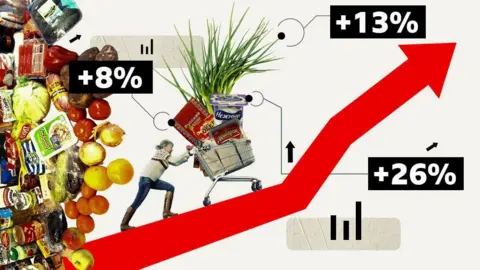
In the course of one month his monthly food budget soared by more than 22% - from 35,000 roubles (£330; $450) to 43,000 (£406; $555).
With Russia's economy hanging somewhere between stagnation and decline, ordinary Russians have begun to feel the pinch from the Kremlin's war on Ukraine, as it approaches its fourth anniversary.
The cost of almost all essentials has gone up in local supermarkets, from eggs and chicken fillets to seasonal vegetables, Alexander has noticed. We have changed the names of everyone we have spoken to for this piece.
Even his daily treat on the way to work - an Americano from a local cafe - has suddenly surged 26% from 230 to 290 roubles.
 Getty Images
Prices have risen steadily in Russia since the beginning of the full-scale invasion in Ukraine, driven by a federal budget dominated by the war effort and defence industry.
This in turn has led to rapid economic growth and raised living standards across the country.
Until now, high levels of inflation have gone largely unnoticed by the general population, especially in the big cities such as Moscow and St Petersburg. Big spending masked the mounting economic consequences of the war, as well as Western sanctions and the exodus of foreign investment from Russia.
That rapid economic growth slowed sharply in 2025, and as salaries could no longer keep up with inflation, rising prices started to hit people's pockets.
Then at the start of 2026, supermarket prices jumped by a sharp 2.3% in less than a month, according to data from Russia's statistics service Rosstat.
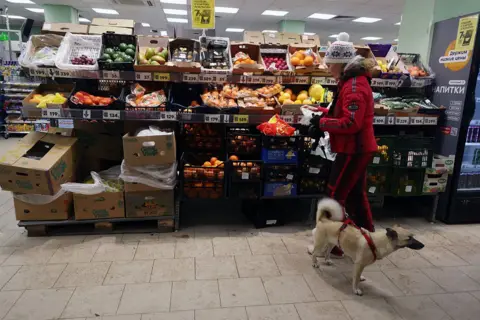
Everything became more expensive at the start of the year: meat, milk, salt, flour, potatoes, pasta, bananas, soap, toothpaste, socks, laundry detergent, and many medicines too.
Average food basket
Every other January since 2019, the BBC has bought the same selection of 59 basic goods from the same supermarket chain, Pyaterochka, in Moscow. The basket includes vegetables and fruits, dairy and meat products, canned goods and instant noodles, sweets and beverages, including beer.
In 2024, the basket cost 7,358 roubles (£63; $83). Last month, it cost 8,724 (£83; $112) roubles - an increase of 18.6%.
That tallies with Rosstat's own 18.1% measure of overall accumulated food inflation from January 2024 to the end of January 2026.
One of the most noticeable price increases in our basket has been a hike of almost 15% in the cost of fruit and vegetables since 2024.
Russia relies on imported fruit and vegetables, so store prices are highly sensitive to fluctuations in the rouble exchange rate and disruptions in the supply chain. Both occurred after the beginning of the war in Ukraine.
At the same time, the price of dairy products - which tend to be locally produced - has soared 41%, the biggest rise in our sample basket in the last two years. This is because Russia's dairy industry has been hit by rising farm costs, expensive loans and staff shortages.
Rising taxes and changing habits
The most recent factor influencing price rises is a two-point increase in VAT from 20% to 22% since 1 January.
The sales tax hike is directly related to the war in Ukraine, as Russia's finance ministry said it was needed to finance the country's "defence and security".
 Getty Images
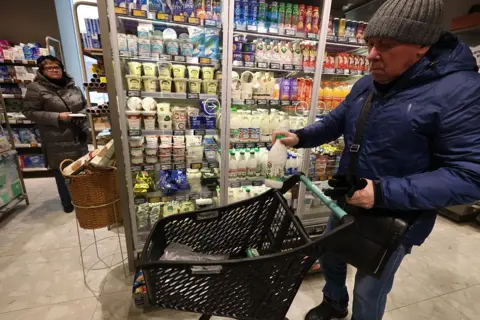
While Alexander from Moscow told the BBC he was not going to change his eating habits, others say rising food prices have hit their diets and family budgets significantly.
Nadezhda, 68, says she can no longer afford to buy beef and has resorted to cheap varieties of fish.
She and her husband, who are both retired, live in Moscow on their state pensions and his additional income. Nadezhda says her entire monthly pension of almost 32,000 roubles (£302; $413) now goes on food.
That means other expenses have been put on hold.
They had been saving to fix their car, but recently had to rely on savings to pay for food. Similarly, buying a new winter jacket for Nadezhda's husband, which would have cost about 17,000 roubles (£160; $220), will have to wait until next year.
Kristina, a Moscow marketing specialist in her mid-40s, also had dig into her savings to buy food last month. She lives with her husband, who is a personal trainer, and says she has started paying attention to discounts and has noticed others in supermarkets doing so as well.
"Now I take a very pragmatic approach: not what I want or don't want to eat, but how much protein is in 100 grams of this product," Kristina says.
She and her husband can no longer afford to eat out, but even when cooking at home, the price of a dinner for two has more than doubled - from around 1,000 roubles (£9.46; $12.92) to more than 2,000 roubles (£18.91; $25.85).
In summer 2025, Russia's Central Bank Governor Elvira Nabiullina said that the economy was close to a "scenario of balanced rates of economic growth".
However, some economists suggest that after slowing down significantly last year, the Russian economy is now at risk of going into the red.
One of the main risks this year will come from the oil market.
The federal budget is based on a high oil price, but market rates have fallen since the start of this year and there is no expectation of any imminent rise.
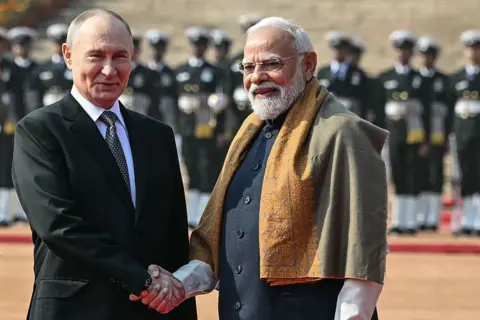
Russian oil sales have also been hit by latest US sanctions that have cut off supplies to one of Moscow's main trading partners, India.
As a result, Russian authorities are likely to face a bigger budget deficit than they had planned.
 Getty Images
Borrowing is difficult due to high interest rates - few are willing to lend to a country currently waging war and with a reputation for being unreliable.
That could mean further unpopular measures - either further tax rises, which would hurt people and businesses, or cutting budget spending, primarily in the public sector. That would slow down the economy and bring down household incomes further.
"Overall, there is a trend towards stagnation and a possible decline in GDP," Tatiana Mikhailova, an economist and visiting assistant professor at Penn State University, told the BBC.
For the moment nothing indicates the economy is in decline, but she believes there is a high likelihood of it happening.
"Every time oil prices fall, a recession is possible in Russia," she says, even if she believes the economy can carry on without growth for some time.
That may be of little comfort to ordinary Russians, who will still feel the effects in their pockets.