Bernd Debusmann JrWhite House reporter

 Getty Images
It was May 1999, and US Army sergeant Andrew Ramirez had been held captive for over a month by Yugoslav forces, enduring days of dark confinement and interrogations.
Just a few weeks earlier, Ramirez and two other soldiers had been on a routine patrol near the Macedonian-Yugoslav border during the war in nearby Kosovo when they unexpectedly bumped into enemy forces and surrendered after a brief firefight.
From captivity, Ramirez had little idea that a behind-the-scenes effort was underway to secure the release of the three US prisoners, he told the BBC in an interview.
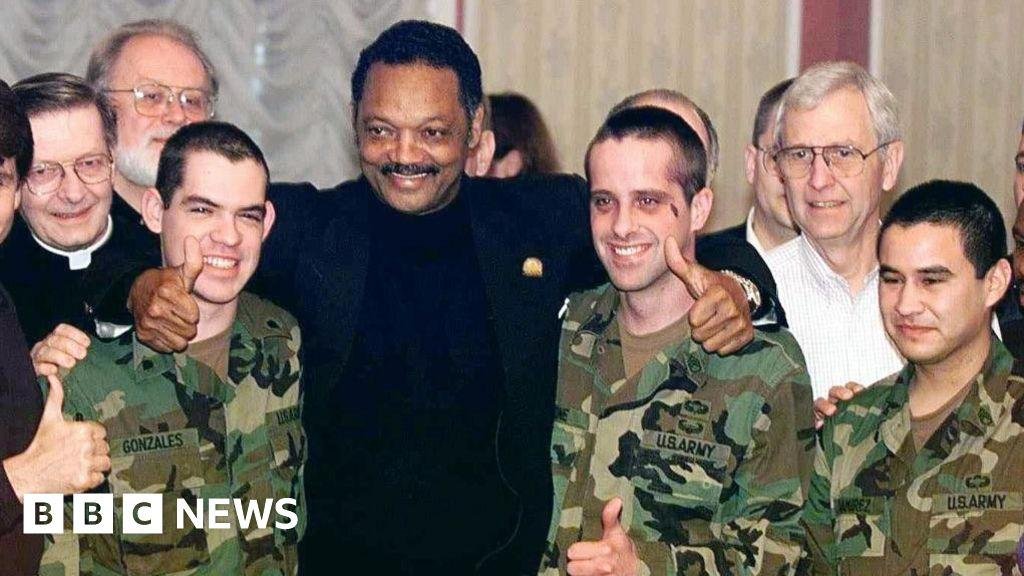
Leading that effort - against the wishes of the White House - was Reverend Jesse Jackson, who died aged 84 on Tuesday.
At the time of Ramirez's capture, Nato forces, led by the US, were just days into a massive air campaign aimed at forcing the Yugoslav government of then Serbian leader Slobodan Milosevic to withdraw from Kosovo.
Jackson, then 57, already had a history of what some termed "private diplomacy" aimed at helping Americans abroad.
This included the 1984 release of a US Navy pilot captured by Syrian forces after being downed in Lebanon, the release of 22 Americans held prisoner in Cuba and the release of US citizens held by the Iraqi government in the build-up to the first Gulf War.
But in early 1999, the Clinton administration was against the idea of Jackson's involvement, quietly warning him that the bombs would continue falling even if he went ahead.
At the same time, the Yugoslav government was making overtures to Illinois Representative - and later Governor - Rod Blagojevich, then the only Serbian-American in Congress.
"The state department wouldn't allow me to go. I was just a junior congressman," Blagojevich recalled to the BBC in an interview.
But at the suggestion of political consultant David Axelrod, later a senior adviser to former President Barack Obama, Blagojevich teamed up with Jackson, first reaching out through his son Jesse Jr.
"Jackson refused to come unless he got access to see our soldiers. What I was able to do was get a guarantee from the government there," Blagojevich said. "We were warned not to go because it was dangerous."
In late April, Jackson, along with Blagojevich and a multi-faith delegation, flew to Belgrade, meeting directly with Milosovic himself in the hope of brokering a release.
"I had to convince him of what his options were," Jackson later told the Associated Press. "One of the failures of war is a failure of diplomacy, communication and trust."
Ramirez and the other two soldiers, Sergeant Christopher Stone and Specialist Steven Gonzales, did not know this was taking place.
"Without any explanation [the Yugoslavs] came and got us. They walked us out, handcuffed and everything, to a room. I saw CNN cameras and some other news agencies," Ramirez said.
"And there was Reverend Jesse Jackson," he added. "We had no knowledge, and no idea what was going on. I later joked to him that I thought the place was crazy - they even got Reverend Jackson captive!"
Behind the scenes, negotiations were still tense.
"It was a frenetic three of four days," Blagojevich added. "Milosovic originally offered to let him take one or two of the soldiers back. Jackson was steadfast. He said we're not going to just take one or two. We take either all of them or none of them."
"Jesse Jackson was the central figure," the former Illinois representative added."I was basically just a guy carrying his bags."
The Yugoslavs relented. The soldiers were released on 1 May and crossed into Croatia with Jackson and his delegation on 2 May before being flown to a US base in Germany.
"[Jackson] was very confident," Ramirez remembers of their initial encounters. "He said he wouldn't leave without us, and that our families in the United States were rooting for us. He wanted to make sure we knew he was going home with us."
Ramirez left the Army about a year after the release, moving back to his native California. He kept in touch with Jackson, flying out to Chicago to introduce him to his newborn son and occasionally seeing him at events around the country.
He was "heartbroken" to hear that the man who secured his released has died.
"He did something for us. He didn't have to do that," Ramirez added. "I truly believe he did it because he saw somebody in need and thought he could intervene. He did it for us and for our families. We're forever appreciative of him."