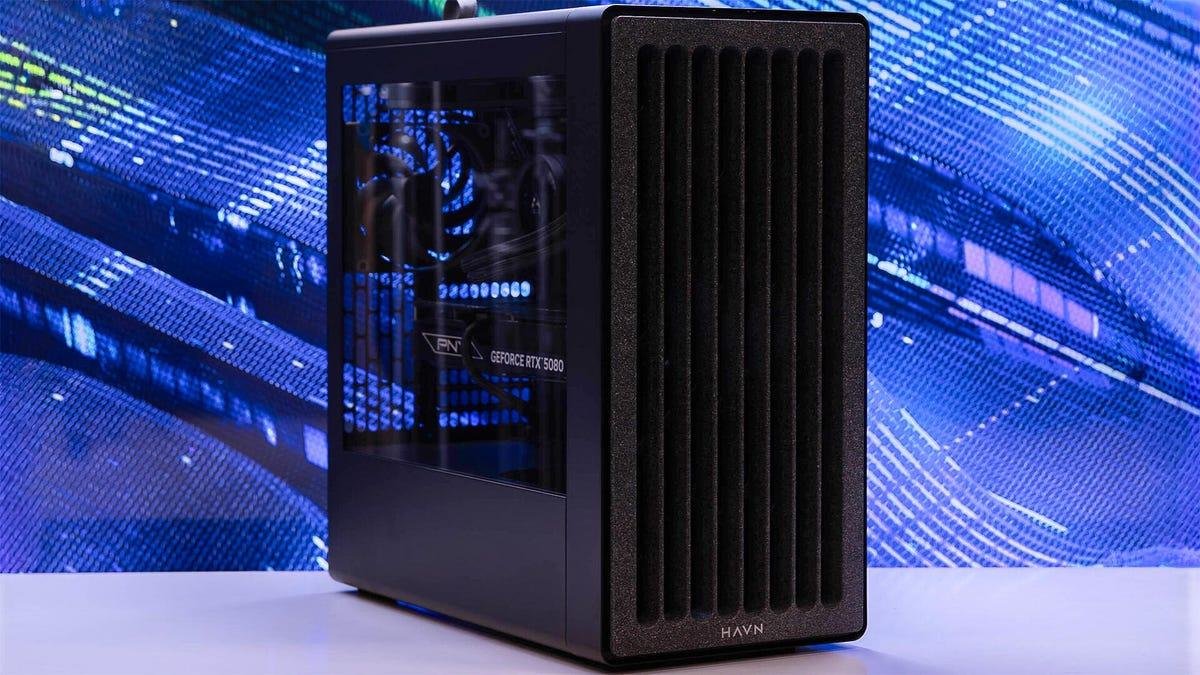

Starforge Explorer III Pro
Pros
- Excellent performance all around
- Solid connectivity
- Plenty of upgrade options
- Effective cooling with good dust filtration
Cons
- Very large case
- Audible fans
Prebuilt gaming PCs come in a couple of flavors. One flavor is those from big PC makers like Dell, HP and Lenovo. Their approach is typically unique cases and a lot of custom parts. Another flavor is PCs from boutique builders who combine off-the-shelf parts, sometimes paired with a custom-designed case. The Starforge Explorer III Pro is definitely that latter flavor, relying entirely on components you could buy yourself. While systems from boutique builders tend to have a price premium, the Explorer III Pro is competitive not just with big-name options but also compared with building it yourself using similar components.
The Explorer III Pro has a high-end configuration for its $3,900 price and packs its components comfortably in a massive case. Cable management and airflow are all well done, and the system has an elegance not just for its lack of gaudy RGB, but also for its consistent black color scheme. Pulling all of this off in a smaller case would have been a bit more impressive, but as it is, the Explorer III Pro delivers strong performance and value with very few compromises.
Starforge Explorer III Pro
| Price as reviewed | $3,900 |
|---|---|
| Size | 68 liter (20.27 x 10 x 20.57 in/515 x 254 x 522 mm) |
| Motherboard | MSI MAG Z890 Tomahawk WiFi |
| CPU | 3900MHz Intel Core Ultra 7 265K |
| Memory | 64GB DDR5-6000 |
| Graphics | Nvidia RTX 5080 |
| Storage | 2TB NVMe M.2 PCIe Gen 4 SSD (boot) (T-Force TM8FFW002T) |
| Networking | 5GbE, Killer Wi-Fi 7 BE1750x 802.11be, Bluetooth 5.4 |
| Connections | Thunderbolt 4 (x2 rear), USB 3.2 Gen 2 Type-C (x1 front, x1 rear), USB 3.2 Gen 2 Type-A (x3 rear), USB 3.2 Gen 1 Type-A (x2 front, x4 rear), USB 2.0 (x4 rear), 3.5mm audio connector (x1 front, x2 rear), SPDIF, 5Gb Ethernet, HDMI 2.1 FRL (x1 on motherboard, x1 on GPU), DisplayPort 2.1b (x3 on GPU) |
| Operating system | Windows 11 Pro |
The Starforge Explorer III Pro comes in three configurations: Core, Pro (tested here) and Elite. All three feature similar cooling hardware with a Havn BF 360 Flow case, six total case fans, a 360mm Arctic Liquid Freezer II 360 AIO CPU cooler, MSI Z890 Tomahawk Wi-Fi motherboard and Windows 11 Pro.
The Core model starts at $3,300 and has an Intel Core Ultra 7 265K processor, 32GB of DDR5 memory, 1TB of storage and an RTX 5070 Ti GPU. The Pro model tested here raises the price to $3,900. For the extra money, you get double the memory and storage and an RTX 5080 GPU. Both of these configurations feature an MSI MAG A850GL PCIe 5 power supply. The Elite tier is $6,000. It adds a second 2TB drive, swaps to an MSI MAG A1000G PCIe 5 power supply and steps up to an Intel Core Ultra 9 285K processor and 32GB RTX 5090 graphics card.
Starforge's pricing is on the reasonable side, reaching only a ~$500 markup over the cost of building the same system yourself with the same components. A big part of the system cost is coming from the recently ramped-up RAM prices, with the Teamgroup T-Create memory used here hitting $749 at the time of writing, where it had historically been under $200 according to CamelCamelCamel. Impressively, at the time of writing, the Explorer III Pro was even on sale for $3,200, making it less expensive than the DIY alternative.
A pack leader
The Starforge Explorer III Pro offers excellent performance, though that should come as no surprise given the hardware it's packing. The Intel Core Ultra 7 265K receives more than adequate cooling from the 360mm radiator, and the RTX 5080 isn't starving for power or fresh air either, with neither experiencing thermal throttling during a 3DMark stress test. The CPU racked up impressive numbers throughout our testing with strong single-core and multicore scores in Geekbench 6 and Cinebench R24, even nipping at the heels of the Intel Core Ultra 9 285K inside the Lenovo Legion Tower 7i Gen 10 and Alienware Area-51 desktops, both of which are more expensive.
Graphical performance is also exceptional. The Starforge Explorer III Pro achieves the best 3DMark scores we've seen yet from a prebuilt system running an RTX 5080, beating all its rivals in the Time Spy, Steel Nomad, Fire Strike Ultra and Speedway tests. While it was generally by narrow margins, it's worth reiterating that the III Pro is faster while being the more affordable system.
Not surprisingly, that translates well to gaming performance. The Explorer III Pro showed it was more than up to the task of 1080p and 4K gaming. It ran Shadow of the Tomb Raider at 251 frames per second in 1080p with graphics settings maxed, and it pulled off just shy of 200fps for Guardians of the Galaxy at High settings. Even Assassin's Creed: Shadows, with no DLSS or frame gen, ran at 82fps with High settings and full ray-tracing features enabled. At 4K, it maintained triple-digit performance nearly across the board, with the exception of Assassin's Creed: Shadows, where it still managed 45fps. Enabling DLSS and frame gen can help get you even more frames, if you want them. With the game set to 4K and at its highest graphics preset, I was able to play the game's opening section at well over 60fps using DLSS Balanced.
While its performance is strong all around, it's not quite the overall performance king. Opting for an Intel CPU has general benefits, but with games, AMD has an advantage. Next to the Velocity Micro Raptor Z95A running an AMD Ryzen 7 9800X3D and RTX 5080, the Starforge Explorer III Pro can fall behind considerably at 1080p. Even with its graphics card leading in 3DMark for the most part, they nearly tie at 4K. For the most competitive gamers, an AMD option will still be an advantage.
All that said, the Starforge Explorer III Pro is formidable. Even its SSD is a high-tier PCIe 4.0 model that makes good use of its bandwidth. Considering that Starforge's asking price is lower than most of its competitors while delivering as much or more performance, it's a strong option, to say the least.
Its only fault is its size
The Starforge Explorer III Pro comes cleanly built, though that's not a terribly impressive feat given that Starforge is working within the "constraints" of a huge 68-liter tower case. The case is a Havn BF 360 Flow, which is ready for the massive graphics cards of today, as well as whatever unthinkably large models might come in the future. It supports up to 277mm E-ATX motherboards, 195mm tower coolers and graphics cards measuring 410mm long and 4.5-slots thick.
For all its bulk, the case has its pluses. The front has a pair of large, 180mm fans that move air quietly. These sit behind an easily removable grille with a fine mesh filter. The filter doesn't separate from the grille, but the whole section can be vacuumed or even rinsed for easy cleaning. The top of the case features similar dust filtration, albeit without the easily removable panel.
The top fan blows air down toward the graphics card and past the CPU's own fan and radiator, getting pulled out the back of the case by the rear 360mm fan. A second intake fan blows toward the PSU shroud, which has a clever scoop to redirect that air right into the graphics card's fans, giving them both fresh air, which is then exhausted out the back. Even though this setup includes four exhaust fans and only two intakes, the high airflow of the two front fans should still be able to create positive pressure.
The system has a classy, subdued vibe. Both inside and out, it's largely an all black affair. Almost everything, from the fans and PCBs to the heatsinks and cables, is black. There are just a few accents here and there, like a light metallic accent on the I/O shield and a granite-like pattern on the front grille. There's no RGB lighting. Pretty much no lighting at all, actually. The motherboard has an error code LCD that can also display CPU temps, but that's it.
Cable runs inside are tidy, only going a short distance where they're visible through the glass side panel. One run for the CPU water pump is even held flush against the motherboard, though it skims along the edge of the RAM slots tight enough that it would press up against a RAM module if all four slots were filled. The cable runs behind the motherboard are tidy too, though it's a bit of a rat's nest right where the cables come out of the power supply.
With such bulk, there's naturally some room for expansion. Memory and storage are easy upgrades. There are three extra M.2 slots on the motherboard and four SATA ports. Behind the metal side panel, the case includes two 3.5-inch drive bays with adapter trays that can each support two 2.5-inch drives, letting you run up to four 2.5-inch drives total. There are also two additional PCIe x16-length slots, though a large card in one of these would get in the way of the graphics card's fans, and the other has space only for a slim card.
With a total of nine fans in the system, including the graphics card's, the Explorer III Pro can be a little noisy. At idle, you can faintly hear its fans, and under a heavy load, the fans manage to make a bit more noise. They're not loud or shrill, but are a relatively steady low-pitch hum.
The system also offers plenty of ports. You get two USB-A and a USB-C up front alongside a headset jack. Meanwhile, the motherboard comes with a host of extra ports, including two Thunderbolt 4. However, though the motherboard supports 20Gbps USB-C for the front I/O, the case's port is limited to 10Gbps.
Overall, the Starforge Explorer III Pro offers impressive performance at a great price, assuming you've got the space for it under (or on) your desk.
Geekbench 6 (single core)
Minisforum AtomMan G7 Ti 2,833Dell XPS 8960 2,948Lenovo Legion Tower 7i Gen 8 34IRZ8 3,062Alienware Area-51 3,149Starforge Explorer III Pro 3,205Velocity Micro Raptor Z95A 3,303Corsair Vengeance A7500 Air 3,382
Cinebench 2024 CPU (multicore)
Velocity Micro Raptor Z95A 1,321Minisforum AtomMan G7 Ti 1,431Dell XPS 8960 1,554Alienware Aurora R16 1,806Starforge Explorer III Pro 2,047Alienware Area-51 2,313Corsair Vengeance A7500 Air 2,256
Shadow of the Tomb Raider gaming test (1080p)
HP Omen 35L 174Alienware Aurora R16 226Alienware Area-51 248Dell XPS 8960 250Starforge Explorer III Pro 251Velocity Micro Raptor Z95A 362Corsair Vengeance A7500 Air 397
Guardians of the Galaxy gaming test (4K)
HP Omen 35L 139Alienware Area-51 177Velocity Micro Raptor Z95A 187Starforge Explorer III Pro 196Corsair Vengeance A7500 Air 263
3DMark Fire Strike Ultra
HP Omen 35L 16,426Dell XPS 8960 17,525Alienware Area-51 21,463Velocity Micro Raptor Z95A 21,665Starforge Explorer III Pro 22,030Corsair Vengeance A7500 Air 33,075
3DMark Speed Way (DX12 Ultimate)
Lenovo Legion Tower 7i Gen 8 34IRZ8 7,425Dell XPS 8960 7,520Alienware Area-51 8,717Velocity Micro Raptor Z95A 9,009Starforge Explorer III Pro 9,150Corsair Vengeance A7500 Air 14,536
The Rift Breaker CPU (1080p)
Alienware Aurora R16 163Alienware Area-51 166Starforge Explorer III Pro 174Lenovo Legion Tower 7i Gen 8 34IRZ8 184Dell XPS 8960 202Corsair Vengeance A7500 Air 254Velocity Micro Raptor Z95A 268
The Rift Breaker CPU (1080p)
Alienware Aurora R16 163Alienware Area-51 166Lenovo Legion Tower 7i Gen 8 34IRZ8 184Dell XPS 8960 202Corsair Vengeance A7500 Air 254Velocity Micro Raptor Z95A 268Starforge Explorer III Pro 273
Configurations
| Alienware Area-51 | Microsoft Windows 11 Pro; 3.7GHz Intel Core Ultra 9 285K; 64GB DDR5-6400; 16GB Nvidia GeForce RTX 5080 graphics; 2TB SSD |
|---|---|
| Alienware Aurora R16 | Microsoft Windows Pro; 3.2GHz; 3.2GHz Intel Core i9-14900KF; 32GB DDR5 5,600MHz RAM; 12GB Nvidia RTX 4070 graphics; 1TB SSD |
| Dell XPS 8960 | Microsoft Windows 11 Home;3.4GHz Intel Core i714700K; 21GB DDR5 RAM; 16GB Nvidia RTX 4080 Super graphics; 1TB SSD |
| Corsair Vengeance A7500 Air | Microsoft Windows 11 Home; 4.4Ghz AMD Ryzen 9 9950X3D; 64GB DDR5-4800 RAM; Nvidia RTX 5090 graphics; 2TB Corsair MP700 Elite (boot drive); 2TB Corsair MP600 Core XT |
| HP Omen 35L | Microsoft Windows 11 Pro; 4.2GHz AMD Ryzen 7 8700G; 64GB DDR5 3,600MHz; 16GB Nvidia RTX 4080 Super graphics; 2TB SSD + 1TB SSD |
| Lenovo Legion Tower 7i Gen 8 34IRZ8 | Microsoft Windows 11 Home; 3.2GHz Intel Core i9-14900KF; 32GB DDR5 4,400MHz RAM; 16GB Nvidia RTX 4080 Super graphics; 1TB SSD |
| Minisforum AtomMan G7 Ti | Microsoft Windows 11 Home; 2.2GHz Intel Core i9-14900HX; 32GB DDR5 5,600MHz RAM; 8GB Nvidia RTX 4070 graphics; 1TB SSD |
| Starforge Explorer III Pro | Microsoft Windows 11 Home; 3.9GHz Intel Core Ultra 7 265K; 64GB DDR5-6000; Nvidia RTX 5080 GPU; 2TB NVMe M.2 PCIe Gen 4 SSD |
| Velocity Micro Raptor Z95A | Microsoft Windows 11 Home; 2.5GHz AMD Ryzen 7 9800X3D; 64GB DDR5 RAM; 16GB Nvidia GeForce RTX 5080 graphics; 2TB SSD |