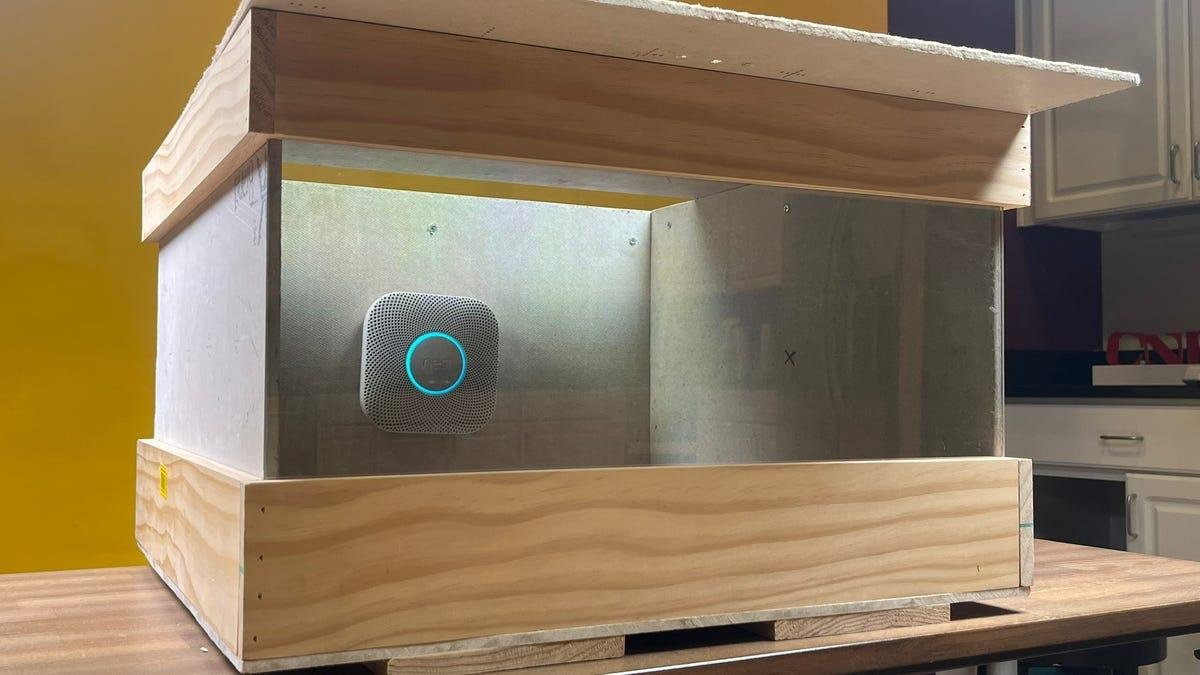
Properly installed smoke detectors are often the first line of defense against a house fire, keeping the homeowner informed and ready to take action. However, it's important that the smoke detector you've bought is efficient and reliable. To find the best options, I simulated house fire smoke to test over a dozen smoke detectors and narrowed it down to five that earned my seal of recommendation.
INDOOR SECURITY CAMERA DEALS OF THE WEEK
Deals are selected by the CNET Group commerce team, and may be unrelated to this article.
What is the best smoke detector?
Kidde's latest smoke detectors combine common sense and extra-smart features.
KiddeAfter days of testing, the best smoke detector in 2026 proved to be Kidde smart smoke detector. It builds on the excellent performance of previous Kidde devices while adding new smart features -- but it doesn’t force you to use the app if you’d rather not. I’ve also picked the best detectors for Nest users, Ring fans, home security setups and more -- so be sure to check out the full list.
Best smoke detectors of 2026
Pros
- Kidde alerts were very fast in our testing
- Well-designed sensor made to avoid false alerts like cooking smoke
- App support for a variety of remote alerts and management
- Wi-Fi options available but not required
Cons
- Expensive for a detector at $75
- No Alexa or Google Home support, only the Kidde app
Throughout our testing we found Kidde smoke detectors to perform especially well when it comes to fast smoke detection. This model has Kidde's excellent photoelectric sensor, designed to ignore fake fire signs like a bit of smoke from cooking, combined with a carbon monoxide sensor to get the best of both worlds.
We also chose this model as our top choice because it offers helpful features and the choice to use app alerts, but not a requirement. You can stick with LED indicators, voice alarms and the 85-decibel alarm if you want to. Or you can enable Wi-Fi features for app alerts for smoke, fire or carbon monoxide, plus battery warnings and other useful info.
There's no voice assistant compatibility here since Kidde is focusing on its own app, but I have another model for with more advanced smart support below if you're interested.
Finally, we chose the hardwired version of this model because so many states required hardwired smoke alarms in certain places, so it's an easy way to meet fire standards.
Pros
- Full Google Nest integration
- Dual sensors for smoke and carbon monoxide
- 6-battery design allows for placement anywhere
- A variety of app alert options
- Sensors designed to reduce false alarms
Cons
- A battery alarm may not be enough if your state requires hardwired alarms in certain areas
- Expensive at well over $100
We highly approved of the Google Nest Protect detector in our testing, but there's a problem. Google has officially discontinued the Nest Protect, and while support should still continue for years, we don't feel comfortable recommending it for this specific list. However, there is an alternative: The new partnership between Nest and First Alert, leading to the newly released First Alert smoke and carbon monoxide alarm with Nest Protect.
The battery detector can be placed nearly anywhere and includes full support for Google Home as well as First Alert's own app. First Alert is another company that has performed very well in our testing. This model augments those sharp sensors with voice alerts, low-battery app alerts and tech to reduce false alarms.
Pros
- Built-in Ring and Alexa compatibility
- Phone alerts for smoke detection, low battery and more
- End of life warning alerts
- Voice alerts
- Hardwired and battery models available
Cons
- You won't find any Google support here
Thanks to a recent partnership with Ring, Kidde is now also offering smart thermostats that are specifically designed to work with the Ring app. They can integrate with Ring security systems, but you don't need one to fully utilize this smart detector. And we like Ring's UI and alerts better than Kidde's app, so that's a score for usability, too.
The model combines Kidde's well-scored sensors with Ring technology that supports a wide variety of alerts and real-time notifications to keep you updated no matter where you are. And there's a separate Ring plan you can add specific for professional fire response if you don't mind a subscription.
Since Ring technology is included, it's no surprise that the detector works well with Alexa, too. Without the apps, you still get voice alerts. We chose the hardwired version here, but there's a battery model, too.
Pros
- Very affordable at under $20
- Easy installation
- Can detect smoke in specific areas like near fireplaces, garages, etc.
Cons
- Battery power doesn't work for some purposes depending on building codes
- Detection speed slightly worse than some brands like Kidde
- No smart features
First Alert's sensors have performed very well in our lab tests in the past, detecting a fire in less than 23 seconds and smoldering smoke in less than 34 seconds. I chose this particular model because of its low price: At under $20 it's incredibly affordable, and as a battery model it can go nearly anywhere.
The downside is that you don't get any smart features with this detector, and since it's a battery model, it won't satisfy most building codes. But it's a strong choice for extra protection in spots like the garage and near an oven or fireplace.
Pros
- Integrates with DIY security system
- Easy setup with wireless design and SimpliSafe app
- Option for professional monitoring but not required
- Great for first-time security users
Cons
- No other smart home or voice assistant integrations beyond the SimpliSafe app
If you aren't a fan of Ring and are more interested in DIY security systems that don't require a subscription or high fees to get good results, we chose this SimpliSafe smoke detector specifically for those who want to handle everything on their own.
This wireless, battery-powered detector is part of the SimpliSafe app, giving you one place to get both security and fire alerts. You can upgrade to connect it to professional monitoring if you want to pay for it, but it's not necessary. If you want to get a home security system that includes smoke detection at an affordable price, this is what we recommend starting with.
Our smoke detection test chamber lets us test how quickly each model raises an alarm when smoke enters the environment.
Gianmarco Chumbe/CNETWhen it comes to detecting smoke, time is of the essence. That is why we designed a test that simulates a real-life emergency.
The first thing to know is that there are two main types of fires that these products are designed for: smoldering fires and flaming fires.
A smoldering (or slow-burning) fire refers to the combustion that occurs at the surface of a solid material. Smoldering fires produce large amounts of thick smoke but can't sustain a flame. Think of a cigarette slowly burning but never actually bursting into flames.
A smoldering fire can and will become a flaming fire if proper action is not taken immediately.
Flaming fires are the ones we're more familiar with, and they usually arise from the ignition of any flammable material, such as a flammable substance, wood, paper, etc. These generally produce less smoke than a smoldering fire but are more destructive.
In my backyard, I built a chamber that houses the smoke detector and fed to it the two different types of smoke through a chimney. I timed the quickness of the response. The faster the smoke detectors' alarm was triggered, the better.
Smoke detection testing in progress.
Gianmarco Chumbe/CNETTo simulate smoke coming from a smoldering fire, I ignited 300g of charcoal and let it heat up for 10 minutes before feeding the smoke. I wanted to make sure most of the coals were ignited and that the smoke was thick enough to trigger the alarm.
Recreating a flaming fire was easy, just 30g of shredded paper did the trick. Again, I ensured a significant amount of smoke was present before feeding it through the chimney and into the chamber.
To the great discomfort of my neighbors, who had to endure smoke alarms going off randomly, and to whom I sincerely apologize, I repeated the whole process three times per smoke detector model under test and per type of smoke, totaling six test runs per smoke detector. Finally, I averaged the response times.
Kidde's voice alert detector is a great option for people who want to stay away from apps.
KiddeKidde Dual Sensor Smoke Detector PI9010: While this detector was at the height of our list for some time, sensor concerns had Kidde recall it even as the company pushed toward more high-tech products. We can't recommend this detector anymore, nor can you find it anywhere despite it's excellent responses in our tests.
Kidde Firex Smoke Alarm i4618AC Ionization Sensor (Update: Out of Stock): As expected from an ionization detector, it had the best performance detecting a fast-flaming fire in just 16.9 seconds, and the second-best score detecting a slow-smoldering fire, in 28.1 seconds. As a former budget pick, we removed it form out best list because its been out of stock for some time.
Kidde Smoke Alarm 20SD10-V: Although we have not tested the Kidde Smoke Alarm 20SD10-V yet, we felt it was worth mentioning as an available product because it has a strong hardwired option. Some states and new construction require your smoke detector to be hardwired along with a battery backup. This smoke alarm by Kidde not only has a hard wiring option it also stands out for its easy installation and reliable operation. The 10-year battery backup and associated warranty should be enough to meet any residential requirements. There's also an easy-access hush button in case the alarm does sound off unnecessarily. It can also connect with other compatible Kidde alarms for simultaneous alerts.
Kidde Firex PI2010 Hardwired Dual Sensor Smoke Detector (Update: Out of Stock): Lowest overall performance detecting a slow-smoldering fire, taking 83 seconds. Second-lowest performance detecting a fast-flaming fire, in 27.9 seconds. The device needs to be hardwired, but it comes with a 9-volt battery as backup.
Onelink Battery Powered Smart Smoke and Carbon Monoxide Detector by First Alert (Update: Out of Stock): This model looked great at first: App-controlled, useful smart features and the ability to pair up with other smart home security devices make it a strong contender for the best for smart home. It did not impress us in the smoke detection test. It had the lowest performance detecting a fast-flaming fire and the second-lowest performance detecting a slow-smoldering fire, taking almost twice as long as the Nest.
A look at the interior of CNET's carbon monoxide detector.
Gianmarco Chumbe/CNETPower source
Battery smoke detectors are incredibly easy to place, but there’s a problem: Local fire codes and state requirements often require hardwired smoke alarms in residential buildings, which can create insurance and remodeling headaches. I advise getting hardwired versions when possible to meet state requirements and use battery models for additional protection in other areas.
Battery backups
Battery backups are another common fire code requirement, so it’s a good idea to look at your local codes to see what kind of battery backup you need. You can check your national Fire Alarm and Signaling Code here.
Battery alerts
Many of my picks mute battery beeps and find other ways to let you know when backup batteries are running low. It’s a nice feature, especially when backed up by an app.
Sensor types
Different sensors specialize in different types of heat or particle detection. My top pick has a dual sensor to take advantage of both, as does Google's Spectrum sensor.
Smart home support
Support for Google Home, Alexa or other platforms may be very important for some users, and the added app support is great. This feature can be rare, but is useful for the right homeowners.
Regulatory and certification standards
When picking a smoke detector, it is essential to look for models certified by recognized standards like UL in the US, or CE in Europe. These certifications ensure that the produce has undergone rigorous testing to meet safety and performance regulations, providing reliable protection against fire hazards.
If your home security system supports smoke detectors, tap into this compatibility.
SimpliSafeSpring 2026: After our latest rounds of testing we did a massive overhaul of our list, replacing almost every product with new models. This allowed us to include major smoke detector developments, like the new partnerships between Kidde and Ring as well as Nest and First Alert, which herald a new era in home smoke detectors. We also added a DIY SimpliSafe detector that makes a good option for those who want to adopt a security system and a smoke detector at the same time. Finally, our top pick receive an overhaul as Kidde has updated its own smart line of detectors.
Are there different types of smoke detectors?
Smoke detectors use various smoke-detecting mechanisms: photoelectric sensors, ionization sensors or a combination of the two, called "dual sensors." We don't need to go too deeply into the science behind them, but it's helpful to know that the main difference between the two is their ability to detect different types of smoke.
For instance, a smoke detector that has a photoelectric sensor is better at detecting slow-smoldering fires, while a smoke detector that has an ionization sensor will be better at detecting fast-flaming ones. Plenty of "combo" or "dual sensor" smoke detectors feature both mechanisms, so you don't have to worry about either eventuality.
My smoke detector goes off, but there's no smoke?
Some smoke detectors, like dual-sensors, and especially ionization detectors, are designed to sense disruptions in the circuitry of the device. The ionization sensor is inside a chamber and has two electrically charged plates that ionize air between them. When smoke particles enter the chamber, they occupy the air within the plates, blocking the flow of ions and, consequently, triggering the alarm. Debris, dust, paint, cigarette smoke, dirt and steam particles can also have the same effect. Keep that in mind if you're renovating your home or if you have your smoke detector installed near a kitchen. If you suspect your smoke detector has been contaminated with foreign particles, give it a good cleaning.
How do I clean a smoke detector?
Smoke detectors will have instructions on how to clean the device in the user's manual, but there are a couple of easy fixes you can try if you don't feel like looking for that elusive bit of paper. Grab a handheld vacuum or a vacuum that's equipped with the smallest nozzle piece. Then, simply vacuum every open spot you can find in your smoke detector. If you have an air blower, blow some air in those spots. If you're renovating your home, cover your smoke detector or remove it from the work area to prevent it from going off when no smoke is present.
My smoke detector makes a chirping noise. What's causing it?
Most smoke detectors will produce a low chirping noise, signaling their batteries are getting low or that the unit itself needs replacing. This is a common feature of most smoke detectors but occurs mostly during the night when your home's temperature drops a couple of degrees. If the chirping continues during the day, it may be a sign of something else. Refer to your smoke detector's manual for troubleshooting specific to your smoke detector model. Keep in mind that the average lifespan of a smoke detector is 10 years, so if your detector is close to that, it'd be a good idea to play it safe and replace it.
Which is better, a hardwired or battery smoke detector?
A hardwired smoke detector is generally more reliable since it’s connected directly to your home’s power supply and doesn’t rely on battery life. However, a battery-powered detector offers easier installation and works even during power outages. Both have their pros, but hardwired models are often preferred for long-term reliability.