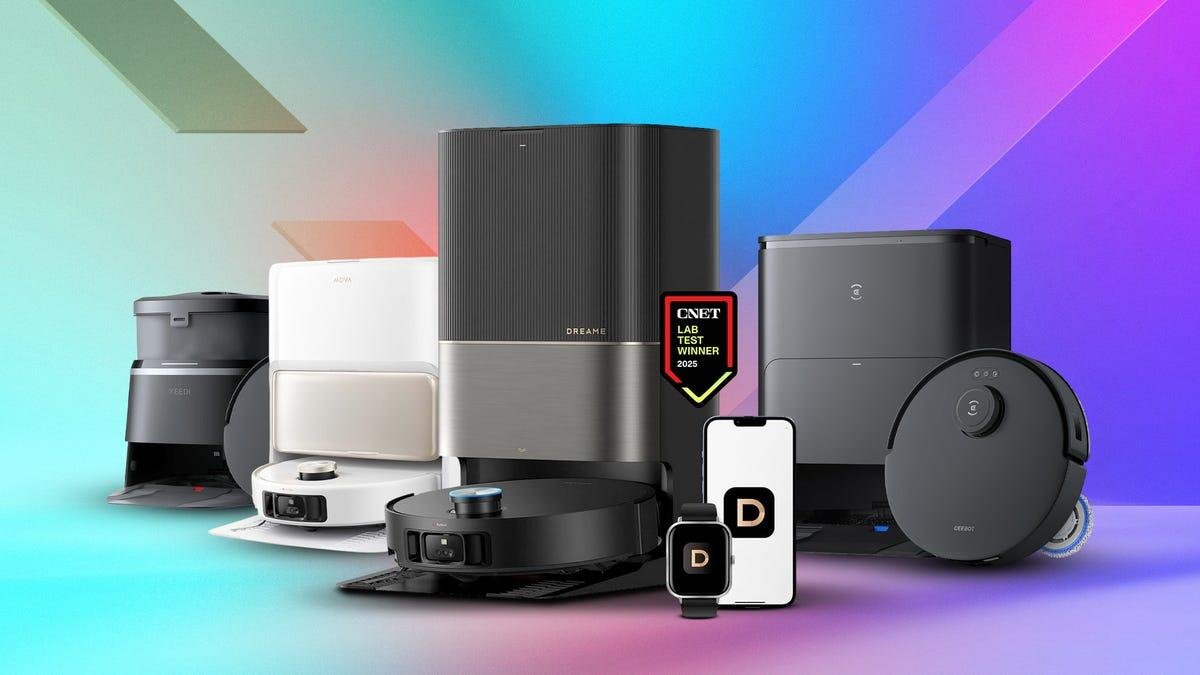
Today's best robot vacuums can map your space, dodge obstacles and even mop for you, so cleaning your home doesn't have to feel like a chore. With CES 2026, wrapped up, we've seen revolutionary changes in the capabilities of robot vacuums. The latest robot vacuums we've seen come with genuine legs and impressive maneuverability, allowing them to climb stairs. We're also seeing great improvements in obstacle-avoidance capabilities, the first carpet-washing robots and even one that can be picked up by a drone.
Pros
- Highest overall average sand pickup (65.14%) and the highest midpile carpet sand pickup (47.54%)
- Moves slowly, which is beneficial for effectively extracting sand from carpet fibers, and has accurate carpet suction boost
- Successfully avoided pet waste, a sock and a pet toy in the obstacle avoidance test
- Cleans well along edges with its pop-out arm and brush roller
- Includes a three-year warranty and a 30-day trial
- Retractable turret to get under furniture and lift system to get over thresholds similar to X50 Ultra
Cons
- Firmware update was time consuming, taking about 20 minutes and failing three times initially
- Initially failed to create a map, though it configured the map after the first cleaning cycle
- Hit three out of six objects despite the intelligent obstacle avoidance setting being turned on
Pros
- Can cross thresholds and obstacles up to 2.36 inches
- Excellent hardwood floor cleaning (98.54%)
- Good obstacle recognition and avoidance with three avoided
- Retractable turret lets it fit under lower furniture
- One of the highest room cleaning coverages at 83.8%
Cons
- Very expensive at $1,600
- Uses 20% of battery life in each cleaning run for 182.8-square-foot room
Pros
- Good price at $479 (we've seen it for $270 on sale)
- Best sand removal on hardwood (99.27%)
- Small robot and base station won't take up too much space
- Can mop and vacuum
- Mechanical paddle helps optimize dustbin space
Cons
- No auto refill water tank
- No mopping settings or customization options in the app
- Only avoided one of six objects
Best for:
The Roborock Saros Z70 is best for homeowners with modern, low-profile furniture who struggle to clean hard-to-reach areas. Because it is designed without a navigational turret on top, it was the only robot vacuum in our testing to successfully pass under our 3.5-inch clearance threshold. It is also a strong choice for homes with complex layouts and high transition strips, as its adjustable chassis allows it to climb over obstacles that trap other bots. The mechanical arm, while a neat feature, is ultimately not what earns it a spot on this list.
Why we recommend it:
While many robots get stuck under couches or beds, the Z70 navigates strategically around chair legs and glides under low gaps to clean where dust bunnies accumulate. In terms of raw cleaning power, it's a capable machine on hard floors, removing 89.05% of sand in our tests. It also posted a very high room coverage score of 83.27%, meaning it doesn't leave many patches of the floor untouched.
Pros
- Best clearance tested; the only robot to pass under 3.5-inch gaps.
- Strong navigational coverage, cleaning 83.27% of the test room.
- Solid hardwood cleaning performance with 89.05% sand removal.
- Chassis lift system prevents it from getting stuck on high thresholds.
Cons
- Extremely expensive at roughly $2,600.
- Terrible pet hair pickup performance in lab testing.
- Average obstacle avoidance, hitting three out of six test objects.
- Struggled to clean midpile carpet thoroughly, leaving zero coverage in some areas on the heat map.
Best for:
The Ecovacs Deebot X8 Pro Omni is a powerhouse best suited for pet owners who struggle with hair wrap but don't have pets prone to accidents inside the house. Its "zero tangle" claim held up in our lab, with the vacuum successfully clearing pet hair from hardwood and low-pile carpet without clogging the brush roll. It's also an excellent choice for homes with low-profile furniture, as its retractable lidar turret allows it to squeeze under 4-inch gaps that would trap standard robot vacuums.
Pros
- Excellent hardwood cleaning performance, removing 97.08% of sand.
- Lab tests showed no hair remaining on hardwood and minimal hair on carpets.
- Its retractable turret lowers to allow the robot to pass under low-clearance furniture (tested on a 4-inch threshold).
- Accurate carpet detection that successfully boosts suction when transitioning from hard floors.
Cons
- Critical safety failure during obstacle avoidance: simulated pet waste got stuck in the main brush.
- Inconsistent midpile carpet performance, ranging from 10.14% to 36.23% across five test runs.
- Navigational room coverage (75.67%) is lower than top-tier competitors like the Dreame X50 or Roomba 205.
VACUUM DEALS OF THE WEEK
Deals are selected by the CNET Group commerce team, and may be unrelated to this article.
The best robot vacuums can handle everything from wet to dry messes across surfaces ranging from carpet to tile -- all without you having to touch a speck of dirt.
CNETTo identify top performers, we completely overhauled our lab testing process and retested a batch of 24 new and old robot vacuums. While we continue to measure sand pickup on hardwood floors, low-pile carpet and midpile carpet, we measure debris pickup differently. We also use heat mapping to check how thoroughly each vacuum cleans, monitor noise levels and test obstacle avoidance with everyday hazards such as pet messes.
What is the best overall robot vacuum?
Our new best overall robot vacuum is a newcomer: the Mova V50 Ultra Complete. This robot from a Dreame sub-brand scored the highest average pickup across different surfaces, with the best sand pickup score and best midpile carpet performance, earning it the Lab Award for the best pickup performance. It also has excellent cleaning coverage and decent obstacle avoidance, but the slightly older Dreame X50 Ultra earned our first-ever lab award for the best cleaning coverage, tackling 83.8% of our test room.
On the more affordable end, the Roomba DustCompactor 205 retained its spot from our previous tests, earning the best score on hardwood floors while costing under $500. iRobot is currently recovering from a bankruptcy and acquisition after being acquired by Picea, its manufacturing partner, but the company has assured us that its existing product lines will continue to be supported.
A note about Editors' Choice and Lab Award picks
After a thorough evaluation of test scores and other factors, we award the best robot vacuums an Editors' Choice or a lab award in a particular category, such as cleaning coverage. However, it's not always the highest-scoring robot vacuum that gets the award. For instance, our current winner for cleaning coverage, the Dreame X50 Ultra, gets 83.8% in cleaning coverage, but it's slightly outperformed by the Roomba 705 Max (86.36%). The reason the 705 Max doesn't make the cut is that it has significantly lower scores in midpile carpet pickup and object avoidance, so it doesn't earn a spot on our main list. The product that earns a lab award is one we wholeheartedly recommend without a significant compromise in one area. In this case, that's the Dreame X50 Ultra.
Best seven robot vacuums of 2026
Pros
- Highest overall average sand pickup (65.14%) and the highest midpile carpet sand pickup (47.54%)
- Moves slowly, which is beneficial for effectively extracting sand from carpet fibers, and has accurate carpet suction boost
- Successfully avoided pet waste, a sock and a pet toy in the obstacle avoidance test
- Cleans well along edges with its pop-out arm and brush roller
- Includes a three-year warranty and a 30-day trial
- Retractable turret to get under furniture and lift system to get over thresholds similar to X50 Ultra
Cons
- Firmware update was time consuming, taking about 20 minutes and failing three times initially
- Initially failed to create a map, though it configured the map after the first cleaning cycle
- Hit three out of six objects despite the intelligent obstacle avoidance setting being turned on
Best for:
The Mova V50 Ultra Complete is best for those seeking the strongest overall cleaning performance across flooring types. Its 65.14% sand pickup score across flooring types was the highest we saw in this batch of 24 robot vacuums. Homes with primarily midpile or plush carpets will also benefit from using it. The sand pickup test on midpile carpet was unprecedented, scoring 47.54%, which is 86% better than the runner-up. It's also suitable for people who value a lightweight base station for easy transport and a robot vacuum with a sleek design and good edge cleaning capabilities. All this earns it our Editors' Choice.
Why we recommend it:
We recommend the Mova V50 Ultra Complete because it offers exceptional cleaning performance where it matters most: extracting sand from carpets, with the highest overall average sand pickup score of 65.14%. It also excelled at low-pile carpet, coming just shy of the Eureka J15 Pro Ultra at 60.29% pickup.
It offers the third-best area coverage we've tested, with 80.78% area coverage in our test room, putting it just under the Dreame X50 Ultra and Roomba DustCompactor 205 Combo. The pop-out arm and roller brush both allow more comprehensive edge cleaning, which is a nice touch.
It successfully avoided common obstacles during our tests, including pet waste, socks and pet toys, and it has an accurate carpet suction boost. The retractable turret and leg, along with a three-year warranty and 30-day trial, make it a compelling and feature-rich choice. It's also about $100 cheaper than a comparable model, the Dreame X50 Ultra, when neither is on sale.
Who shouldn't get it:
This robot vacuum might not be ideal for those who aren't comfortable with initial setup difficulties, as the firmware update failed three times and took about 20 minutes. The device also initially failed to create a map (though it did after the first cleaning cycle). Also, while its intelligent obstacle avoidance had some successes, it still hit three out of six test objects. If you're expecting flawless navigation, you might be disappointed. Finally, its slow movement, while beneficial for cleaning efficiency, means a longer run time, which could be a drawback for those who prioritize fast cleaning cycles.
The $1,399 price is also on the higher end, so if budget is a concern, you may want to take a look at the Roomba 205, which runs you under $500 when not on sale. For superior obstacle avoidance and useful carpet cleaning features, we like the Eufy E28.
Pros
- Can cross thresholds and obstacles up to 2.36 inches
- Excellent hardwood floor cleaning (98.54%)
- Good obstacle recognition and avoidance with three avoided
- Retractable turret lets it fit under lower furniture
- One of the highest room cleaning coverages at 83.8%
Cons
- Very expensive at $1,600
- Uses 20% of battery life in each cleaning run for 182.8-square-foot room
Best for:
The Dreame X50 Ultra is best for those who want comprehensive room coverage and excellent hardwood floor cleaning. It's also a robot vacuum designed to solve the problem of crossing thresholds. It can cross them, and obstacles up to 2.36 inches, by deploying a pair of small legs to lever itself across. It offers excellent vacuum performance on hardwood at 98.54%, nearly identical to that of the Roomba 205. And it has the best room coverage at 83.8%, cleaning the largest area of our test room compared with other robot vacuums. This earns it our lab award for cleaning coverage.
Why we recommend it:
In our lab testing, it successfully climbed a stack of plywood up to 2.36 inches, although it faced some issues coming down from anything more than 1.5 inches. Dreame says that it works best when there's a transition between the two vertical obstacles, such as a 1.65-inch threshold followed by a 0.7-inch threshold.
In cleaning capabilities, it's no slouch either. In lab testing, it removed 98.54% of sand from a hardwood floor. It also did well on carpet, with 51.88% pickup on low-pile and a midpile score of 25.51%. Mopping functionality is also solid. Our lab engineer took it home and tested the mopping and vacuuming on his 1,200 square-foot main floor. It mapped the main level in 11 minutes and cleaned everything in a little more than 2 hours. The base station also comes with two tanks, one for clean water and one for dirty water, along with another compartment for cleaning solution.
In real-world testing, it worked great with pet hair, removing most -- if not all -- of the pet hair from hardwood and carpet. The tangle-free roller brush never got tangled in a household with a Great Pyrenees. Navigation was also good, with the X50 Ultra able to identify objects such as shoes, socks, tennis balls, electrical cords and other items it could have gotten stuck on. It also recognized and worked around pets.
Who shouldn't get it:
At $1,600 at full price, it's one of the more expensive robot vacuums you can buy, so we only recommend it if you truly have numerous thresholds and challenging transition strips in your home. It also didn't last long, using up 20% of its charge during a single cleaning session for our relatively small 182.8-square-foot test room.
Pros
- Good price at $479 (we've seen it for $270 on sale)
- Best sand removal on hardwood (99.27%)
- Small robot and base station won't take up too much space
- Can mop and vacuum
- Mechanical paddle helps optimize dustbin space
Cons
- No auto refill water tank
- No mopping settings or customization options in the app
- Only avoided one of six objects
Best for:
The Roomba 205 DustCompactor Combo is the best for those on a tight budget who don't want to compromise too much on cleaning performance. It's our favorite midprice robot vacuum at $470 full price. It offers strong suction on hard flooring with an impressive 99.27% pickup, the highest we've tested and a total average of 58.64%. It also supports mopping and has a unique mechanical paddle that compresses debris in the dustbin, allowing you to store up to 60 days' worth of dirt in the robot vacuum at a time. You also get impressive area coverage, with our second-highest score at 82.44%, putting it just behind the Dreame X50 Ultra. All this makes it a great affordable pick for most people and earns our Editors' Choice.
Why we recommend it:
The 205 DustCompactor Combo gives you everything you need in a surprisingly small package. Our lab technician, Schylar Breitenstein, noted that the entire unit, including the docking station, is tiny, making it a good option for people in apartments or small homes. In terms of performance, it did well in our testing, scoring our highest hardwood score at 99.27%. It's not as strong on carpet, at 42.32% on low-pile and 16.23% on midpile, but it works out to an average of 52.61%, which we consider good.
As mentioned, area coverage is excellent, with our second-highest score. You can see on the heat map, there are very few missed spots. It actually does better than our best overall, the Mova V50.
It also mops, though strangely, the mopping settings aren't available in the app. Despite that, it still worked perfectly, taking about 30 minutes to clean our test area and removing all stickiness from the floor after the first cleaning cycle.
Who shouldn't get it:
Despite having a charging base station, the 205 DustCompactor doesn't self-empty or self-refill its water tank, so you'll still need to do that manually. If this is a deal breaker, many robot vacuums on our list have this feature, though they'll all run you quite a bit more. Object avoidance is also a disappointment. It avoided just one out of six objects, with two critical failures, where the test had to stop due to poop wrapping around the wheel and a sock getting sucked in. The only obstacle it successfully avoided was the 90-degree pet waste. For better object avoidance at a reasonable price, we like the Eufy E28, though it won't have as good of a cleaning performance on hardwood.
Pros
- Best clearance tested; the only robot to pass under 3.5-inch gaps.
- Strong navigational coverage, cleaning 83.27% of the test room.
- Solid hardwood cleaning performance with 89.05% sand removal.
- Chassis lift system prevents it from getting stuck on high thresholds.
Cons
- Extremely expensive at roughly $2,600.
- Terrible pet hair pickup performance in lab testing.
- Average obstacle avoidance, hitting three out of six test objects.
- Struggled to clean midpile carpet thoroughly, leaving zero coverage in some areas on the heat map.
Best for:
The Roborock Saros Z70 is best for homeowners with modern, low-profile furniture who struggle to clean hard-to-reach areas. Because it is designed without a navigational turret on top, it was the only robot vacuum in our testing to successfully pass under our 3.5-inch clearance threshold. It is also a strong choice for homes with complex layouts and high transition strips, as its adjustable chassis allows it to climb over obstacles that trap other bots. The mechanical arm, while a neat feature, is ultimately not what earns it a spot on this list.
Why we recommend it:
While many robots get stuck under couches or beds, the Z70 navigates strategically around chair legs and glides under low gaps to clean where dust bunnies accumulate. In terms of raw cleaning power, it's a capable machine on hard floors, removing 89.05% of sand in our tests. It also posted a very high room coverage score of 83.27%, meaning it doesn't leave many patches of the floor untouched.
The Saros Z70's main selling point is the mechanical arm, which can pick up and sort small objects like crumpled papers, napkins, slippers and shoes. It's neat to watch the arm automatically emerge from the robot vacuum's body to do some pickup. It's fairly easy to designate a sorting zone in the app and the arm will usually put things where it's told but to be frank, the arm is hit-and-miss. It's capable of recognizing the objects it's trained for, but it usually wasn't able to pick up things like pet toys and, on one occasion, it confused my standing desk mat with a sock and got stuck trying to pick it up. (That's something Roborock is working on, though, and that potential makes it a robot vacuum worth watching.)
"The arm is a neat feature to watch, but I personally don't find it very useful," said Jared Hannah, senior technical project manager at our Louisville testing lab. "I feel like if the robot is smart enough to avoid obstacles such as shoes and socks, I don't need it to try and pick them up and move them. As long as the robot doesn't get stuck on anything during its cleaning cycle, that's good enough for me."
I was also impressed by its mapping. After a quick scan, the robot did a great job of generating a layout of my apartment, identifying flooring types, key pieces of furniture, pet areas and cords. Tagging things manually was also fairly straightforward, though if I have one gripe, it's that the app's settings and customization options are a bit overwhelming.
For me, the AdaptLift chassis was the real lifesaver. Like the Dreame X50 Ultra, it can deploy a pair of legs to lever itself over obstacles. It's one of the few robot vacuums that can cross the 2-inch thresholds in my apartment.
Who shouldn't get it:
If you have shedding pets like me, you should avoid this model. Our testing found its pet hair pickup performance to be terrible. Additionally, the object avoidance needs work for the price: It identified and avoided the pet toy and lamp cord, but failed to avoid the sock and two types of simulated pet waste. This also means the robot arm had trouble identifying objects as well. Finally, at $2,600, it is difficult to justify if you have significant carpeting, as it only removed 31.88% of debris from midpile carpet and totally missed sections of the rug during heat map testing.
Pros
- Excellent hardwood cleaning performance, removing 97.08% of sand.
- Lab tests showed no hair remaining on hardwood and minimal hair on carpets.
- Its retractable turret lowers to allow the robot to pass under low-clearance furniture (tested on a 4-inch threshold).
- Accurate carpet detection that successfully boosts suction when transitioning from hard floors.
Cons
- Critical safety failure during obstacle avoidance: simulated pet waste got stuck in the main brush.
- Inconsistent midpile carpet performance, ranging from 10.14% to 36.23% across five test runs.
- Navigational room coverage (75.67%) is lower than top-tier competitors like the Dreame X50 or Roomba 205.
Best for:
The Ecovacs Deebot X8 Pro Omni is a powerhouse best suited for pet owners who struggle with hair wrap but don't have pets prone to accidents inside the house. Its "zero tangle" claim held up in our lab, with the vacuum successfully clearing pet hair from hardwood and low-pile carpet without clogging the brush roll. It's also an excellent choice for homes with low-profile furniture, as its retractable lidar turret allows it to squeeze under 4-inch gaps that would trap standard robot vacuums.
Why we recommend it:
In terms of raw cleaning power, the X8 Pro Omni is a top-tier contender. It secured a high hardwood sand pickup score in its test batch at 97.08% and maintained a strong overall average of 60.28% across all floor types. We were particularly impressed by its intelligent design features. Unlike some competitors, its carpet suction boost worked reliably, and the retractable turret is a legitimate problem-solver for cleaning under beds and sofas. It also navigated safely around common household hazards such as a lamp cord, a sock and a pet toy during our avoidance tests.
Who shouldn't get it:
Who shouldn't get it: If your pets aren't house-trained, this robot poses a significant risk. During our obstacle avoidance testing, the X8 Pro Omni failed to avoid the 90-degree and 180-degree simulated pet waste. Worse, one of the fake messes got stuck in the main brush.
"One of the simulated pet poops got stuck in the dustbin main brush," said Breitenstein. "This would’ve been catastrophic if it were actual pet poop." Additionally, if your home is primarily covered in plush or midpile carpet, you may find the cleaning results inconsistent, as the vacuum's pickup rate on this surface fluctuated wildly (from 10% to 36%) during our five test runs.
Pros
- Bagless base station eliminates the ongoing cost of disposable dust bags.
- Excellent hardwood cleaning performance with a 94.89% sand pickup rate.
- Passes easily under 4-inch clearance thresholds.
- Zero pet hair left in the dustbin or brush roll after testing.
- Solid obstacle avoidance, successfully evading four out of six test objects.
Cons
- Struggles on plush surfaces, picking up only 23.19% of sand from midpile carpet.
- Failed to accurately trigger suction boost when detecting carpet during lab tests.
- Ran over the lamp cord and the 180-degree simulated pet waste in avoidance testing.
- Robot announces its actions frequently, which some people may find annoying.
Best for:
The Yeedi S20 Infinity is the best choice for eco-conscious folks, or for those tired of paying for disposable vacuum bags. Because it uses a clear, washable dust reservoir in its base station rather than a throw-away bag, it's a money-saver in the long run. It's also an excellent pick for homes with predominantly hard flooring and shedding pets, as it achieved near-perfect sand removal on hardwood (94.89%) and handled pet hair without tangling.
Why we recommend it:
We recommend the S20 Infinity primarily for its base station design, which our lab team highlighted as a standout innovation. "The new OmniCyclone base station is an amazing engineering development for the robot vacuum world," said CNET lab technician Schylar Breitenstein. "This completely erases the need to buy replacement bags and breaks down an unnecessary paywall."
Beyond the base station, it is a capable cleaner on hard surfaces, removing 94.89% of sand in our tests. It also proved to be low-maintenance regarding hair wrap. Our testing showed "no hair left in or around the dustbin after the pet hair test". Navigation was generally safe, with the unit avoiding the sock, pet toy and two types of simulated pet waste.
Who shouldn't get it:
If your home has wall-to-wall carpeting, specifically plush or midpile rugs, this robot is not for you. It struggled significantly on softer surfaces, retrieving only 23.19% of debris from midpile carpet. Breitenstein also noted that the unit "didn’t accurately use suction boost on carpet like Yeedi says it does," which likely contributed to the lower scores. Additionally, while it avoided most objects, it failed to avoid a lamp cord and one configuration of pet waste, so it requires a slightly tidier floor than the top-tier obstacle-avoidance models.
Pros
- Great value by including a robot vacuum and a portable carpet cleaner in one
- Excellent obstacle avoidance with five of six avoided
- Only robot vacuum with a carpet cleaning feature
Cons
- Pickup scores are on the average side at 44.49% across flooring types
- Lowest room coverage we tested at 70.03%
Best for:
The Eufy Omni E28 is the best robot vacuum for impressive obstacle avoidance and portable spot cleaning functionality. It's another of Eufy's unique three-in-one robot vacuums. Unlike the E20, which incorporates a cordless and handheld vacuum into the robot, the E28 is a portable deep cleaner built into the robot's base station. The detachable dual water tank (clean and dirty water) doubles as a deep cleaner, complete with a handle and hose attachment that lets you spot-clean various soft surfaces, including carpets and fabric.
"At home testing the carpet cleaner, I loved the self-cleaning feature on the extractor," said Breitenstein. "It cleans very well. It does need to be plugged in to use, but with an extension cord, it's very attainable to clean everywhere." Add excellent obstacle avoidance that managed to avoid five of six obstacles, and you get a very capable robot vacuum for $1,000 full price, though it's usually less on sale.
Why we recommend it:
In terms of performance for regular usage, the robot vacuum scores on the average side, with 44.49% sand pickup across flooring types. On carpet, it gets 40.58% from low-pile carpet and 11.88% from midpile, which isn't as high as we'd have liked for something specifically designed to clean carpets. Obstacle avoidance was also excellent, with five of six obstacles avoided.
In terms of other capabilities, it has all the key elements you'd expect, including self-washing and drying for the mop, brushes that prevent entanglement with pet hair, the ability to clean corners and self-emptying and automatic refilling for the base station.
At full price, the E28 will run you $1,400, but you can often get it on sale for less, which makes it a good option if you have a lot of carpeting at home but need to save space by not having a dedicated carpet cleaner. "For $999 or less, I think this price is completely justified considering it comes with a carpet cleaning function," said Breitenstein, also noting that the dustbin is quite large compared to competitors.
Who shouldn't get it:
If comprehensive room cleaning is important to you, the E28 doesn't do so well. It had the lowest average cleaning score at just 70.03% -- the worst of any robot vacuum we tested in this batch of 12. As the heat map shows, it missed a significant number of spots, left lines between cleaning areas and wasn't able to fit under two items of simulated furniture. For superior cleaning coverage, we like the Dreame X50 Ultra (83.8%), Roomba 205 (82.44%) and Mova V50 (80.78%).
These robot vacuums are ones that tested well, scoring at least a 7 overall rating, or that might be the right fit for a specific situation.
Yeedi S16 Plus
The S16 Plus has great pet hair pickup, but not-so-good avoidance of pet waste.
Amazon/Zooey Liao/CNETYeedi S16 Plus: The Yeedi S16 Plus distinguishes itself with the best pet hair pickup we've tested, completely clearing our hardwood test area. It also has one of the most user-friendly app interfaces available. However, it falls short of our main list due to significant failures in obstacle avoidance and inconsistent cleaning power on specific surfaces. In our navigation tests, it avoided only two of six objects, running over a sock and two types of simulated pet waste, which makes it a risky choice for homes where messes might occur.
While its overall sand pickup average is a decent 51.51%, its specific performance lags behind top-tier competitors. It achieved a mediocre 86.13% pickup rate on hardwood and struggled significantly on midpile carpet, with only a 17.39% success rate. Consequently, despite its sleek design and effective self-rinsing Ozmo mop, we recommend models like the Eufy E28 for people who need reliable obstacle avoidance.
Yeedi M14 Plus
The M14 Plus has impressive obstacle avoidance capabilities, but has poor midpile carpet pickup.
Amazon/Zooey Liao/CNETYeedi M14 Plus: The Yeedi M14 Plus is a standout choice for smart navigation, tying for the best obstacle avoidance score in our testing by successfully evading five out of six common hazards, including pet waste and socks. It pairs these smarts with excellent hardwood performance, removing 92.7% of sand in our lab tests, and has what our testers rated as the most intuitive and comprehensive app interface available. With a base station that offers self-emptying and hot water mop washing, it's a highly capable automated cleaner for homes with hard floors.
However, the M14 Plus falls short of our main list due to its abysmal performance on soft surfaces; it managed a dismal 8.7% pickup rate on midpile carpet, making it unsuitable for homes with rugs. Its navigation coverage was also below average at 71.18%, leaving more missed spots than top-tier competitors like the Mova V50 or Dreame X50. While often available at a deep discount, its high retail price of $1,199 makes the iRobot Roomba 205 DustCompactor a stronger value proposition for most buyers.
Roborock Qrevo Curv
The Qrevo Curv is an older and distinctive-looking robot vacuum.
Roborock/CNETRobock Qrevo Curv: The Roborock Qrevo Curv is easily recognizable by its distinctive egg-shaped base station and has an AdaptiLift chassis that helps it cross high thresholds. In our lab tests, it proved to be a specialist for homes with plush rugs, achieving a 35.65% sand pickup rate on midpile carpet. This was the highest score recorded in its specific test batch and the second-highest midpile score we've seen to date, trailing only the Mova V50.
However, the Qrevo Curv misses our main list due to its underwhelming performance on hard floors and poor hazard detection. It removed only 75.91% of sand from hardwood, a mediocre result compared to top-tier competitors, which consistently score above 90%. Additionally, its navigation systems failed to identify common clutter. It avoided only one out of six obstacles in our avoidance test. Our lab experts also noted that its cleaning path was inefficient, with heat maps showing it focused heavily on the room's edges while neglecting the center.
Eufy E25
The Eufy E25 is a capable robot vacuum for obstacle avoidance, but it doesn't offer quite as much value as the E28.
Eufy/CNETEufy E25: The Eufy E25 stands out as one of the better obstacle-avoidance systems for robot vacuums. It successfully evaded five out of six hazards, including simulated pet waste and cords -- a feat matched only by its sibling, the E28, and the Yeedi M14 Plus. While setup was a breeze, thanks to an app that instantly recognized the device, its cleaning power didn't quite match its brains. It managed a respectable 85.4% sand pickup on hardwood but struggled significantly on soft surfaces, recording the lowest low-pile carpet score in its batch at just 31.88%.
We ultimately excluded the E25 from our main list because it offers less utility than the Eufy E28 for a similar or higher price. "I would recommend the Eufy E28 over this unit because it offers the carpet-cleaning functionality with similar cleaning abilities," noted lab technician Schylar Breitenstein. With a price tag hovering around $1,300 without sales and a midpile carpet pickup rate of only 12.17%, it is hard to justify the E25 when the E28 provides the same elite obstacle avoidance plus a unique portable carpet cleaner for better value.
iRobot Roomba 705 Max
The Roomba 705 Max had the best cleaning coverage we've tested and it's a capable cleaner on hardwood.
CNETiRobot Roomba 705 Max: The iRobot Roomba 705 Max distinguishes itself with room coverage, with an impressive 86.36% score. It is a thorough cleaner on hard floors, picking up 92.7% of sand, and it has a compact, stylish base station that auto-empties the dustbin without dominating your floor plan. If you have a tidy home with predominantly hard floors and want a vacuum that won't miss a spot, the 705 Max offers the thorough cleaning pattern iRobot is known for.
However, we excluded it from our main list because its obstacle-avoidance technology is virtually nonexistent compared to modern standards. In our lab tests, it failed to avoid a single object, running over everything from socks to simulated pet waste -- an odd flaw for a robot touting its AI vision. Additionally, it lacks the mopping capabilities standard on most robots in this price class. Our lab team critiqued the app as "underdeveloped," noting that the expensive warranty add-ons feel "like an unnecessary paywall." For a smarter robot that can actually dodge trouble, we recommend the Eufy E28.