Anthony ZurcherNorth America correspondent on Capitol Hill
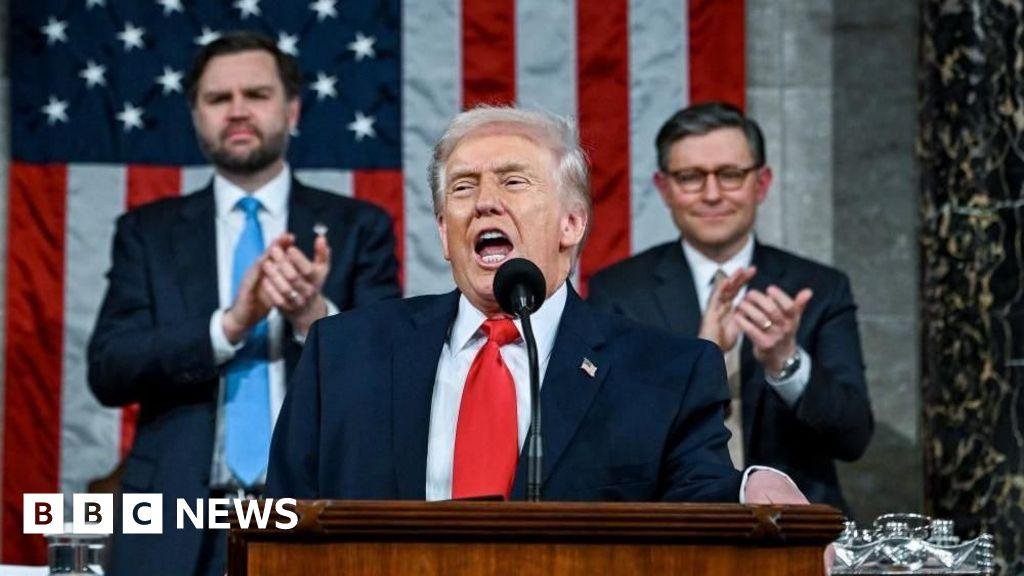
Donald Trump delivered a combative State of the Union address on Tuesday night that hailed what he said was an American "turnaround for the ages".
At a time when polls suggest many in the US are dissatisfied with the current state of the nation – and with Trump's leadership of it – the president offered little hint of a change of course.
Instead, with an eye on crucial midterm elections later this year, he delivered a sales pitch to the nation, a patriotic rallying cry to his loyal supporters and taunts for his political opponents.
It was a speech filled with theatrical flourishes – the kind of made-for-the-cameras moments the man who once hosted a reality television show seems to enjoy.
Early on, he welcomed the US Olympic men's hockey team to the gallery. They held up their gold medals as Republicans chanted "USA!" and even Democrats stood and applauded.
Later, Trump would call out military heroes, a 100-year-old World War II veteran and a Coast Guard swimmer who rescued 165 people trapped in last year's Texas flooding. The latter received a Congressional Medal of Honor and the former a Legion of Merit award for Extraordinary Heroism.
Although his speech set a record for length, these moments quickened the pace of the evening and fit with the president's larger theme of American patriotism and accomplishment.
His speech opened with familiar lines. "Our nation is back," he said. It was the "hottest" country in the world. At one point, after blaming Democrats for creating a crisis of "affordability", he added: "We are doing really well."
He pointed to the rising incomes, a growing stock market, lower petrol prices, a southern border with dramatically reduced undocumented migrant crossing and tamed inflation.
"Our country is winning again," he concluded.
The challenge for the president is that his public approval ratings are hovering around 40 percent, and the American public wants him to do more to address their concerns.
Last month, he gave a national address from the White House where he struck similar themes and cited similar statistics – but it hasn't convinced the public. The president and his aides appear to be hoping that with a bigger State of the Union audience, which should measure in the tens of millions, the results will be different.
What Trump didn't do in this speech, however, was offer much in the way of new policies.
He sprinkled the nearly two-hour address with a handful of ideas, including new retirement savings accounts for working-class Americans and a deal with AI companies to provide sufficient electricity for their plants to avoid consumers being hit with higher bills.
He made new pitches for other, older ideas, such as a healthcare plan that provides direct payments to Americans to help cover insurance premiums, a law to require all voters to prove their citizenship and ban on providing commercial driver's licences to undocumented migrants.
He also pledged to continue to push ahead with his broad tariff regime, even in the face of last Friday's Supreme Court decision striking down many of the duties he had previously imposed.
Three of the justices who had ruled against the president remained expressionless as they watched on from the front row. Earlier, Trump and Chief Justice John Roberts - who penned the court's tariff opinion - briefly shook hands, but neither man smiled.
In a speech that was frequently interrupted by cheering Republicans in the crowd, Trump's tariff discussion prompted murmurs from Democrats and uncomfortable silences from Republicans, many of whom have been uneasy about their economic cost and the threat their unpopularity with the public might pose to their electoral chances.
If tariffs sucked the air out of the chamber, when Trump turned to immigration tempers flared.
Trump's passages on what he said was the threat of "illegal aliens" prompted some of the most thunderous applause from Republicans in the chamber and angry shouts and icy stares from Democrats.
The immigration issue had been one of Trump's political strengths, but his enforcement surge in Minneapolis, which resulted in the shooting deaths of two American citizens by federal agents, has significantly eroded his standing.
The president made no mention of those fatal shootings - or the "softer approach" to enforcement he had suggested might be needed in the aftermath. Instead, Trump's speech, with its focus on crimes committed by undocumented migrants – murders, accidents and corruption – was an attempt to wrest back the issue.
"The only thing standing between Americans and a wide-open border right now is President Donald J Trump and our great Republican patriots in Congress," he said.
That was a tacit acknowledgement that in just over eight months, Americans will head to the polls in midterm elections that will determine the composition of both chambers of Congress.
As is typical with these congressional addresses, no matter who the president is, foreign policy tended to take a back seat. Despite the massive build-up of American forces near Iran, Trump did little to make the case to the American public that a sustained US military action was necessary.
"My preference is to solve this problem through diplomacy, but one thing is certain: I will never allow the world's number one sponsor of terror to have a nuclear weapon," he said, and then moved on.
For the moment, the political winds are blowing in the president's face. But Trump may believe that the public's mood is poised for a change.
Perhaps he is convinced Americans will begin to feel the economic benefits of his policies. Or maybe he believes the mood will shift, with a renewed sense of patriotisim, during the nation's 250th birthday celebrations this summer.
His speech, with call-outs to military heroes and gold-medal-winning hockey players in the audience, could hint that this is a political wager he has placed.


Follow the twists and turns of Trump's second term with North America correspondent Anthony Zurcher's weekly US Politics Unspun newsletter. Readers in the UK can sign up here. Those outside the UK can sign up here.