Spain declassifies files on 1981 attempted coup in effort to dispel conspiracy theories
Guy Hedgecoe,BBC Madrid correspondentand Robert Greenall,BBC News

 Getty Images
Spain's government has released dozens of documents related to an attempted coup that took place 45 years ago - regarded as a key moment in the country's history.
A group of armed officers burst into parliament and threatened MPs, aiming to overthrow the country's fledgling democracy and return it to dictatorship. Their efforts failed when King Juan Carlos refused to support them.
However, conspiracy theories have abounded since, including that the king may have had prior knowledge of the coup or even that he may have been actively involved.
The release of the files also came on the same day as the death of the coup's leader, Antonio Tejero Molina, at the age of 93.
Tejero's lawyer described him as a "man of honour, unwavering faith, and great love for Spain".
"May God grant him the peace that men denied him," he wrote on X on behalf of his family.
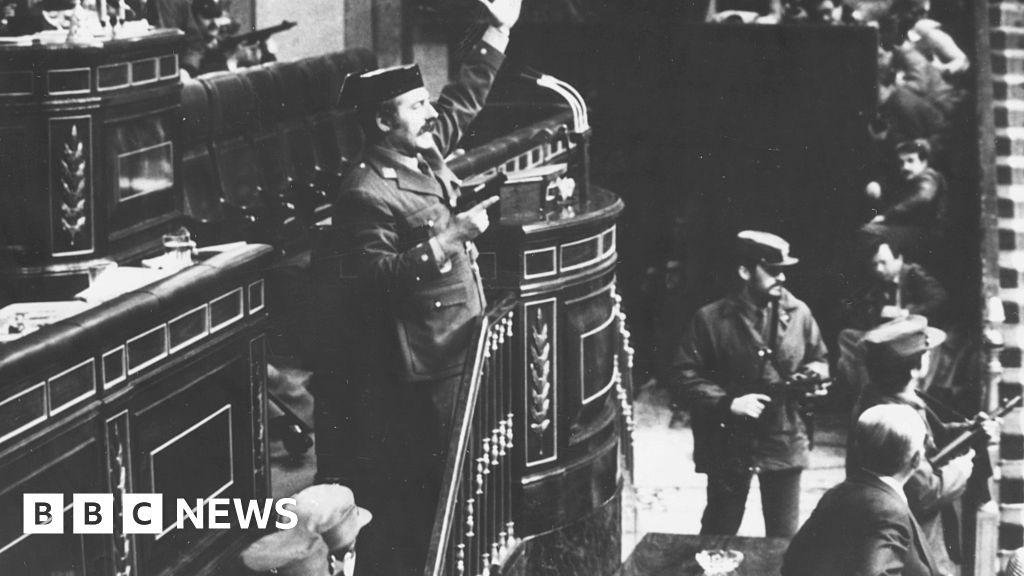
On 23 February 1981, a group of officers led by Tejero burst into the main chamber of the national parliament, wielding guns and threatening the politicians as a new government was being sworn in. Their aim was to return authoritarianism - six years after the death of the country's dictator Francisco Franco.
A photo of Tejero brandishing a handgun in the parliament as MPs take cover is perhaps the most famous image of the coup.
 Getty Images
The release of the 153 classified files generated enormous expectation - so much so that the government web page where the documents were to be posted collapsed temporarily.
They include police and judicial reports, transcriptions of conversations between officials, and the reactions of foreign governments to the events.
But the files themselves appear to contain no explosive revelations.
Franco - Spain's brutal dictator - died in 1975, paving the way for the introduction of a parliamentary monarchy.
Six years later, Spain's fragile democracy appeared to hang in the balance for several hours as the coup attempt took place.
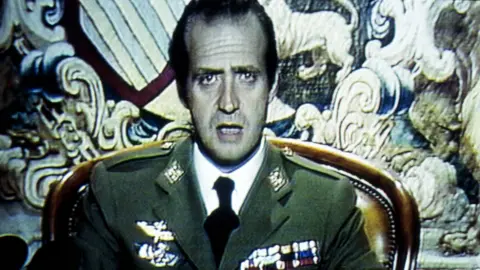
Eventually, it failed, after the young king addressed Spaniards - and the armed forces - via a televised message, expressing his opposition to the rebels and ordering all military to remain in their barracks.
For many Spaniards, the episode sealed Juan Carlos's status as the saviour of their young democracy and the country's rejection of Francoist values.
However, in the decades since, many have cast doubt over the supposedly heroic role of the king.
Other theories claimed the uprising was a set-up by the political establishment aimed at providing a test that would reinforce the country's democracy.
The current, Socialist-led government of Pedro Sánchez said having documents related to this event under lock and key was an "historical anomaly" that needed to be corrected and that their release posed no risk to anyone.
It also said their declassification would serve to undermine those peddling false theories about the coup.
However, there were some interesting revelations in the files, including that six members of the intelligence services were involved in the plot.
Another document showed the security forces estimated that, if a police special unit attempted to break into the parliament building, it might lead to "between 80 and 110 deaths".
Among the documents were also messages of support from foreign governments once the coup had failed.
A message in Spanish from Queen Elizabeth II to King Juan Carlos read: "All of us in Great Britain are reassured to know the final result."