The SIP Formula Is Broken and Everyone Knows It

The SIP Formula Is Broken and Everyone Knows It
Investors around the world know that it's important to know what the right prices for stocks are, and ideally, that they don’t end up paying too much for the stocks they are buying.
In the U.S., solving that problem included creating a consolidated tape (aka Securities Information Processor, or SIP) and a National Best Bid and Offer (NBBO) as part of Reg NMS.
The SIP has been undeniably good for the public. By consolidating all the best prices, it protected investors, reduced trading costs and complexity. That, in turn, arguably improved liquidity, helping attract more companies to U.S. public markets.
But the NBBO isn’t a “free service.” It is a result of venues and traders who decide to advertise their liquidity publicly. To their credit, regulators at the time realized that those providing data to the public should be rewarded and incentivized.
However, as we show today, the market has evolved in ways that take advantage of economics – usually without adding the desired compensating value to the public, who expect that they are paying for good NBBO quotes.
The SIP formula works to reward those providing its data
We have detailed how the SIP economics works here. At a basic level, the SIP charges different kinds of users different prices based on how much that data helps those users.
- Professionals pay more than retail investors.
- Electronic trading systems pay more than professionals.
It then rewards those who contribute data to the SIP.
Because both quotes and trades contain essential signals about a stock’s value and market interest, the current formula splits revenue evenly:
- 50% to trades,
- 50% to quotes,
- With (relatively) more money allocated to less-liquid stocks (that need market makers more).
The totals are shown in Chart 1.
Chart 1: The SIP charges data users and pays data producers based on a formula

Note that “non-display” data, which we will talk about later, is based on the “use” (for routing, trade pricing and benchmarking) of the data by computers, rather than display (on screens) for their brokers or customers to see prices.
Research suggests quotes are twice as important as trades
A number of well-known academics have thought deeply about price discovery — and many are also pretty good at math.
What their research shows is that for most stocks, quotes matter around twice as much as trades.
This makes sense when you consider that the trades in the market are often using NBBO prices. (For example, midpoint trades only occur at that price because it’s in the middle of the NBBO at the time.)
Chart 2: Some research suggests quotes are twice as important as trades

The more detailed math done in Brogaard’s study is interesting when we consider a fragmented marketplace. With an NBBO on multiple venues, it helps answer the question “who is actually doing price discovery.”
What they find is that merely matching the NBBO provides very little value.
Instead, setting a new, better NBBO is important. In fact, even being the final order to cancel, making the NBBO worse, provides more value informationally than merely copying existing quotes.
Quote copying is easy (and profitable)
Unfortunately, the SIP doesn’t care if you are first, last, or always pegged to the NBBO.
Instead, the SIP shares quote credits equally for every share at the NBBO based on the amount of time they are quoted. As a result, SIP quoting revenues accrue equally to exchanges that set and copy quotes.
We have seen that quote copying happens a lot. In fact, the 10 smallest venues improve the quote just 17% of the time, and yet last year they were paid $66 million (or around 34%) in SIP quote revenues.
Chart 3: Some exchanges earn more quote revenues than they set prices

In short, the SIP formula allocates far more quote revenue (pink bar) than academics suggest for copying the existing quote (orange diamond).
Importantly, instead of improving market quality, those revenues support fragmentation and market complexity.
Everyone agrees phantom quotes are bad
It makes even less sense to reward phantom quotes.
Phantom quotes evaporate the moment someone tries to trade with them. That means there is less liquidity in the market than the SIP indicates. It makes the SIP misleading and noisy, so it really shouldn’t be something the SIP rewards.
In fact, “actionable quotes“ were a fundamental principle of early electronic trading. Quotes that can be traded against are also implied by the Order Protection Rule (or OPR, Rule 611). It's also a fact that all exchanges are meant to offer fair and equal access (Rule 610).
Given that all exchanges are expected to have fair access and actionable quotes, you would expect their trading activity to be roughly equal to their time and size at NBBO. Said another way, you would expect quote revenues to be proportional to trade revenues.
However, as the data below shows, that’s not always the case.
In 2024, some venues earned much more from quoting than they did from trading (pink bar) and, in fact, the exchanges with the largest trading revenues (purple diamonds) generally have quote-revenue-to-trade revenue ratios close to one. The same data shows in 2024 some venues earned over $17 million more in SIP quote revenues than their trade revenues, mostly because they traded less than 0.5% of ADV. It’s something Themis even wrote a blog about.
Chart 4: Quote vs. trade revenues show some exchanges provide a lot of quotes and very few trades

Not all high quote-to-trade ratios are bad
However, there is a problem with focusing the wrong way on quote-to-trade ratios.
When there is a competitive NBBO, with a tight spread, but no trades – that NBBO is valuable:
- Investors and issuers benefit from the protection the NBBO provides on any off-exchange trades they might do.
- Price-setters should be rewarded for providing continuous prices even though they don’t capture spread or trading fees.
We saw an example of this when we studied Limit Up-Limit Down (LULD), which we show below. In this chart, you can see that the bid and offer cost of this exchange-traded fund (ETF) is extremely small, and price updates occur frequently. Despite that there are just three, mostly small, trades all day (yellow dots).
Many illiquid stocks (and especially ETFs) benefit from accurate quoting, even if investors rarely actually trade. That costs market makers money to do, and is a behavior worth rewarding.
Chart 5: Illiquid stocks can also have high quote to trade ratios, where accurate quoting is a positive

Other research suggests that dark trades contribute very little value
We already discussed that trade data likely contributes much less than 50% to price discovery.
Other academic studies suggest that off-exchange trades could contribute much less to information than trades from exchanges. In fact:
- Chakrabarty thinks they add less than 14%.
- Meanwhile, Hasbrouck calculated that they add almost no value to NBBO.
Chart 6: Research suggests trades that reference the NBBO prices add little new information to NBBO

This makes sense when you consider that almost all dark trades are printed at a price that is derived from the NBBO. Consequently, they add little new information about the correct price in the market. That said, in small, less-traded stocks, sometimes the trade is the only thing that has been updated in hours.
In fact, the data suggests that a lot (30%) of off-exchange trades are at the NBBO (with no price improvement) – with another 19% using the mid-price derived by the NBBO. Even the roughly 40% of orders that are price improved are improved vs. the NBBO – and research has shown that a lot of those prints are very close, economically almost the same, to the far touch price in the NBBO.
Chart 7: Most off-exchange trades rely on the NBBO to determine their trade prices

In short, there are a lot of trades done in dark pools, allowing the capture of spread in the dark pool, using the prices set by market makers on exchange, and taking spread capture away from those advertising on exchange. Economically, this is known as free riding. The SIP should not add to the economic misallocation.
SIP economics shouldn’t pay venues to take trades away from NBBO
It's worth quantifying what we are talking about above.
If you look at the data, most off-exchange venues are buying a so–called “non-display data” SIP. And when those venues print the trades to the TRF, they often earn SIP trade revenues from reporting those trades.
Although non-display data is the most expensive SIP feed, in reality:
- The SIP data shows that the total costs of all non-display data feeds add to just $52 million.
- While off-exchange venues recover around $80 million in SIP trade revenues just for printing those trades.
Chart 8: Non-display SIP quotes cost less than off exchange revenues shared for trade reports

In short, the SIP is paying more for the trades than the costs of the data those trades are pegged to. That’s not a subsidy – it’s a net profit. And that’s before including trade revenues earned in those venues.
The loser is the NBBO-setter, who is deprived of the spread capture and SIP trade revenue.
From an economic rent perspective: either the costs for “non-display” quotes are too low, or the rewards for printing trades off exchange are too high. As a result, the SIP is financially rewarding fragmentation and more off-exchange trading.
Issuers matter, too, and need a good NBBO for all their tickers
It's also important to remember that markets aren’t all about quoters and traders.
We need to ensure that markets support companies, trying to raise capital, too.
Often, new companies are smaller and less liquid. As a result, there are less spreads to be captured, and spreads tend to be wider.
To be fair, the original SIP formula does attempt to boost rewards for less liquid stocks (see Chart 6 here). However, research shows that many trading venues focus their platforms on stocks that trade a lot, which is where they can make the most profits from trading.
Chart 9: Many trading venues focus on tickers that trade a lot – at the expense of companies that really need NBBO support

However, this comes at the expense of supporting the whole ecosystem. Ultimately, expensive trading costs and low liquidity are factors that can discourage companies from going (or staying) public. They are, after all, key reasons why public markets are attractive – as they help reduce a company's costs of capital.
SIP economics do more to encourage fragmentation than reward NBBO
When the SIP was built, it was designed not only to provide an NBBO that made markets more efficient, but also to ensure the economics rewarded and encouraged that NBBO, making price transparency and spread costs even better.
What we see today is that those incentives have instead created economics that supported unintended behaviors – like quote copying, phantom quotes and a focus on trading only active stocks.
Rather than making the NBBO better, it has added to both on- and off-exchange fragmentation.
In short, the SIP formula has been broken and — in reality — everyone knows it.
Shiyun Song, Research Principal, contributed to this article.
Sponsor
Sponsor
Sponsor
Sponsor
Zoekertjes
Categorieën
Read More
More Than 1 in 5 Users Make Health Decisions Based on Social Media, Despite Widespread Distrust The lack of accessible healthcare drives many to rely on social media feeds for medical advice. Anna Gragert Senior Editor, Health and Home Anna Gragert (she/her/hers) was previously the lifestyle editor at HelloGiggles, the deputy editor at So Yummy and the senior lifestyle editor at...

Watch: Why is Trump not at the World Cup?US President Donald Trump became the first American president to skip a United States opening match at a Fifa World Cup. President Claudia Sheinbaum also did not attend the Mexico opener at Azteca Stadium on Thursday, and Prime Minister Mark Carney skipped the Canada opener in Toronto on Friday.The BBC's Carl Nasman breaks down the significance of...

OpenAI deepens India push with Pine Labs fintech partnership As India pitches itself as a global hub for applied artificial intelligence, OpenAI has partnered with Pine Labs to integrate AI-driven reasoning into the fintech firm’s payments stack, automating settlement and invoicing workflows in a move the companies say could help accelerate AI-led commerce in India. The partnership will see...

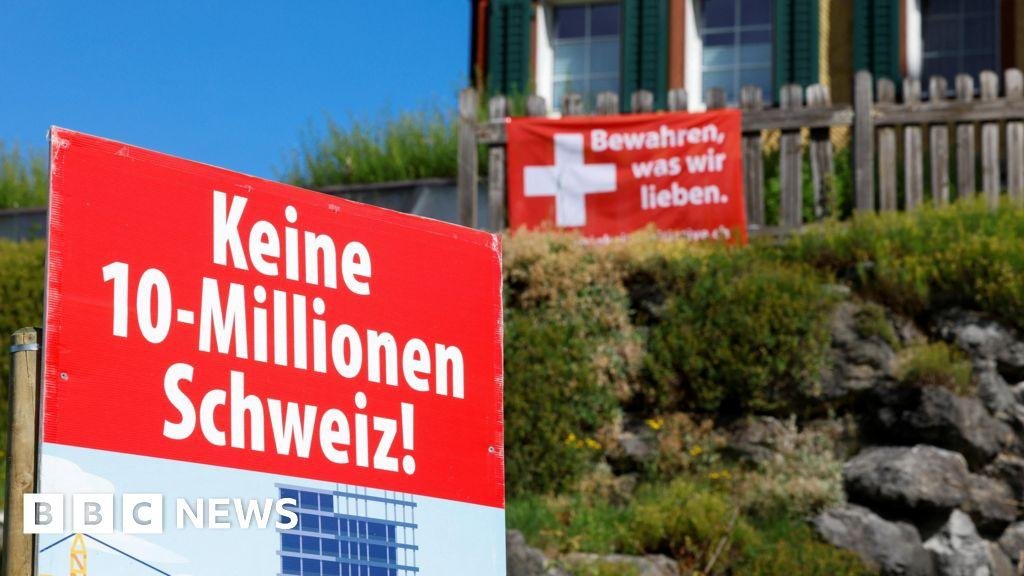
Swiss vote against proposal to cap population at 10 million by cutting migration, projections saySwiss voters reject 10 million population cap, early projections say22 minutes agoImogen FoulkesBern, SwitzerlandReutersIn the run-up to the poll, opinions on the likely outcome were dividedVoters in Switzerland have rejected a proposal to limit the country's population to 10 million, early...
Ricoh GR IV Review: Peak Pocket Photos to Potentially Outperform Your Phone Ricoh GR IV Pros Fantastic size Fast and easy to use Takes great photos Cons Only slightly different to the GR III Video is only 1080p Ricoh GR IV Review: Peak Pocket Photos to...