Amir AzimiBBC News Persian

 EPA/Shutterstock
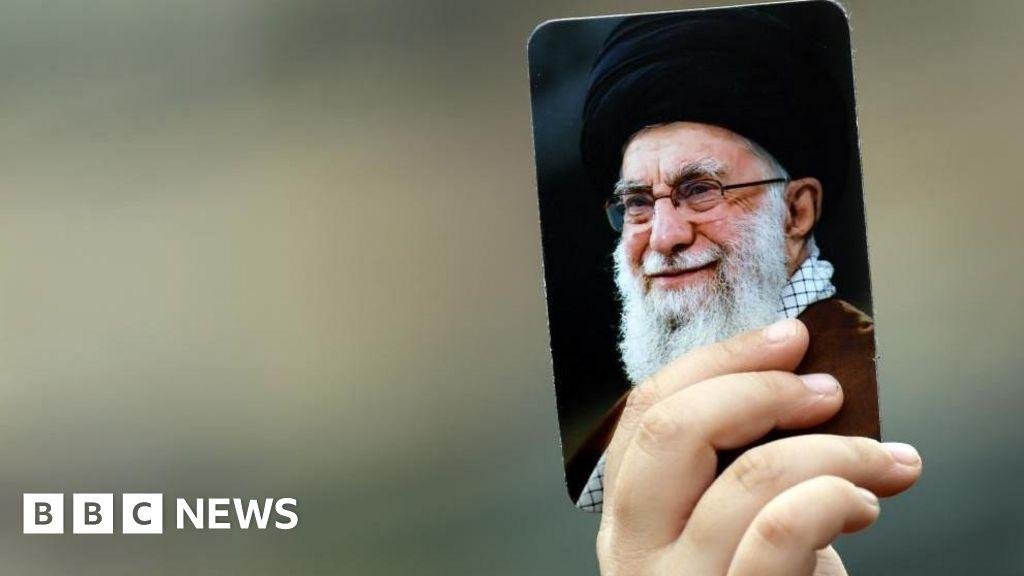
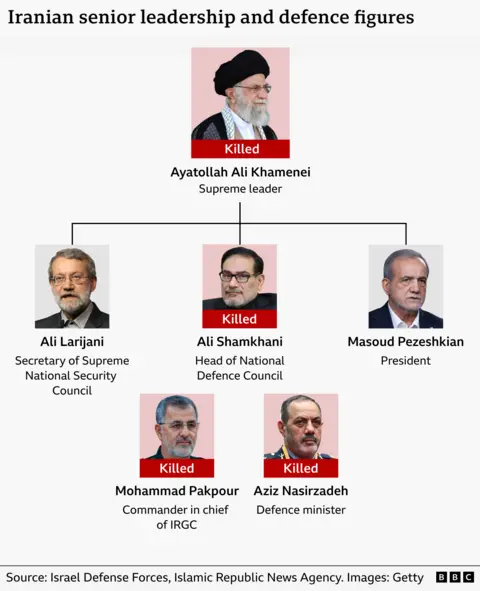
The killing of Iran's Supreme Leader, Ali Khamenei, in the opening wave of joint US-Israeli strikes has pushed the Islamic Republic into its most precarious moment since 1979.
By Saturday night, reports about Khamenei's death were circulating widely, setting off scenes few would have imagined possible just days earlier.
Videos showed pockets of celebration in major Iranian cities. Similar scenes unfolded among large parts of the Iranian diaspora abroad. For many, the elimination of the supreme leader appeared to represent a historic rupture - an opening that years of civil resistance had failed to achieve on its own.
Both the US president and Israel's prime minister used direct language in their public statements following the strikes. President Donald Trump urged Iranians to seize the opportunity to "take over your government". Israeli Prime Minister Benjamin Netanyahu echoed the theme, arguing that regime change is both desirable and attainable.
While the military phase of Operation Epic Fury, as the US have dubbed it, appeared tightly co-ordinated and largely under US control, the political appeal to the Iranian public remains far less predictable.
On Sunday morning, Iranian state television formally confirmed Khamenei's death, before swiftly announcing the formation of a temporary council of three men to assume executive authority.
Under Iran's constitution, the selection of a new supreme leader falls to the Assembly of Experts - an 88-member clerical body elected by popular vote for eight-year terms.
However, the electoral process includes a critical limitation.
All candidates for the Assembly must be vetted and approved by the Guardian Council.
That 12-member body is itself deeply intertwined with the leadership structure, six members appointed directly by the supreme leader and six nominated by the judiciary and approved by parliament, with the judiciary chief also appointed by the supreme leader.
In effect, Khamenei has had significant influence over the institution tasked with choosing his successor.
The regime has moved quickly to project continuity and stability.
By invoking constitutional mechanisms and activating the temporary governing arrangement, authorities aim to signal that the system remains intact despite the loss of its apex figure.
Speculation has inevitably turned to possible successors.
It is uncommon in Iran for potential candidates to be publicly identified in advance, and the process takes place behind closed doors.
Within the Assembly of Experts, however, there is understood to be a small committee tasked with reviewing and narrowing down names, potentially presenting a shortlist to the full body once formal proceedings begin.
The sessions are held behind closed doors and voting is not made public, limiting outside scrutiny.
In recent years, there has been speculation that Khamenei's eldest son, Mojtaba, might be in the running. Yet with several of his father's most trusted commanders in the Islamic Revolutionary Guard Corps reportedly killed in the recent strikes, the internal balance of power may have shifted.
The precedent from June 1989, when Khamenei himself emerged as supreme leader despite not being widely viewed as a frontrunner, is a reminder that the outcome can defy expectations.
The selection process could move quickly, potentially concluding within a matter of days.
Militarily, however, the Islamic Republic has absorbed a severe blow.
Reports indicate that several senior commanders were killed in the initial strikes. Surviving officials remain under threat as aerial operations continue.
The sense of vulnerability is tangible - command centres damaged, leadership decapitated, and decision-making compressed into crisis mode.
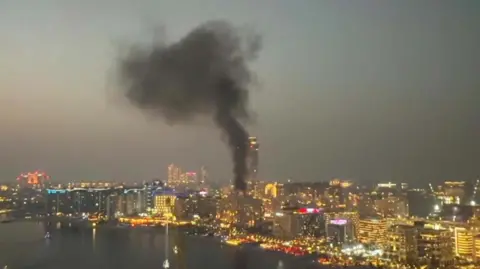
Still, Iran has demonstrated an ability to retaliate.
The escalation signals that, despite leadership losses, Iran retains operational capabilities and the will to use them.
 Muskaan Kataria
The prospect of further regional escalation now hangs over the crisis.
From the point of view of Iran's leaders, if the conflict widens and its militant groups allies across the Middle East join the fight, Tehran could gain some leverage to press for a ceasefire or at least avoid a total surrender on terms dictated by the US and Israel.
From another perspective, sustained military pressure, combined with renewed large-scale protests, could push the Islamic Republic toward systemic breakdown.
Should elements of the security forces fragment or refuse orders, any formal constitutional transition process may quickly become irrelevant, overtaken by developments on the ground.
The coming days will reveal whether the IRGC and other elements of the country's coercive apparatus can remain cohesive in the absence of its long-serving supreme leader.
For now, all scenarios remain in play.
The Islamic Republic appears to be holding a weaker hand than it did before the strikes - deprived of its central authority figure, stripped of key commanders, and exposed to continuing military pressure.
Yet, it retains institutional structures, armed forces and a capacity for retaliation that complicate any straightforward path to regime change.
The death of Ali Khamenei has pushed Iran into a volatile and uncertain phase.
What happens next will depend on whether Tehran can maintain internal control under continued air strikes, whether protests gather momentum, and how far the fighting spreads across the region.
The direction of events is likely to become clearer in the coming days, as all sides test their military limits and their political resolve.