Dolby Atmos is a spatial audio found in movie theaters, home audio products such as soundbars and receivers -- and even in some headphones. You can even find it in some high-end cars, too. On the professional side, it gives audio pros that create sound for movies, TV shows and music a suite of tools to better and more accurately create convincing surround sound, regardless of the speakers that play that audio back to you.
How it works -- and how well it works -- varies depending on the situation. In the best use cases, it can create immersive 3D sound to augment the visuals on screen or add an extra dimension to music. In lesser use cases, it might add some "space" to the audio but not convincing surround sound. And understanding how it works will help you determine if it's worth considering Dolby Atmos compatibility in your next audio purchase.
The basics
In its most elaborate form, typically in high-end cinemas and home theaters, Atmos uses height speakers to create a verticality to the sound. These speakers are typically mounted high on walls or in the ceiling. In less-elaborate -- and far less expensive -- setups, upward-facing drivers built into soundbars and speakers bounce sound off the ceiling to mimic height speakers. In the least elaborate, least expensive Atmos-enabled gear, audio processing tries to do what physical speakers and drivers do in their more expensive versions. Atmos can also be combined with head-tracking technologies in headphones, and using other processing techniques in tablets and phones.
Because Atmos covers a suite of different technologies, it can be a bit confusing. Here are a few pointers:
- Height channels can create more immersive sound. This is what you'll usually hear in cinemas with Dolby Atmos.
- The best sound will be with a multi-speaker setup, but even soundbars with Atmos offer a much "bigger" and more enveloping soundstage than stereo bars without Atmos.
- Ceiling speakers are great, but many companies sell upward-firing speakers that come close in performance without the need for speaker mounting or installation.
- Head-tracking in headphones is liked by some, but considered gimmicky by others.
- Atmos in some high-end cars can help create a more spacious sound.
- To fully take advantage of an Atmos audio system, you need content with Atmos. Most movies and many TV shows have Atmos audio tracks. There are some Atmos music, but only certain streaming services support it.
To understand what makes Atmos different from, say, its direct predecessor Dolby Digital, let's first take a look at how sound is mixed for movies and TV shows.
Making sound surround
Everything you hear in a movie, from the music to the voices to the sound effects, all gets mixed into specific "channels." For simplicity's sake, we'll say these channels are, as you look at them in a room, left front (L), center (C), right front (R), right surround (RS) and left surround (LS). Some more complex systems add "surround back" channels. All the low-frequency booms and thumps go to the ".1" subwoofer channel. This diagram should help:
A traditional 7.1 surround system in a theater. Lots of speakers, but only a few "channels" to direct the sound to. So a sound would come from the left "wall," not a specific speaker on that wall.
DolbySo if two actors are speaking onscreen, that gets mixed to the center channel. When the music swells during a dramatic moment, that's usually in the front left and right channels. Zooming and swooping special effects might appear in the surround speakers. To an extent, this same mix of channels also translates to the home. After all, if you have a 5.1 speaker system, you have all those same speakers.
Except… you don't. Not exactly. Where your speakers are, how powerful they are, and increasingly, how much range each has, varies greatly compared with a decent movie theater.
At the mixing stage, Dolby Atmos doesn't use channels. Instead, most sounds are treated as "objects." Instead of assigning a sound to a channel (and by extension, a speaker), Atmos lets filmmakers assign a sound to a place. Not "left surround speaker" but "left rear corner." Not "pan from left surround speaker to right sound speaker" but "pan smoothly across the rear wall." Not only does this give greater flexibility, but it improves the experience in the theater and, potentially, at home.
With Atmos (on the right), sound designers can pinpoint exactly where in any Atmos theater they want a sound to "appear." This could be just about any place in the room, including overhead.
DolbyAtmos is an end-to-end change in theater and home audio. The mixing is different, as we've discussed, but so is the decoding. At different theaters, the number of speakers can vary dramatically, but Atmos will scale with them regardless. Most theaters have many speakers along the walls to ensure everyone gets a similar experience. With Atmos, those speakers can be individually addressable and a sound designer can pinpoint the exact location in a theater where they want to place a sound. A smoother experience for everyone and this is represented in the image above.
The ability to place sound anywhere naturally includes the headline Atmos feature: height. With speakers hanging from the ceiling, sound engineers can now move sounds seamlessly over your head and all around. Done right, it's not only more convincing than before but also less obtrusive. It's more natural, so you're less likely to notice the special effects and more likely to stay absorbed in the movie. That's the point, right?
So what about the home?
Note the Dolby Atmos logo.
MaxTheaters are great and all, but most of us watch movies and TV shows at home. All the big-name streaming services, like Apple TV+, Amazon Prime Video, Disney+, HBO Max, Netflix, Paramount+ and Fandango at Home (nee VUDU), have movies and TV shows with Dolby Atmos. Not every movie or show will have Atmos, of course, but increasingly most will. Typically the Atmos logo will be somewhere obvious in the show/movie description.
Dolby has been branching Atmos out into music as well. Apple Music, Tidal and Amazon Music Unlimited offer a selection of titles which been mixed in Atmos.
Tidal offers a selection of Dolby Atmos Music titles via its app.
Sarah Tew/CNETTo let mobile users experience both Atmos music and movies, many newer mobile devices have a version of the technology called Dolby Atmos for Headphones. Although those are stereo-only, they're designed to simulate Atmos effects with any headphones. The tech is available for Xbox and PC as well via the Dolby Access app, which also adds Atmos to some games. In addition, many AirPods models now enable Atmos as part of its spatial audio technology.
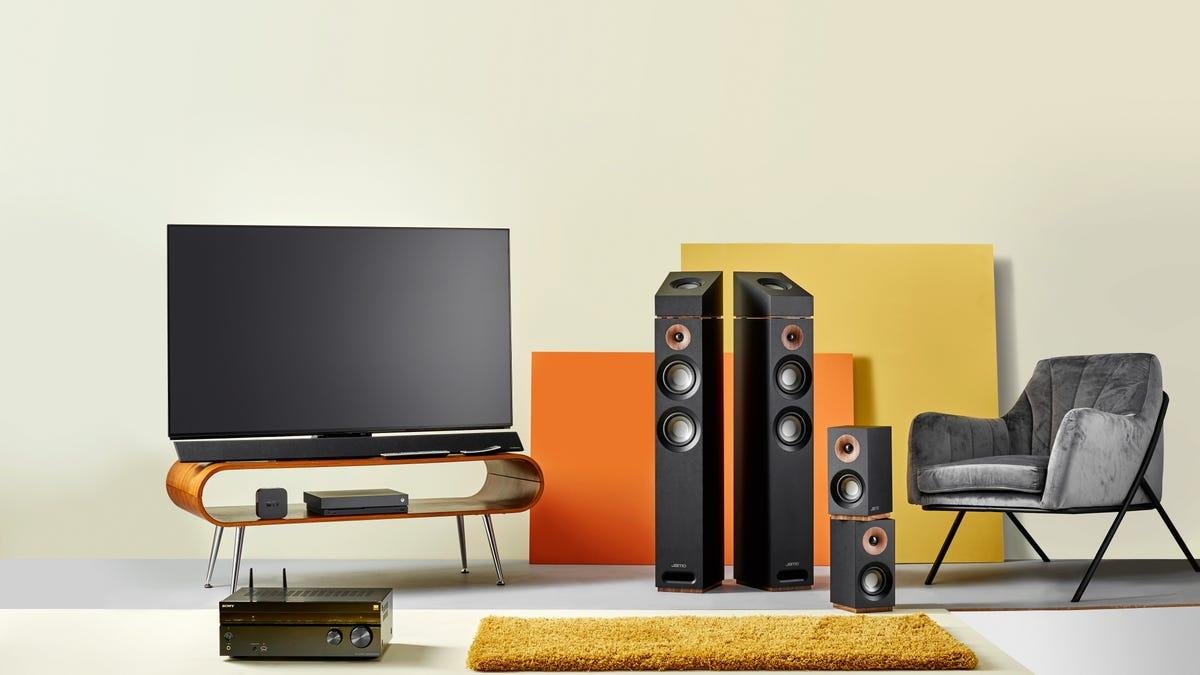
If you're listening at home, though, let's get this out of the way first: Most people aren't going to install height speakers in their ceiling. That's fine because there are a growing number of speakers and soundbars that either feature built-in height channels or fit on top of existing models. In the case of a standard tower or bookshelf speaker, you can fit a speaker model on top that has a separate, upward-firing driver. These speakers bounce sound off the ceiling to mimic "real" height speakers. I've heard quite a few of these and they work surprisingly well. Not as well as real height speakers, of course, but it works and is a far simpler option if you aren't interested in installing speakers in or near the ceiling.
If you want to take advantage of true Atmos surround you'll need new hardware. Dolby Digital is still the default for everything, so this isn't a required upgrade. If you're not interested in Atmos, your gear will still work. Even if you get a brand-new 4K streamer to connect to your older receiver, the audio will still work if it doesn't have Atmos. It will just play a Dolby Digital or Dolby Digital Plus track.
Two Atmos home setup examples.
DolbyIf you want height channels, more channels or other benefits of Atmos, then you'll need a receiver or soundbar that can decode it and a source that provides it. (Those sources include 4K Blu-ray players, newer media streamers and some game consoles.) You'll need Atmos content, which we'll discuss in a moment.
To the right, you'll see a couple of Atmos home setup examples. At the top, you see a setup with specially designed upward-firing speakers. Each is a traditional speaker but also has separate drivers that shoot sound to bounce off the ceiling. These are tuned so the bounced audio sounds correct to your ears. At the bottom, you see a soundbar designed to do the same.
Atmos also lets you have a greater number of possible speakers. How many could you have if you really wanted to go wild? Just 24… plus 10 height speakers. That's 34 speakers if you want. You don't need to do that, but if you've got a bunch of spare speakers and amps lying around and a room that can fit them, go for it.
On the left, a well-installed Atmos home theater system with four in-ceiling height speakers. On the right... good luck with that.
DolbyFor Atmos, Dolby uses a slightly different twist on the nomenclature of home systems. Traditionally a 5.1 system has three speakers up front, two on the sides or in the back and a single subwoofer. If you then added two Atmos height speakers, Dolby would describe this system as a 5.1.2 system. If you see "a 7.2.4 home theater" you can deduce that it's probably got three speakers up front, two on the sides, two in back, two subwoofers and four height speakers.
In the car?
Atmos in a Rivian R1S.
Geoffrey Morrison/CNETDolby has recently partnered with a few automotive brands to bring Atmos to cars. Atmos-to-go works similarly to how it works at home and the in the theater, taking advantage of all the speakers in a vehicle to create a more enveloping sound. Speakers in the roof of the car add height, so the sound seems to surround you more than a typical car audio system that's typically limited to speakers that are rarely above chest height and usually lower.
One of the height speakers. Note its location near the grab handle. The "sky" in this image is literally the sky, as seen through the panoramic roof.
Geoffrey Morrison/CNETNot only will you need to subscribe to one of the music streaming services that offers Atmos Music, but in some cases you'll also need to subscribe to the vehicle's own data service. For more about these systems, check out I Listened to Dolby Atmos in a Rivian SUV: Is It the Future of Automotive Audio?, our Volvo EX60 preview, and if you want to retrofit your car, the Pioneer Sphera.
All around
In addition to the gear, you'll also need Atmos content. That's actually pretty easy. There are shows and movies on all the major streaming services. For music, there's Amazon Music Unlimited, Apple Music and Tidal. On disc, Atmos can be found on 4K and regular Blu-ray discs. It's even in a handful of video games.
Chances are if the movie is 4K, it's also Atmos -- although that doesn't mean it's in Atmos everywhere you can find that movie. It might be available with Atmos on the 4K Blu-ray, but not on Amazon, for example, or it could be in the competing DTS: X or Imax Enhanced formats. The thing with Atmos is that it's also backward compatible, and so if you buy a movie featuring Atmos it will also have an audio track your current gear can play, even if it's minus the height channels.
Is it worth upgrading all your gear to take full advantage of Atmos? No. It's cool, but if you're not a home theater junkie this might be more money than you need to spend if you're not using it. When you're ready to upgrade anyway, chances are the gear you're considering will have Atmos. For example, most of our favorite receivers already work with Atmos, as do several of our favorite soundbars.
Originally published in 2017 but updated regularly with new info about Atmos and spatial audio in general.
In addition to covering audio and display tech, Geoff does photo tours of cool museums and locations around the world, including nuclear submarines, aircraft carriers, medieval castles, epic 10,000-mile road trips and more.
Also, check out Budget Travel for Dummies, his book, and his bestselling sci-fi novel about city-size submarines. You can follow him on Instagram and YouTube.