Barbara Plett Usher Africa correspondent

 BBC
BBC
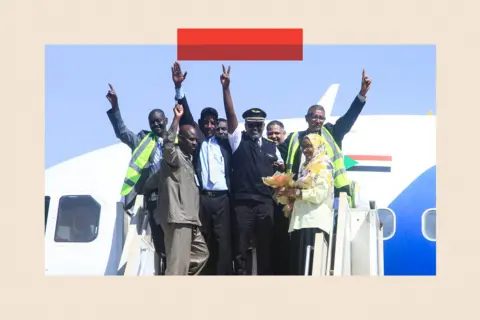
On Sunday 1 February, a yellow, blue and white Sudan Airways jet landed on the runway at Khartoum International Airport. As 160 passengers stepped off the aircraft, they cheered, hugged each other and took selfies. This was only the second commercial flight to arrive in the city since 2023 - a significant milestone given the continued threat of drone attacks in a country riven by civil war.
Weeks earlier, Sudan's prime minister had declared 2026 would be "the year of peace". Kamil Idris spoke in January as the military-led government announced its ministries would return to the country's shattered capital.
 AFP via Getty Images
Almost a year ago I saw Khartoum for myself - driving carefully around unexploded munitions on the tarmac, touring the wrecked passenger halls in the airport's terminal, just days after Sudan's army recaptured it from the paramilitary Rapid Support Forces (RSF).
The city had been the epicentre of a civil war that erupted in April nearly three years ago, leaving its centre a burnt-out shell and exiling the government to the safer haven of Port Sudan on the Red Sea.
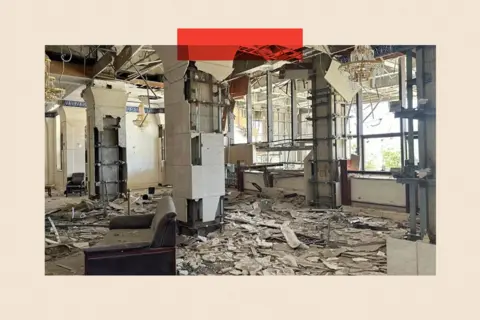
The devastation was stunning: government ministries, banks and towering office blocks stood blackened and burned.
I toured the shattered presidential palace, even now still too damaged to be used, and the British embassy, its pockmarked, bullet-proof glass bearing testimony to intense fire fights, its rooms looted.
It felt then like a seismic moment in a war that has inflicted epic destruction, death, famine and human rights violations on civilians, plunging Sudan into what the UN has called "an abyss of unfathomable proportions".
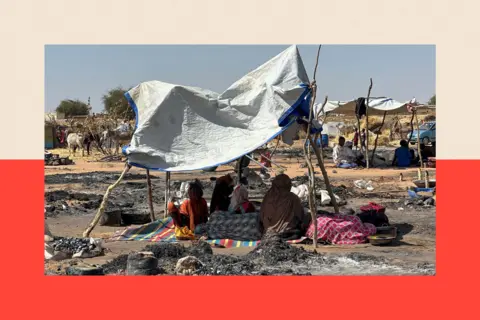
On a later trip, I went to a tent camp in army-controlled territory to speak with people who'd managed to escape the fall of el-Fasher in October and heard stories of mass killings and sexual violence.
The takeover of the city in the western Darfur region was a major victory for the RSF. But the evidence of atrocities carried out by its fighters was such that it triggered an international outcry.
For a moment then, too, it had seemed that world powers might finally intervene to stop the endless suffering.
 AFP via Getty Images
Yet despite the condemnations and expressions of horror, nothing changed and fighting continues to rage away from the capital - with the rest of the world's attention focused elsewhere on air strikes across the Middle East.
As the start of Sudan's dreadful conflict approaches its third anniversary, the flight may have offered a glimpse of normality - but the fundamentals underpinning the fighting remain untouched. So if international outrage has not been enough to overcome them, what could actually compel both sides to end the civil war?
Near-constant fighting
Sudan has been at war in some form or another most of the time since its independence from British colonial rule in 1956 – 58 out of the past 70 years.
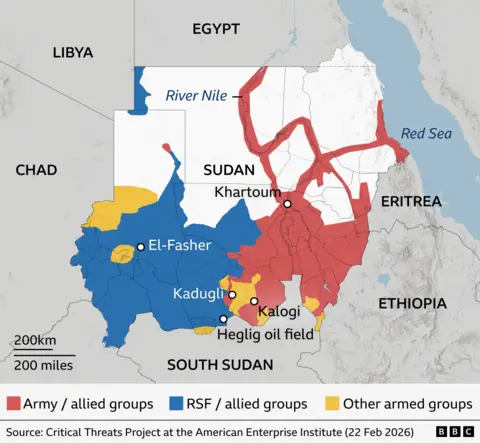
But the previous conflicts were fought on the periphery, away from Khartoum. This one has torn through the country's core, displacing unprecedented numbers of people, hardening divisions and threatening to split the nation.
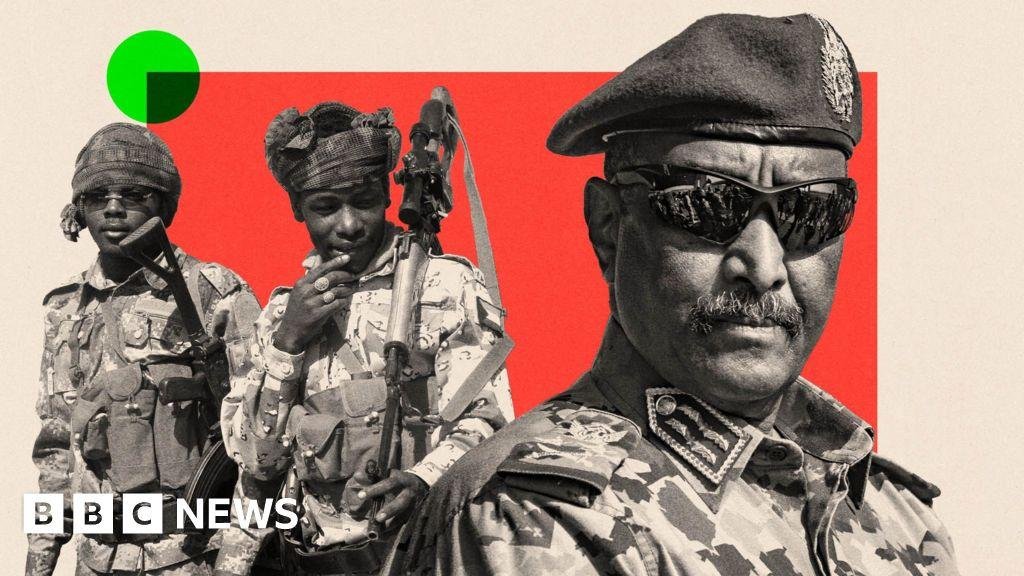
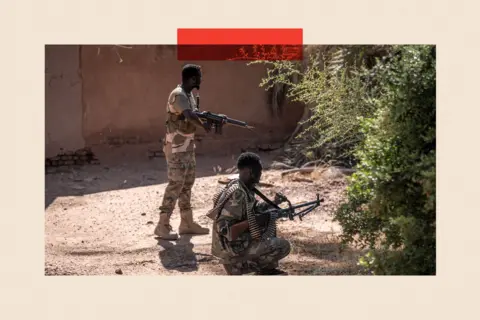
It started as a power struggle between the Sudanese Armed Forces and the RSF, a paramilitary force appointed by and loyal to the country's long-time former military ruler Omar al-Bashir, who was deposed in 2019 following widespread public protests.
 BBC / Critical Threats Project at AEI
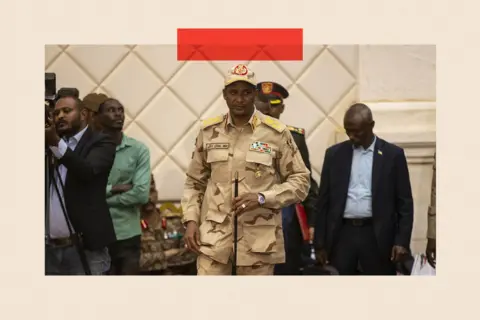
Bashir had empowered Gen Mohamed Hamdan Dagalo, widely known as Hemedti, to run the RSF as a praetorian guard to protect him against possible challenges from within the army.
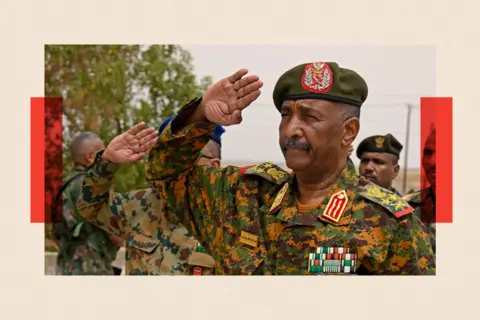
Following Bashir's departure, tensions between Hemedti and the army chief Gen Abdel Fattah al-Burhan erupted into wider violence.
At first "there was a consensus that this is not a Sudanese war but a war within the security state", says the Sudanese political analyst Kholood Khair, founder of the Confluence Advisory think tank.
 AFP via Getty Images
But then both sides broadened their coalitions and grafted their narratives onto grievances as old as the foundation of the state.
These are rooted in an embedded culture of cronyism and kleptocracy that sees Sudan's military controlling vast amounts of the country's economy. Hemedti, a camel trader turned successful businessman, accrued much wealth from his position as head of a powerful paramilitary force.
But as someone from the western Darfur region, he positioned himself as the champion of the disgruntled and of deprived areas beyond the capital.
 AFP via Getty Images
He now frames the conflict in existential terms, declaring the RSF a revolutionary force aiming to dismantle the "1956 state" - shorthand for the military-dominated state apparatus - and to start again with its own self-declared rival government headquartered in Darfur.
The Sudanese Armed Forces also define the war as an existential struggle, a rebellion by a "terrorist militia".
"There is strong resistance within the army to legitimise the RSF in any way, including by accepting its control of territory through a ceasefire agreement," says Ahmed Soliman, a senior Horn of Africa researcher at the UK's Chatham House think tank.
Both sides have weaponised long-standing ethnic divides between the nomadic Arabs in the south and west – who form the core of RSF support – and the Nile Valley Arabs from cities and farms, who rule the country.
A regional history of ethnic violence in Darfur has also been reignited, with RSF Arab militias massacring non-Arab populations in atrocities that UN experts say show "hallmarks" of genocide.
On top of this, the war is being fuelled by foreign powers who have a direct stake in the outcome or see the conflict as a way to expand their influence.
There is widely documented evidence that the United Arab Emirates supplies weapons to the RSF – something Abu Dhabi officially denies.
Sudan's military has deployed Turkish and Iranian drones, and it has received political and other backing from Egypt, Qatar and Saudi Arabia.
A roadmap towards peace
Many think the best diplomatic hope is talks by the so-called Quad nations - the United States, Saudi Arabia, the UAE and Egypt. This is a mechanism "to mediate between regional actors more so than it is the warring parties", says Chatham House's Soliman. But there are enormous obstacles to reaching an agreement.
The RSF has verbally accepted a Quad roadmap for peace beginning with a humanitarian truce, but neither side has formally responded and fighting has accelerated rather than abated.
Burhan, the army chief, says he cannot agree to the plan unless the RSF accepts conditions that amount to surrender. The army also opposes the involvement in the talks of the UAE, which it accuses of backing the RSF.
Furthermore, the roadmap explicitly rejects any Islamist influence in Sudan's future. Analysts such as Soliman see Abu Dhabi's hand here, as the Emiratis have made their antipathy to an Islamist-controlled government clear - a sentiment shared by many anti-war Sudanese civilians.
 AFP via Getty Images
It's widely believed that's one of the reasons the UAE is motivated to back the RSF.
Islamist militias are an important part of the army war effort. And the Islamist establishment, although weakened by the 2019 revolution, still has influence.
That makes it difficult for Burhan to accept these terms.
US envoy Massad Boulos says he has a revised plan and is "cautiously optimistic" of getting agreement soon on a humanitarian truce.
Stopping the weapons
But for a ceasefire to hold it would have to be accompanied by an agreement that regional backers stop arming the parties - and that will not be easy to achieve.
"Obviously, trying to produce a ceasefire when everyone's pouring weapons into the country doesn't work," says Alan Boswell, Horn of Africa analyst for the International Crisis Group.
 Getty Images
Official ambiguity over the role of the UAE makes it a difficult part of the equation to solve.
Numerous investigative reports citing flight data and satellite images have documented the Emiratis' involvement in transferring weapons and mercenaries to RSF-controlled territory, with evidence the UN has called credible.
But Abu Dhabi forcefully denies this – and has told the BBC it "categorically rejects allegations that it has provided, financed, transported or facilitated any weapons, ammunition, drones, vehicles, guided munitions or other military equipment to the RSF, whether directly or indirectly".
The UAE has called for a full arms embargo across Sudan, something army supporters reject because they argue it creates parity between a militia and a national government, says Boswell.
"Those are the sort of bogs this ends up getting stuck in," he says.
Abu Dhabi's role came under increasing scrutiny after the RSF capture of el-Fasher following an 18-month siege, during which its forces recorded their own mass killings of unarmed people amid widespread accounts of sexual violence and detentions.
Just days after the city fell, I joined a call with seasoned humanitarian activists who were seething with anger and clear about which steps should be taken.
"The UAE cares immensely about how it curates its global reputation," says Jeremy Konyndyk, president of Refugees International. "The strongest point of leverage that Washington or anyone has is to puncture that public image. And so the US should be calling that out."
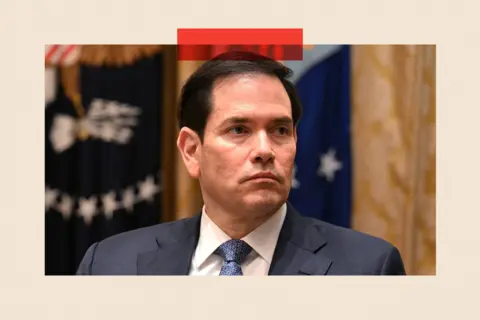
Secretary of State Marco Rubio came close to doing so.
"We know who the parties are that are involved (in weapons supply)," he said in November. "That's why they're part of the Quad along with other countries involved. Pressure is being applied to the relevant parties."
 Getty Images
But Rubio did not name the party, and analysts agree the Trump administration is unlikely to do so, let alone apply pressure by targeting the UAE's assets, as suggested by advocacy groups.
"It's quite a difficult circle to square for them," says Khair, the Sudanese political analyst. "The US has to figure out how to allay the concerns of, as well as appease, its foreign friends who are actively involved in this war, in particular Egypt, Saudi Arabia and the UAE. And it hasn't yet figured out how to do that."
Soliman says that the US government has been "hedging its bets because it doesn't really want to choose between Saudi Arabia and the UAE, which would damage wider relationships" with the countries involved.
A pawn on the international chessboard?
The search for a solution is made harder by tussles involving nearby powers – with some analysts comparing Sudan's war to a modern-day scramble for Africa.
And the landscape has become even more tricky in recent months, as other members of the Quad become more actively involved in the war.
Egypt has begun bombing RSF supply convoys and other targets with a powerful model of Turkish combat drone from a remote airstrip near its south-western border with Sudan, according to investigations carried out by the New York Times and the Reuters News agency – something on which Cairo has not commented.
The escalation came after fighting moved closer to Egypt's border.
It may also have been influenced by more muscular support for the army from Saudi Arabia, as Riyadh seeks to push back on Emirati influence in the region.
Tensions between Saudi Arabia and the UAE have been building and in December relations between the two Gulf powers ruptured over the conflict in Yemen - with potential consequences for any chance of a solution in Sudan.
How to bring peace
To achieve peace, talks would have to deal with the root causes of the conflict - particularly the fact that both sides have reasons why it might suit them for the war to continue.
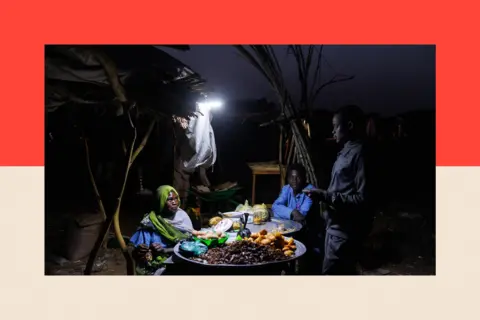
If a ceasefire could be agreed, in the short term it could provide some respite to the civilians trapped in the world's worst humanitarian crisis – including 25 million people facing acute food shortages and 12 million people displaced.
But many fear it wouldn't lead to lasting peace.
"I don't really see a humanitarian truce working," says Boswell.
"It's become so existential that neither party would agree to stop their operations unless it was part of a broader deal that sorted out the most important questions of what comes next, because neither side would trust the other to actually stop."
 AFP via Getty Images
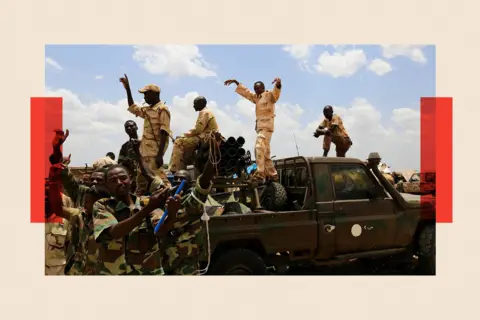
And although this is a national struggle between two powerhouses of Sudan's security state, it is being driven at the local level by marginalised ethnic groups – allied to the RSF – who see it as their chance to get better access to resources and better representation, or just to get their slice of the war economy.
At the same time, the Islamist establishment has seen opportunity in the war.
"They don't want it to end before they've positioned themselves for a comeback," says Kholood Khair.
There is also the question of accountability. The army and the paramilitaries, along with their allied militias, all stand accused of war crimes, ethnically targeted atrocities and the mass killings of civilians - raising the prospect of post-war prosecutions for military leaders.
So political negotiations would most likely need to include a formula for armed actors to retain some of their gains and soften some of the consequences of laying down their weapons. But even this might not be enough.
Civilian rule – the stated goal of the Quad roadmap – would also mean a loss of income for the security forces, Khair adds.
"A permanent end to the conflict would require demilitarising Sudan and a new constitution that enshrines rights and access to resources," she says, but these "are precisely the things that the security complex in Sudan does not want".
Effective and dedicated mediation would also be required. But while the Trump administration has made serious efforts, its staying power and attention span are in question.
"The US isn't going to be involved in a peace process for the long haul," says Soliman. "And nobody else is presenting a coherent follow-up mechanism."
The big fear
In September 2024 I asked a senior Sudanese defence official how long he thought the war would last – ominously, he compared the conflict to America's 20-year battle against the Taliban in Afghanistan.
He needn't have looked that far afield. History shows all of Sudan's wars have been long - one of them lasted more than 20 years.
But another protracted conflict could bring with it new dangers – including the potential for the country to split, or fragment.
"We're only in year three of this war," says Khair. "If it continues for another 10, 15, 20 years, as history tells us is likely, then we could see the balkanisation of Sudan."
That is a worrying scenario for the entire region.
Already the conflict has drawn in Sudan's neighbours - all seven of them are hosting Sudanese refugees. There's evidence some are serving as conduits for RSF weapons and other supplies, as well as warning signs that the violence could cross borders and aggravate internal tensions.
Perhaps the dangers of a destructive stalemate might eventually lead the powerful backers of Sudan's warring parties to rethink their strategies, says Soliman.
"A fragmented, insecure and highly unstable Sudan is not beneficial to them," he says. "That's the one grain I hope will push the regional actors to come together at some point to make some concessions and chart a way forward. I don't envisage anything else being feasible."

BBC InDepth is the home on the website and app for the best analysis, with fresh perspectives that challenge assumptions and deep reporting on the biggest issues of the day. Emma Barnett and John Simpson bring their pick of the most thought-provoking deep reads and analysis, every Saturday. Sign up for the newsletter here