

Perhaps it's my refusal to uncritically buy into the idea that everyone will be a specs wearer in the future, but I always appreciate it when companies think of alternative AI-based wearables to smart glasses. That's why I was excited to get some hands-on time with Motorola's Project Maxwell at MWC in Barcelona this week, after missing out on seeing it at CES back in January.
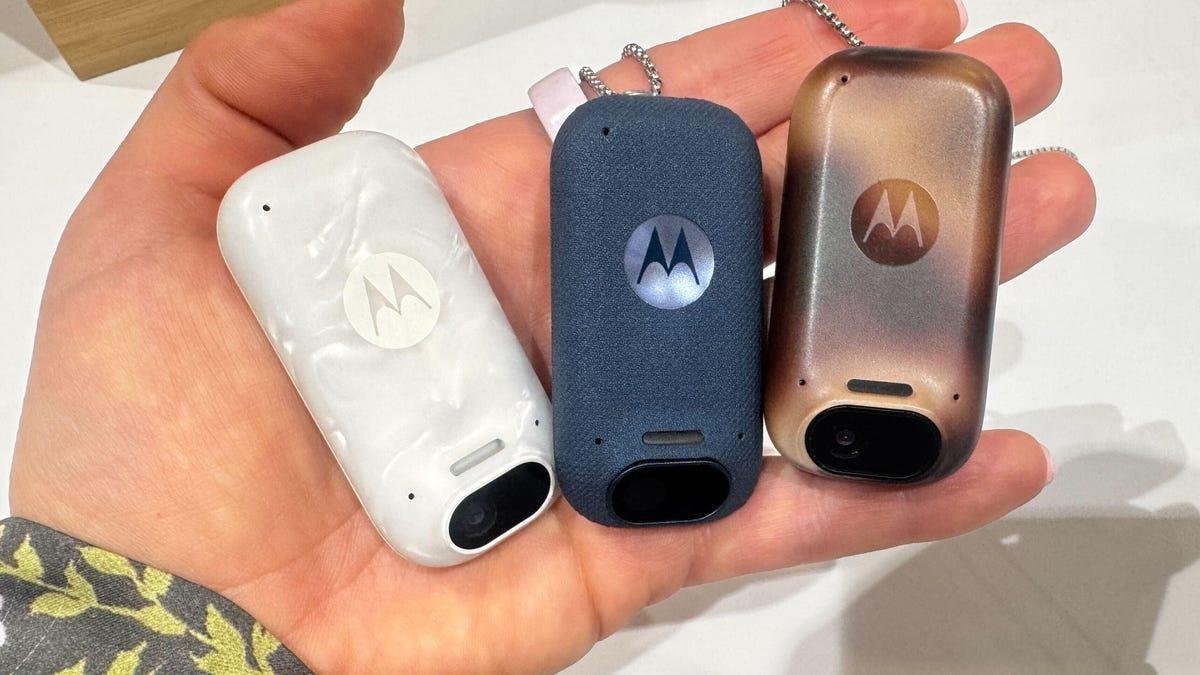
Project Maxwell is an aesthetically pleasing pebble-shaped pin/pendant with a camera and microphones that functions as a perceptive companion. It hangs around your neck, seeing what you see and hearing what you hear. What it absolutely is not, says Mohammed Abdul-Gaffoor, the executive director of engineering who leads Motorola's experimental 312 Labs, is an attempt to replace your phone.
This is perhaps where previous attempts to build standalone AI devices, such as the Humane AI Pin, failed. But Project Maxwell is part of a new cohort of AI wearables, also including the Plaud AI Pin and the Looki L1 life-logging pendant, that take advantage of advances in large language models and agentic AI to provide a new experience. Abdul-Gafoor is the first to admit that concept of a pin is not new, but this is perhaps the first time a major existing player in the mobile market has thrown any weight behind the idea.
"What it allows you to do is be heads-up, hands-free and be in the moment," he tells me at MWC. Wearing the proof-of-concept device around his neck, Abdul-Gaffoor shows me how it can read a menu in a foreign language and make recommendations about dishes he might like based on its knowledge of his preferences. Like other wearable AI, it can also offer turn-by-turn directions and translate a real-time conversation between two people speaking different languages.
But Abdul-Gaffoor also encourages me to think about exactly how Project Maxwell might integrate into a wider ecosystem of AI-enabled devices, rather than just as a way to interact with Motorola's smart assistant Qira. It also serves as a learning sensor, inputting data about your life, preferences and surroundings that can provide your other devices with context.
It was key to tap into voice and vision to bring this project to life, as they're the most natural form of interaction for humans, says Abdul-Gaffoor. "We got used to managing without that by having typing or writing or touch over the years -- because of the limitations of the technology," he says. "But the technology is now getting to a point where we can actually directly use those primordial human interaction modes."
Motorola wants its wearables to feel somewhat comfortable and familiar.
Katie Collins/CNETEqually important was the look and feel of the device, which sits easily in the palm of your hand, is soft to the touch and comes in a range of colors and patterns (with the dappled white being my personal favorite). "Anything people want to wear, it's something they need to be somewhat familiar with," said Abdul-Gaffoor. "And also anything that they put on their body, it needs to be... not a geeky thing."
Dating all the way back to the original Razr days, Motorola has also had a flair for iconic design. Today that's echoed in partnerships with Pantone and Swarovski, and most recently in the luxurious look and feel of the Motorola Razr Fold.
Motorola's experimental approach
As cool as Project Maxwell is as a standalone concept, it also signals to Motorola's broader experimental approach to the emerging AI wearables space that leaves me excited for what might come next.
On the first day of MWC, Qualcomm unveiled its new Snapdragon Wear Elite wearables chip, promising that it would be in devices from Google, Samsung and Motorola. For Google and Samsung, this, at least initially, will mean the next generation of their smartwatches. But it seems as though Motorola is thinking bigger.
The proof-of-concept device is already powered by a Qualcomm chip.
Katie Collins/CNETProject Maxwell is currently powered by an earlier wearable chip, but the increased power efficiency of Wear Elite and the ability to process locally on device opens up new opportunities for Motorola to experiment further even than it has already. "The Wear Elite platform will allow us to fully explore concepts like Maxwell and to push further -- even further beyond what we've demonstrated so far," said Francois LaFlamme, Motorola's VP and chief strategy and marketing officer speaking at the Qualcomm launch event.
It's not currently clear exactly what these other concepts might be, but through his work at 312 Labs, Abdul-Gaffoor has a legacy of working on unique concepts such as Motorola's adaptive bendable phone, not to mention its rollable phone. The company is evaluating many different ideas, he tells me. "I cannot go into specifics of it, but everything, as part of our labs mission, we are exploring those different concepts and the experience and then the form factors."
This feels like just the beginning for wearable AI. Smart glasses and smartwatches will no doubt continue to dominate the conversation at large, but pins, pendants and other yet-to-be-invented devices all have an opportunity here to win us over -- and Motorola is one of the biggest players currently leading that charge.