

There might not seem much use for a physical switch on a phone that manually shuts off your camera and microphone -- unless you're worried about somebody listening in without your consent.
That's the appeal of the Hiroh, a $1,100 privacy-focused Android smartphone due out in late April that I saw among the tech on display at MWC 2026. While it may sound paranoid to wonder who's listening in or watching you through your own phone's components, some people in sensitive positions, like many government contractors, need phones with cameras and microphones disabled. Others prefer to be safer than sorry when it comes to personal privacy, in general or when they travel to countries where digital snooping is more likely.
A decade after Facebook's Cambridge Analytica scandal, people have become increasingly aware of how their activity and data are collected by owners of the services and products they use. There have been privacy-oriented alternatives to popular software for some time, but hardware is catching up, with devices like the Punkt MC03 and other phones that deliberately restrict app and software access to people's data. The Hiroh is another approach to appeal to folks with these concerns, with access to more apps and better cameras than current privacy phones, Hiroh CEO Victor Cocchia told me.
"What I've seen over the past 15 years is that people for the most part don't want to give up convenience for security. They want to be able to do all the things because we've become so dependent on our phones," Cocchia said.
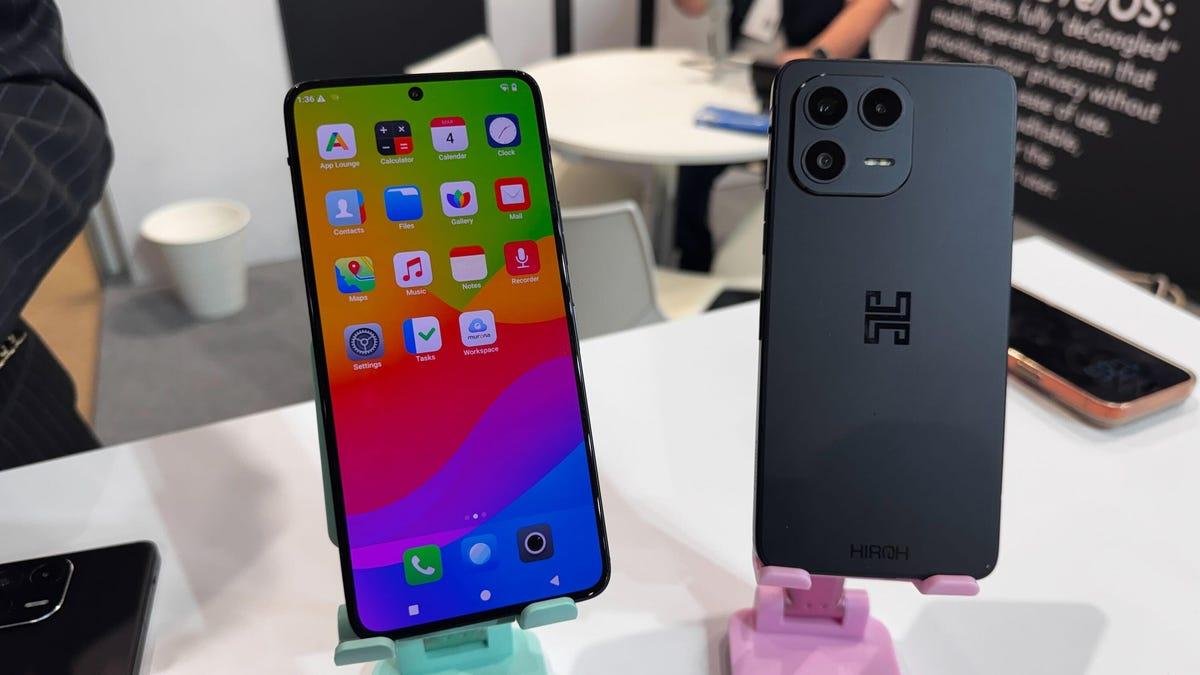
The Hiroh phone is the first device from the company of the same name, which is made up of veteran phone makers producing a device for a privacy-concerned audience. On the surface, the Hiroh doesn't look very different from many of the other phones we saw at MWC as a standard smartphone with a glass front and a matte black back, topped by a 108-megapixel main camera.
On the left side of the Hiroh phone is a privacy toggle that cuts off access to the microphone and camera -- when it's switched on, the light glows red.
David Lumb/CNETThe only thing tipping off onlookers that the Hiroh has something else going on are the two physical switches on either side of the phone. One is the aforementioned toggle on the left side of the phone to switch off the cameras and microphones, which happens at the circuit level. Once switched off, an app can't turn them back on, Cocchia said.
He demonstrated how it works during a phone call, in which I heard his voice coming out of the other phone's speaker until he flicked on the privacy switch. Ditto with the camera. When the privacy switch is on, a red light indicates that the feature is engaged.
"[With the toggle on,] from a government standpoint, if I'm out in the field talking to someone, I know that I'm not being attacked. If I'm doing business in a meeting, I know someone's not stealing my IP," Cocchia said. "And if I'm a consumer, I know that the apps on my phone aren't listening to what I say."
On the right side of the Hiroh is the other switch, which cuts off all connectivity when the switch is thrown -- essentially, it's a physical super Airplane Mode toggle, but one that cuts all communications, including Wi-Fi and Bluetooth. This assures that apps aren't leaking your location or tapping your other sensors, like gyrometer or altimeter, to mine more information.
That's the hardware part, but the Hiroh also has privacy features in its software. It has a proprietary app with text messaging, email and other communication options that are end-to-end encrypted -- friends you want to connect with securely need only download the free Hiroh app and send messages within it.
The Hiroh phone's EOS operating system also has advanced privacy options to further stymie surveillance and data collection.
David Lumb/CNETThe Hiroh's other privacy software is the phone's operating system itself. By default, the phone runs the EOS operating system, created by European company Murena as an Android open-source alternative that has strict privacy controls, including a settings submenu with options to block apps' trackers and ads, spoof a person's location and even hide their IP address through the TOR network.
If folks want, they can opt to buy the phone with stock Android instead and still get the benefits of the physical toggles. It may do a worse job of protecting user data than the EOS version, but it's still better than most other phones.
The Hiroh is otherwise a standard Android smartphone, with a 6.67-inch display, one 108-megapixel camera, one 13-megapixel telephoto camera and a 2-megapixel ultrawide camera on the back along with a 32-megapixel selfie shooter on the front. It's powered by a Dimensity 8300 chip and has 16GB of memory as well as 256GB of storage to start, with a microSD slot for up to 2TB of extra encrypted storage. In accordance with EU law, the Hiroh provides five years of software and security updates. Cocchia noted that Hiroh plans to add more of its own privacy-focused apps in the future as part of its support strategy.
In contrast with the Hiroh, the Punkt MC03 smartphone I saw at CES takes a far more extreme and transparent approach to app privacy, allowing owners to dial an app's privacy settings up or down to enable more casual use or completely isolate it from the world to safeguard user data. But the MC03 also requires a paid monthly subscription to supplement its development and support.
The Hiroh has a less severe approach to privacy, making it likely more appealing to the average phone owner who's just starting out on their privacy-protecting journey and could use a more familiar interface. But both represent a new era of devices that put privacy more in the hands of the people using the devices, not the companies harvesting their customers' information.