Spectacular images reveal unique sea creatures and corals off Caribbean islands
Georgina RannardScience reporter

 CEFAS
CEFAS
The waters off the glittering coastlines of Britain's Caribbean territories have long been a mystery.
But now scientists on the first expedition beyond the islands' shallows have discovered an underwater mountain range, a massive "blue hole", coral reefs apparently untouched by climate change and never-before-seen sea creatures.
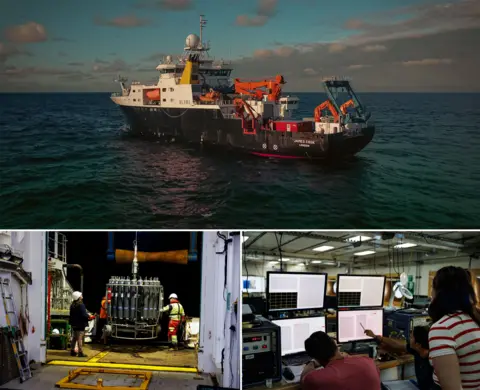
Operating 24 hours a day for the last six weeks, researchers subjected cameras and other equipment to extreme water pressure, recording as deep as 6,000m (19,700ft).
To navigate the Cayman Islands, Anguilla and Turks and Caicos, they were forced to rely on decades-old maps with serious errors and whole areas missing.
The UK Centre for Environment, Fisheries and Aquaculture Science (CEFAS) has shared their footage and discoveries exclusively with BBC News.
 Lawrence Eagling and the Blue Belt Programme
The UK government shares responsibility for protecting the islands' nature and up to 90% of Britain's unique species are found around these and other British Overseas Territories.
Now scientists say the race is on to protect this "relatively pristine" environment from the threats of climate change and pollution.
"This is the first step into environments people have never seen, and in some cases didn't know existed," says Prof James Bell, leading the expedition on the British research ship RSS James Cook with scientists from the three islands.
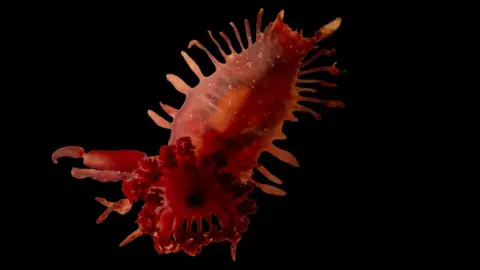
"Just yesterday we found a kind of type of swimming sea cucumber, and we still don't know what it is," he added, calling the diversity he's seen "really, really astonishing".
 CEFAS
CEFAS
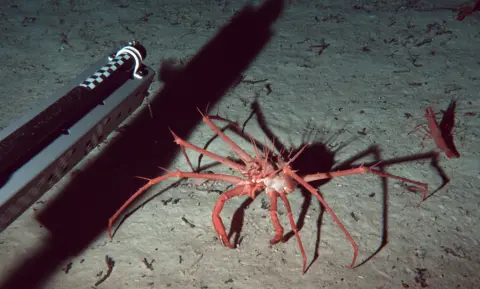
The Cayman Islands, Anguilla and Turks and Caicos are home to 146 species that only live in those territories, and this research expedition should add even more to the list.
The team documented nearly 14,000 individual specimens and 290 different types of marine creatures, although more scientific work is needed to confirm their findings.
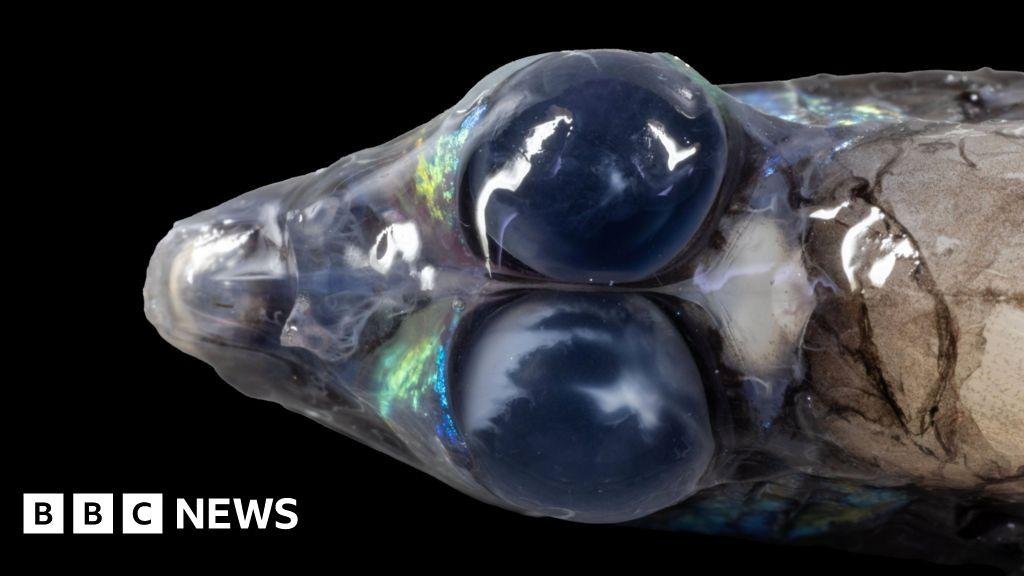
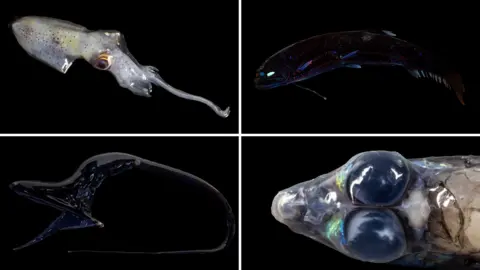
They found a pelican eel with a glowing pink tail that flashes red to lure in food, a barreleye fish with tubular eyes pointing upwards to see the silhouettes of its prey, and a dragonfish with a glowing rod under its chin.
Talking to BBC News as the ship navigated an uncharted underwater mountain called Pickle Bank, Bell said: "We're not sure how close to it we are. It's quite difficult to map it without running the risk of running aground."
The team eventually worked out that the mountain, which is north of Little Cayman island, rises from 2,500m (8,200ft) deep to about 20m (65ft) below the sea surface.
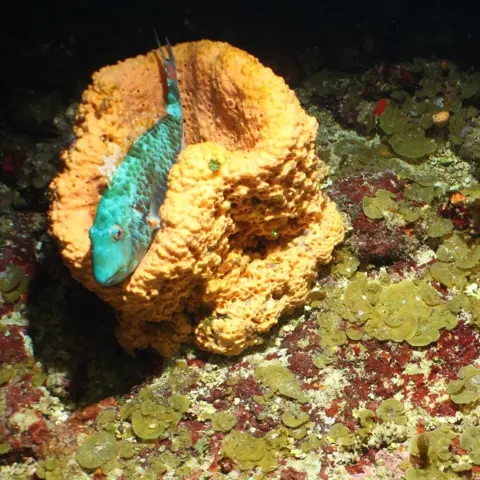
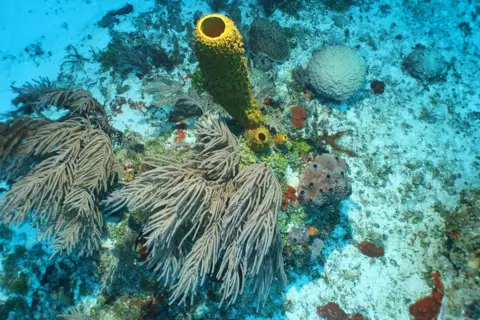
Footage reveals a bright blue, yellow and orange mountain side teeming with life - golden towers of coral growing next to coral that look like large brains.
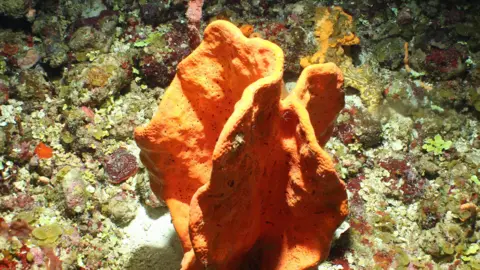
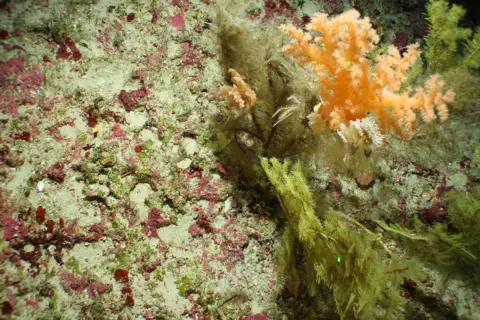
The team filmed fish darting between gorgonian whip coral, and jelly-like orange sea sponges near black coral.
They have found one of the healthiest, most diverse reefs in the region, free from the ravages of the stoney coral disease plaguing the Caribbean. It is likely that this reef is protected, for now, by its depths and the mountain's steep slopes.
 CEFAS
CEFAS
 CEFAS
CEFAS
Deep-water, or mesophotic, reefs, are also usually too deep to be affected by warming ocean temperatures - caused largely by climate change - which have damaged 80% of the world's corals since 2023.
Using deep-sea cameras and echo-sounders lowered from the ship's side, the researchers have mapped almost 25,000 sq km (9,700 sq miles) of sea-floor and captured 20,000 photos, including of glowing lantern fish and alien-like cephalopods.
"We know the surface of Mars or the Moon better than we know the surface of our own planet. You send a satellite around them and map them in a few weeks," Bell says.
"We can't do that for our ocean. We have to map it bit by bit using acoustic instruments on ships," he explains.
In Turks and Caicos, the team discovered something missing from existing sea charts - an extremely steep 3,200m (10,500ft) high mountain ridge stretching 70km (45 miles) along the sea bed, west of a place called Gentry Bank.
 CEFAS
CEFAS
They were also astonished to discover a massive, vertical sinkhole called a blue hole, 75km south of a bank called Grand Turk, that formed when a cave collapsed inwards.
"Imagine taking an ice cream scoop out of the sea-floor. That's what we saw - a crater about 300m (980ft) wide to 550m (1,800ft) below sea level," says Bell.
They believe its steep walls could form the deepest blue hole in the Caribbean, rivalling Belize's famous Great Blue Hole.
Usually nothing lives inside a blue hole, but cameras dropped inside the new discovery show small sponges, a species of urchin called large spatangoid, and diverse fish species.
And 25km (15 miles) north of Anguilla, the researchers followed rumours spread by local fishers who had pulled up pieces of coral while working. The team confirmed there was a 4km (2.5 mile) reef with mosaics of coral growing in sponge "gardens".
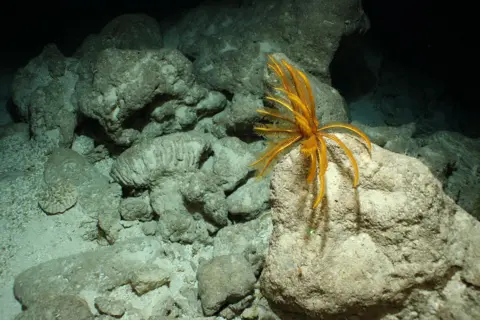
They also found black coral that could be thousands of years old, making them some of the oldest ever recorded.
"It tells us that these environments are really pristine and healthy," says Bell.
 CEFAS
CEFAS
 CEFAS
CEFAS
 CEFAS
CEFAS
Scientists are interested in these areas of deep water and steep mountains because they can funnel nutrient-rich water up to the surface, providing feeding grounds for animals or as fishing spots.
On board the ship, CEFAS worked alongside a group of environmental experts from the Cayman Islands, Anguilla and Turks and Caicos who will use the findings to improve biodiversity management plans and find new fishing opportunities for island communities.
"Our islands were literally born from the sea. But when it comes to our offshore environments, we really haven't had a chance before to discover what's out there," Kelly Forsythe from the Cayman Islands Department of Environment told BBC News. The island governments joined the research as part of a project called Blue Belt Programme.
The work should provide information to help the UK fulfil its legally-binding UN commitments to protect 30% of the world's oceans by 2030 in designated Marine Protected Areas.
"Anyone can draw a box on a map and say, 'That's a marine protected area'," explains Bell.
"But unless you know what's in it, you don't know if that's useful at all."
 CEFAS
CEFAS