Ukraine strings nets over cities as killer drones turn streets into war zones
Ukraine strings nets over cities as killer drones turn streets into war zones

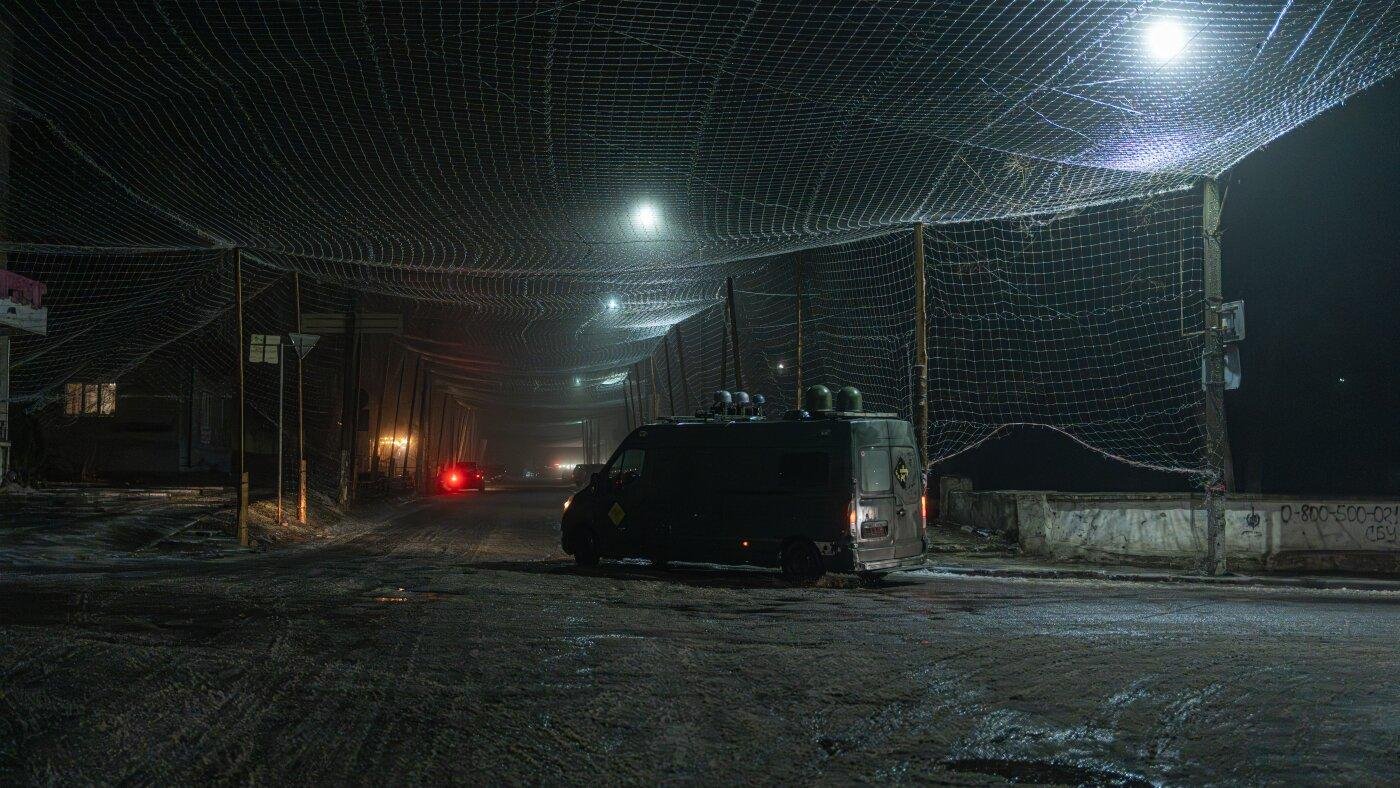
Drone nets cover the streets of Izium, Ukraine, on Feb. 7. The netting discourages drones from diving at cars and people because their propellers get tangled in it. Anton Shtuka for NPR hide caption
toggle caption
Anton Shtuka for NPR
IZIUM, Ukraine — It's not the sight of 19th century buildings pockmarked by shell fragments and bullets that shocks visitors most in this eastern Ukrainian town. It's the fact that they drive into the city through a corridor of white drone netting. It's the latest, low-tech way of stopping one of the high-tech advances of the war — the use of FPV, or first-person-view, drones.
The entire town of Izium is draped in a canopy of anti-drone nets.
"It is strange to suddenly see them appear in a major town," says Andriy, a soldier based here who is not allowed to give his last name. "I think it's kind of sad."
Remotely piloted, FPV drones use a camera to home in on their targets, and the nearly invisible fiber-optic cables they're attached to for navigation purposes make them unjammable. FPV drones have completely transformed the war. They have made the entire front line into what commanders call the "kill zone," a 25-kilometer (15-mile) area where nothing moves and no soldier or vehicle dares to go unless under cloud cover.
According to the Ukrainian military, up to 80% of front-line casualties are now caused by FPV drones, which can fly up to 15 miles.
To change those numbers, Ukrainian military leaders are using a strikingly simple technique: tough, nylon drone netting that stops the drones from diving at cars and people, because their propellers get tangled in it.

Nets line the city streets in Izium, Ukraine, in front of a building that's been destroyed by a Russian attack. Anton Shtuka for NPR hide caption
toggle caption
Anton Shtuka for NPR
Soldier Andriy is sitting in a vibrant café off Izium's Main Street. There's a mix of soldiers and civilians sitting at tables, drinking coffee. It almost feels normal. The air buzzes with light music and the sound of the espresso machine as Victoria Semerei, absorbed in a book, lounges in a chair. The fashion rep from Kyiv is here to spend a couple of days with her husband, on leave from the front line. She says last year they met up in the nearby city of Kramatorsk, a couple of miles to the southeast. But it's become too dangerous now.
"Just at a click, everything changed there," she says. "And now we see all these nets here, and we all understand that it's a sign of something. That the drones can reach any part of the city."
Sophia Verbytska, 19, is the barista. She grew up in Izium and says it was a nice place before the Russians invaded.
"These nets scare us," she says with a nervous sigh. "Because before, there were no nets. And since they appeared, local people feel uncomfortable because it means that the front line is approaching the city."

Sophia Verbytska, 19, is a barista and local resident of Izium, Ukraine. Anton Shtuka for NPR hide caption
toggle caption
Anton Shtuka for NPR
Izium was occupied by Russian forces during the first six months following Russia's full-scale invasion in 2022, before being liberated by the Ukrainian army. Hundreds of civilians were killed during the occupation. There is a mass grave just outside of town, and people say they cannot bear the thought of the Russian army getting closer again.
Outside the café, cars drive along roads inside a tunnel of netting, and people go about their everyday lives as best they can. Twenty-year-old Maksym Yevsiukov makes his way up the icy sidewalk under the drone nets. He says he doesn't mind them because he knows they're here to keep people safe. He and his family lived under the Russian occupation.
"I remember the day they arrived," he says. "We had just returned from shopping. I heard shooting, and when I came out in the street, there were Russian military vehicles and soldiers waving Russian flags. Our family lived in the kitchen for six months. We cooked food outside on an open fire because there was no power."

Civilians walk along Izium's city streets where nets overhang. Anton Shtuka for NPR hide caption
toggle caption
Anton Shtuka for NPR
Yevsiukov says the Russians would take you to the basement and kill you simply for speaking Ukrainian. Or if you said something wrong. He says Ukraine cannot give up any territory it has held onto. "We cannot leave people to the Russians."
Izium is about 10 miles from the border of the Donetsk region, which Russia has been unable to completely conquer. The Kremlin wants Ukraine to hand over the 22% it does not control — in a peace deal — but Ukrainian President Volodymyr Zelenskyy has so far refused, saying a referendum would have to be held on the issue, and a ceasefire would be needed before that could happen.
Pensioner Vadim Iliyenko says he lived in his basement for six months when the Russians were here, but he'd rather not talk about it. "If they put a gun in a dog's mouth, imagine what they did to people," he says.
Iliyenko says the Russians cannot be trusted. "They say they want only the Donbas region, but they will be back for more later. This is not a real war. War is when soldiers fight soldiers. The Russians are killing civilians. This is a crime," he says.

Vadim Iliyenko, a pensioner and local resident of Izium, says he lived in his basement for six months when the Russians were here. Anton Shtuka for NPR hide caption
toggle caption
Anton Shtuka for NPR
At an undisclosed location outside of town, Dr. Oleksiy Mykoliuk treats soldiers from the front line. He's seen the damage done by FPV drones and says Izium is taking a necessary step.
"We did not have a lot of drones here yet, but we don't know how many drones we're going to get in even a couple weeks," he says. "The front line is coming every day. We don't know for how much time our skies will be safe."
Mykoliuk says the nets can save the lives of pedestrians and drivers.
Earlier this month, in another front-line area, a drone attacked a bus carrying mine workers returning home from their shift. Twelve people were killed.
As a precaution, the highway leading out of Izium to the next town has also been enclosed in a corridor of netting. Ukraine's government plans to install some 2,500 miles of drone nets on front-line roads by the end of 2026.

Nets along the city streets in Izium, Ukraine. Anton Shtuka for NPR hide caption
toggle caption
Anton Shtuka for NPR
Patrocinado
Patrocinado
Patrocinado
Patrocinado
Anúncios
Categorias
Leia Mais
Ukrainian slider Vladyslav Herasevych's appeal to wear 'helmet of remembrance' dismissed by sport courtUkrainian skeleton racer Vladyslav Heraskevych will not compete at the Winter Olympics after the Court of Arbitration for Sport (Cas) dismissed his appeal to wear a helmet depicting images of athletes killed during Russia's invasion of his home country.Heraskevych asked Cas to reinstate his...

Trump cuts his losses on Kristi Noem after mounting backlashTrump cuts his losses on Noem after controversial tenure at homeland securityDaniel BushWashington correspondentWatch: The BBC's Daniel Bush on Trump replacing Kristi NoemSooner or later, advisers in President Donald Trump's orbit all come to learn the same unwritten rule: no one can outshine the boss.Kristi Noem, the secretary of the...

AI Cooking Robots Have Flopped. Will the Nosh One Be Any Different? Here's My Take Why You Can Trust CNET Our expert, award-winning staff selects the products we cover and rigorously researches and tests our top picks. If you buy through our links, we may get a commission. Reviews ethics statement I saw the new $1,499 Nosh One up close. Here's my take on the latest AI-powered...

Who is held accountable if a war crime is committed in Iran?Who is held accountable if a war crime is committed in Iran? NPR's Scott Detrow speaks with international law expert Gabor Rona about attacks on civilian infrastructure in the Iran conflict and how they may constitute war crimes. World Who is held accountable if a war crime is committed in...

Job Hunting? Cut These 3 Overused Words from Your Resume Now We research all brands listed and may earn a fee from our partners. Research and financial considerations may influence how brands are displayed. Not all brands are included. Learn more. Today’s job market is competitive, and hunting for a new role can feel like a slog. The last...