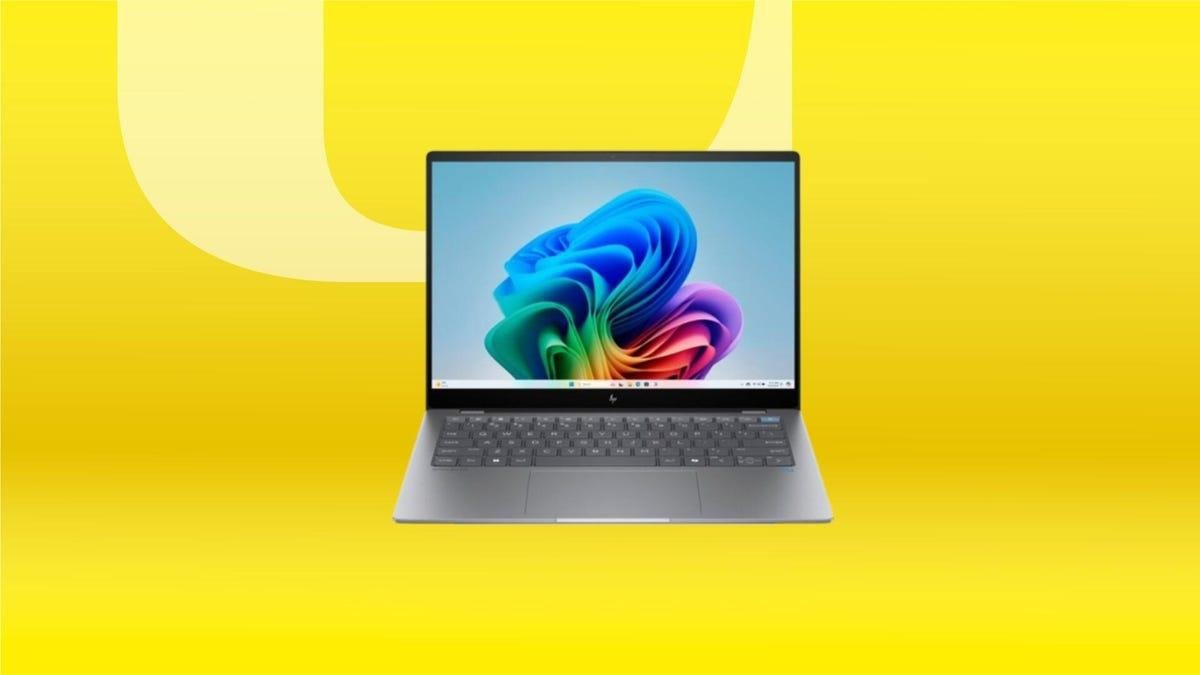
Apple's MacBooks have dominated in battery life in recent years, but the situation has changed now that Windows laptops, in addition to Intel and AMD, have a third CPU option: Qualcomm's Arm-based Snapdragon X chips. The longest-running laptop we've tested is the HP OmniBook 5 14, which has a Snapdragon X Plus chip. Intel-based laptops have also proved to be efficient of late, from the Lunar Lake-based Lenovo Yoga 9i 2-in-1 Aura Edition to the MSI Prestige 14 Flip AI Plus and Dell XPS 14 with processors from Intel's latest Panther Lake series. If you are shopping for a long-lasting laptop, you've got a variety of options. Here are our favorites.
Only a few weeks after ceding the battery life throne to Lenovo in our tests, HP has snatched back the crown with the OmniBook 5 14.
Pros
- Unbelievable battery life
- Sturdy, stylish and compact design
- OLED display delivers deep blacks, vivid colors
- Generous RAM and SSD for the price
Cons
- OLED display isn't the brightest
- Slow USB-C ports
The Lenovo Yoga 9i 2-in-1 Aura Edition is greater than the sum of its parts. Based on a common Intel Core Ultra Series 2 processor, its component lineup is not all that unusual. But placed inside a sleek and compact enclosure and outfitted with a beautiful 2.8K OLED display becomes a truly exceptional two-in-one.
Pros
- Beautiful OLED display
- Compact package with sleek aesthetics
- Record-setting battery life
- Great audio and webcam
Cons
- Mechanical rather than haptic trackpad
- No HDMI port or SIM card reader
The Prestige 14 Flip AI has a Core Ultra Series 3 processor from Intel’s new Panther Lake series and offers an unprecedented combination of 3D graphics power and all-day battery life.
Pros
- Playable framerates from integrated Intel Arc B390 graphics
- Around-the-clock battery life
- Thin and light and quiet
- MSI's new Prestige design is huge improvement
Cons
- Display is only 60Hz
- Bottom panel gets hot during games
- Diving-board effect with mechanical touchpad
Built around an Arm-based Qualcomm Snapdragon X processor, the Zenbook A14 is the lightest Copilot Plus PC we've tested and the second-longest running. It weighs less than 2.2 pounds and offers a battery life of more than 24 hours.
Pros
- Incredibly thin and light without feeling flimsy
- All-day-and-all-night battery life
- OLED display at this price is a nice surprise
- Ample RAM and storage for the price too
Cons
- Meh performance from Snapdragon X CPU
- Meh mechanical touchpad
- Meh speakers
The 14-inch MacBook Pro was the first to get Apple's latest M5 processor. CNET senior editor Lori Grunin tested the new M5 MacBook Pro and found the chip's upgraded GPU architecture delivers big performance improvements over the M4 in certain areas such as AI image generation and ray-traced graphics.
Pros
- Excellent screen, especially with nano-texture
- Great performance
- Good size and reasonable weight for everyday use
- Same first-rate design as previous models
Cons
- Screen notch remains irritating
- Big drop in performance in low-power mode
- Only two external displays supported in the M5 model
- Prone to fingerprint smudges
- Bundled 70-watt adapter doesn't support fast charging
LAPTOP DEALS OF THE WEEK
Deals are selected by the CNET Group commerce team, and may be unrelated to this article.
What makes a laptop have good battery life?
Everyone can agree that longer battery life in a laptop is better, but many parts of a laptop stand in contrast to a long runtime. High-powered CPUs and graphics, for example, drain the battery faster than more efficient and less powerful components. Larger, brighter and higher-resolution screens consume more battery resources than smaller, dimmer displays that have fewer pixels to power. The type of display matters too. While an OLED panel offers a superior picture to that of an LCD screen, it tends to drain the battery faster. The size of the laptop can also play a role, with compact and thin ultraportables usually relying on smaller batteries than larger laptops that have room for a bigger, longer-lasting battery.
So there are trade-offs to be made in many cases in order for a laptop to achieve lengthy battery life. If your primary concern, however, is finding a laptop that will last the majority of a day on a single charge, then you've come to the right place. We've assembled a list of the laptops that have produced the longest battery life scores in CNET Labs in the past year.
Powered by a Qualcomm Snapdragon X processor, the HP OmniBook 5 14 offers more than 28 hours of battery life.
Matt Elliott/CNETHow do we test for battery life? In CNET Labs, we put every laptop we review through a suite of benchmarks to test for performance and battery life. To get a sense of how long a laptop can last on a single charge, we fully charge its battery and, with uniform screen brightness, volume and sleep/hibernate settings, we conduct a video playback test that streams a video over Wi-Fi on an endless loop until the battery dies. For more details, you can read how we test laptops.
Our battery benchmark is just that, a benchmark. We use it because it can be replicated on any laptop, regardless of operating system or manufacturer. You'll likely get shorter runtimes than the results of our battery-drain test if you're using the laptop for more demanding applications than streaming video, and you might be able to eke out even better battery life under scenarios where the laptop sits idle in between sessions of use instead of constantly streaming a video.
Best battery life laptops for 2026
These are the longest-lasting laptops we've tested in the past year, and each offers 15 hours or more of battery life.
| Laptop name | Processor tested | Battery life in hours, minutes |
|---|---|---|
| HP OmniBook 5 14 | Qualcomm Snapdragon X Plus X1P-42-100 | 28 h 19 m |
| Lenovo Yoga 9i 2-in-1 Aura Edition | Intel Core Ultra 7 258V | 25 h 45 m |
| MSI Prestige 14 Flip AI Plus | Intel Core Ultra X7 358H | 25 h 18 m |
| HP OmniBook X 14 | Qualcomm Snapdragon X Elite X1E-78-100 | 25 h 12 m |
| Microsoft Surface Laptop (13 inch) | Qualcomm Snapdragon X Plus X1-P42-100 | 24 h 20 m |
| Asus Zenbook A14 | Qualcomm Snapdragon X X1-26-100 | 24 h 7 m |
| Acer Swift Go 14 AI | Qualcomm Snapdragon X Plus X1P-42-100 | 23 h 13 m |
| Apple MacBook Pro 14 (M5, 2025) | Apple M5 | 22 h 59 m |
| Microsoft Surface Pro (12-inch) | Qualcomm Snapdragon X Plus X1P-42-100 | 22 h 29 m |
| Acer Swift 14 AI | Intel Core Ultra 7 258V | 22 h 13 m |
| Acer Aspire 16 AI | Qualcomm Snapdragon X X1-26-100 | 21 h 9 m |
| Dell XPS 14 | Intel Core Ultra 7 355 | 21 h 7 m |
| Microsoft Surface Laptop 7 | Qualcomm Snapdragon X Elite X1E-80-100 | 19 h 50 m |
| Acer Aspire 14 AI | Intel Core Ultra 5 226V | 18 h 56 m |
| Lenovo ThinkPad X1 2-in-1 Gen 10 Aura Edition | Intel Core Ultra 7 258V | 17 h 40 m |
| Apple MacBook Air 13 (M5, 2026) | Apple M5 | 17 h 2 m |
| Apple MacBook Air 15 (M4, 2025) | Apple M4 | 16 h 41 m |
| Apple MacBook Air 13 (M4, 2025) | Apple M4 | 15 h 50 m |
| Asus Vivobook S 15 | Qualcomm Snapdragon X Elite X1E-78-100 | 15 h 26 m |
| Asus Zenbook S 14 | Intel Core Ultra 7 258V | 15 h 20 m |
Pros
- Unbelievable battery life
- Sturdy, stylish and compact design
- OLED display delivers deep blacks, vivid colors
- Generous RAM and SSD for the price
Cons
- OLED display isn't the brightest
- Slow USB-C ports
Only a few weeks after ceding the battery life throne to Lenovo in our tests, HP has snatched back the crown with the OmniBook 5 14.
Why we like it
For starters, it runs and runs (and runs and runs). It’s the current battery life champ, lasting more than 28 hours in testing. In addition to record-setting battery life, the OmniBook 5 14 offers a simple, elegant design and easy-to-carry weight -- plus, an OLED display that delivers stellar contrast and vivid colors. It also supplies an ample 32GB of RAM and a roomy 1TB SSD, neither of which is a given in a laptop that costs less than $1,000.
Who it’s best for
For students and others constantly on the go, the OmniBook 5 14 is a fantastic pick at a great price.
Who shouldn’t buy it
If you are concerned about Windows-on-Arm compatibility issues, then you should skip the Snapdragon X-based OmniBook 5 14 and go for an Intel- or AMD-based laptop.
Pros
- Beautiful OLED display
- Compact package with sleek aesthetics
- Record-setting battery life
- Great audio and webcam
Cons
- Mechanical rather than haptic trackpad
- No HDMI port or SIM card reader
The Lenovo Yoga 9i 2-in-1 Aura Edition is greater than the sum of its parts. Based on a common Intel Core Ultra Series 2 processor, its component lineup is not all that unusual. But placed inside a sleek and compact enclosure and outfitted with a beautiful 2.8K OLED display becomes a truly exceptional two-in-one.
Why we like it
This 14-inch ultraportable two-in-one is well-crafted, well-specced and remarkably well-priced. We love the trim and sturdy chassis, beautiful 2.8K OLED display and unique rotating soundbar that produces robust audio output. And the Yoga 9i runs and runs and runs.
Who it’s best for
The Yoga 9i is perfectly tailored for remote or office workers -- or really anyone who wants a modern laptop that can also rotate into a tablet. Its record-setting battery life will let you leave the charger at home for days at a time and makes up for the fact that this premium two-in-one lacks a premium haptic touchpad.
Who shouldn’t buy it
Anyone who demands a haptic touchpad in a premium laptop. And students and other budget shoppers can save some money and still get a great package with Lenovo’s mainstream Yoga 7 series.
Pros
- Playable framerates from integrated Intel Arc B390 graphics
- Around-the-clock battery life
- Thin and light and quiet
- MSI's new Prestige design is huge improvement
Cons
- Display is only 60Hz
- Bottom panel gets hot during games
- Diving-board effect with mechanical touchpad
The Prestige 14 Flip AI has a Core Ultra Series 3 processor from Intel’s new Panther Lake series and offers an unprecedented combination of 3D graphics power and all-day battery life.
Why we like it
It’s the first laptop with integrated graphics I’ve tested that delivers playable 3D framerates in AAA titles. So, without needing a dedicated GPU, the Prestige 14 Flip AI is compact, portable and quiet during operation. These are not things that usually describe a laptop capable of playing games. And it offers incredible battery life -- calling it “all-day” battery life undersells it.
Who it’s best for
Anyone who wants a do-it-all laptop with enough power for gamers and creators inside a compact, lightweight design with luxuriously long battery life.
Who shouldn’t buy it
If you're shopping for a true gaming laptop, then you’ll still want a model with dedicated Nvidia RTX graphics that supplies higher frame rates. You’ll also want a display that’s faster than the 60Hz panel found here.
Pros
- Incredibly thin and light without feeling flimsy
- All-day-and-all-night battery life
- OLED display at this price is a nice surprise
- Ample RAM and storage for the price too
Cons
- Meh performance from Snapdragon X CPU
- Meh mechanical touchpad
- Meh speakers
Built around an Arm-based Qualcomm Snapdragon X processor, the Zenbook A14 is the lightest Copilot Plus PC we've tested and the second-longest running. It weighs less than 2.2 pounds and offers a battery life of more than 24 hours.
Why we like it
Its Ceraluminum shell allows the Zenbook A14 to be incredibly light yet rigid, and its 14-inch OLED display is excellent. It also serves up ample RAM and storage for the price.
Who it's best for
Students and anyone who is on the road with regularity for their job. If portability is paramount, then the lightweight, long-running Zenbook A14 is the pick.
Who shouldn't get it
If you are concerned about Windows-on-Arm compatibility issues, then you should skip the Zenbook A14 and find an Intel- or AMD-based laptop.
Pros
- Excellent screen, especially with nano-texture
- Great performance
- Good size and reasonable weight for everyday use
- Same first-rate design as previous models
Cons
- Screen notch remains irritating
- Big drop in performance in low-power mode
- Only two external displays supported in the M5 model
- Prone to fingerprint smudges
- Bundled 70-watt adapter doesn't support fast charging
The 14-inch MacBook Pro was the first to get Apple's latest M5 processor. CNET senior editor Lori Grunin tested the new M5 MacBook Pro and found the chip's upgraded GPU architecture delivers big performance improvements over the M4 in certain areas such as AI image generation and ray-traced graphics.
Why we like it
It offers a great mix of power and portability, and the mini-LED display is stunning -- especially with the optional nano-texture layer. And it’s a ProMotion display, meaning it has a smooth 120Hz refresh rate, which is one thing you don’t get with a MacBook Air.
Who it’s best for
Anyone who wants or needs more power that you get with a MacBook Air but doesn’t want to lug around (or pay even more for) the massive 16-inch Pro model.
Who shouldn’t get it
Budget shoppers can save hundreds by opting for a MacBook Air, either the even more portable 13-inch Air or the even roomier 15-inch Air. And power users who need a bigger display and the added power from the higher core counts of an M4 Pro or Max chip are better off with the 16-inch MacBook Pro.
Pros
- Same great Surface Pro design at a smaller price, size
- Good size for tablet mode and light laptop use
- IPS display is sharp and bright
- Good overall performance for the price and exceptional battery life
Cons
- Necessary accessories add to the bill
- Seriously, the charger is an extra $70?
- 12-inch display can feel cramped in laptop mode
- External connectivity limited to a pair of USB-C 3.2 ports
The smaller 12-inch version of Microsoft's detachable two-in-one laptop sacrifices some items to hit a lower price but maintains many of the positives of its larger 13-inch sibling.
Why we like it
With a better build quality than most laptops at its price, the 12-inch Surface Pro offers great value and versatility. We love its sleek aluminum chassis and detachable design.
Who it’s best for
Anyone who wants a secondary device to have around for browsing the web, watching shows and playing casual tablet games on a screen that's larger than your phone's.
Who shouldn’t buy it
People who want a detachable two-in-one as their primary, everyday laptop should consider the larger, more powerful 13-inch Surface Pro.
Pros
- Optimal balance of screen size and laptop weight
- Incredible battery life
- Comfortable keyboard and roomy touchpad
- Crisp 1440p webcam
- Excellent external expansion options
Cons
- Design can't be described as "exciting"
- So-so speakers
Weighing less than 3.5 pounds and offering amazing battery life, the Acer Aspire 16 AI is a 16-inch laptop that's easy to take with you.
Why we like it
The Aspire 16 AI offers an optimal balance of screen size and system weight, making it a unique laptop: the rare 16-inch ultraportable. Plus, its battery life is fantastic, which lets you lighten your load further by leaving the power cord at home. If you are looking for an affordable and portable productivity machine, the Aspire 16 AI checks a lot of boxes.
Who it’s best for
Budget laptop shoppers who are unwilling to choose between screen size and a light weight. The 16-inch Aspire 16 AI doesn’t weigh much more than the average 14-inch laptop, giving you extra screen real estate without sacrificing much in portability.
Who shouldn’t buy it
Students and others constantly on the go will be better served with a smaller, 14-inch laptop that’s more compact and even lighter than the Aspire 16 AI.
Pros
- Sleek, solid design at a reasonable weight
- Strong performance with long battery life
- Quiet and cool operation
- Physical keys have returned to the Function row
- Huge, haptic touchpad
- Quad speakers produce great sound
Cons
- Matches MacBook Pro in price but not performance
- Seams along the edges and below the keyboard are magnets for debris
- Limited port selection with no adapter included
- No fingerprint reader
After killing it off last year, Dell turned right around this year and brought back the XPS this year. The XPS 14 marks a grand return for Dell’s longtime premium laptop brand.
Why we like it
The XPS 14 corrects many of the errors of the Dell 14 Premium, including the most egregious ones, while coming in at a reasonable weight and retaining a solid, well-built chassis. Physical keys returning to the Function is another move in the right direction. Based on Intel’s latest Panther Lake processors, the XPS 14 delivers strong overall performance and long battery life.
Who it’s best for
Creators and other power users who want the power and style of a MacBook Pro in a Windows laptop.
Who shouldn’t buy it
If you are OS agnostic, the MacBook Pro offers better performance and battery life for the same price.
Pros
- Optimal balance of screen size and system weight
- Improved app, graphics and AI performance from M5 chip
Cons
- Costs $500 more than MacBook Neo
- Smooth ProMotion display still exclusive to MacBook Pro
The 15-inch MacBook Air is proof that you don't need a Pro to get a larger display. It supplies a larger screen that you once found only on the pricier Pro models. If you're eyeing the 14- or 16-inch Pro models primarily for the added screen size, the MacBook Air 15 is the more affordable option you should go for, especially at its new lower starting price.
Why we like it
The roomy, 15.3-inch display is powered by Apple's M4 chip and 16GB of RAM. The M4 update adds incremental improvements -- and a new sky blue color -- to an already fantastic laptop that sits in the Goldilocks Zone of Apple's MacBook lineup.
Who it's best for
People looking for a big-screen MacBook who don't need the power of a MacBook Pro. With its roomy display, trim design and new lower starting price, the 15-inch M4 MacBook Air should be viewed as the default Air, with its cheaper and smaller 13-inch sibling a good alternative for students and others with tighter budgets and busy, on-the-go lifestyles.
Who shouldn't get it
Students who need a more affordable and portable laptop will be better off with the 13-inch Air. Creative types who need more graphics oomph will need to spend more for the added power of a MacBook Pro.uni
GeekBook X14 Pro: Geekom’s first laptop is impressively thin and light but battery life disappoints. And I detest the touch pad.
Lenovo IdeaPad 5i 16 2-in-1 Gen 10: Lenovo's low-cost, 16-inch two-in-one is a versatile machine, but it forces you to live with more than a couple of compromises in the design.
Lenovo Yoga Pro 9i Pro 16 Aura Edition: Centered around a gorgeous 16-inch OLED display, this kick-ass Yoga laptop provides the performance and build that graphics pros demand.
Dell 14 Premium: Dell’s creator laptop is rock solid to a fault.
Dell 16 Premium: It’s a good fit for creators as long as you aren't turned off by its peculiar design, hefty weight and high price.
Acer Aspire 16 AI: Weighing less than 3.5 pounds and offering amazing battery life, this is the rare 16-inch laptop that's easy to take with you.
Lenovo Yoga 9i 2-in-1 Aura Edition: This premium two-in-one is a near-perfect package with a fantastic OLED display and record-setting battery life.
Lenovo LOQ 15: This budget gaming laptop has an outdated design but serves up modern components and good 3D performance for the price.
Lenovo ThinkPad X1 2-in-1: This business convertible boasts great build quality and battery life but the display disappoints.
HP Omen 16: This Nvidia GeForce RTX 5060 rig offers good looks and competitive 1080p performance along with surprisingly long battery life and a cool twist on four-zone RGB keyboard backlighting
Alienware Aurora 16: I tested two Alienware Aurora gaming laptops, and this is not the one to get.
Alienware Aurora 16X: This is the Aurora to get.
Lenovo Legion 5i Gen 10: I was impressed with this midrange gaming laptop's 3D performance, but its vibrant, surprisingly bright OLED display puts it over the top.
Acer Nitro V 16S AI: This budget gaming laptop serves up a big screen and big value.
MSI Katana 15 HX: I liked its 1080p performance but little else.
HP OmniBook X Flip 16: While it has a handful of appealing features, this midrange 16-inch convertible ends up being a clumsy assemblage of disparate parts.
Lenovo ThinkPad X9 14 Aura Edition: It offers a cheap path to an OLED ultraportable, but is a ThinkPad a ThinkPad without the little red nub in the middle of the keyboard?
The review process for laptops consists of two parts: performance testing under controlled conditions in the CNET Labs and extensive hands-on use by our reviewers. This includes evaluating a device's aesthetics, ergonomics and features with respect to price. A final review verdict is a combination of both objective and subjective judgments.
We test all laptops with a core set of benchmarks, including Primate Labs Geekbench 6, Cinebench 2024, PCMark 10, a variety of 3DMark benchmarks (whichever can run on the laptop), UL Procyon Photo and Video (where supported), and our own battery life test. If a laptop is intended for gaming, we'll also run benchmarks from Guardians of the Galaxy, The Rift Breaker (CPU and GPU) and Shadow of the Tomb Raider.
For the hands-on, the reviewer uses it for their work during the review period, evaluating how well the design, features (such as the screen, camera and speakers) and manufacturer-supplied software operate as a cohesive whole. We also place importance on how well they work given their cost and where the manufacturer has potentially made upgrades or tradeoffs for its price.
The list of benchmarking software and comparison criteria we use changes over time as the devices we test evolve. You can find a more detailed description of our test methodology on our How We Test Computers page.
There are a ton of laptops on the market at any given moment, and almost all of those models are available in multiple configurations to match your performance and budget needs. So if you're feeling overwhelmed with options when looking for a new laptop, it's understandable. To help simplify things for you, here are the main things you should consider when you start looking.
Price
The search for a new laptop for most people starts with price. If the statistics chipmaker Intel and PC manufacturers hurl at us are correct, you'll be holding onto your next laptop for at least three years. If you can afford to stretch your budget a little to get better specs, do it. And that stands whether you're spending $500 or more than $1,000. In the past, you could get away with spending less upfront with an eye toward upgrading memory and storage in the future. But laptop makers are increasingly moving away from making components easily upgradable, so again, it's best to get as much laptop as you can afford from the start.
Generally speaking, the more you spend, the better the laptop. That could mean better components for faster performance, a nicer display, sturdier build quality, a smaller or lighter design from higher-end materials or even a more comfortable keyboard. All of these things add to the cost of a laptop. I'd love to say $500 will get you a powerful gaming laptop, for example, but that's not the case. Right now, the sweet spot for a reliable laptop that can handle average work, home office or school tasks is between $700 and $800 and a reasonable model for creative work or gaming upwards of about $1,000. The key is to look for discounts on models in all price ranges so you can get more laptop for less.
Operating system
Choosing an operating system is part personal preference and part budget. For the most part, Microsoft Windows and Apple's MacOS do the same things (except for gaming, where Windows is the winner), but they do them differently. Unless there's an OS-specific application you need, go with the one you feel most comfortable using. And if you're not sure which that is, head to an Apple store or a local electronics store and test them out. Or ask friends or family to let you test theirs for a bit. If you have an iPhone or iPad and like it, chances are you'll like MacOS too.
But when it comes to price and variety (and, again, PC gaming), Windows laptops win. If you want MacOS, you're getting a MacBook. While Apple's MacBooks regularly top our best lists, the least expensive one is the M1 MacBook Air for $999. It is regularly discounted to $750 or $800, but if you want a cheaper MacBook, you'll have to consider older refurbished ones.
Windows laptops can be found for as little as a couple of hundred dollars and come in all manner of sizes and designs. Granted, we'd be hard-pressed to find a $200 laptop we'd give a full-throated recommendation to, but if you need a laptop for online shopping, email and word processing, they exist.
If you are on a tight budget, consider a Chromebook. ChromeOS is a different experience than Windows; make sure the applications you need have a Chrome, Android or Linux app before making the leap. But if you spend most of your time roaming the web, writing, streaming video or using cloud-gaming services, they're a good fit.
Size
Remember to consider whether having a lighter, thinner laptop or a touchscreen laptop with a good battery life will be important to you in the future. Size is primarily determined by the screen -- hello, laws of physics -- which in turn factors into battery size, laptop thickness, weight and price. And keep in mind other physics-related characteristics, such as an ultrathin laptop isn't necessarily lighter than a thick one, you can't expect a wide array of connections on a small or ultrathin model and so on.
Screen
When it comes to deciding on a screen, there are a myriad considerations: how much you need to display (which is surprisingly more about resolution than screen size), what types of content you'll be looking at and whether you'll be using it for gaming or creative work.
You really want to optimize pixel density; that is, the number of pixels per inch the screen can display. Though there are other factors that contribute to sharpness, a higher pixel density usually means sharper rendering of text and interface elements. (You can easily calculate the pixel density of any screen at DPI Calculator if you don't feel like doing the math, and you can also find out what math you need to do there.) We recommend a dot pitch of at least 100 pixels per inch as a rule of thumb.
Because of the way Windows and MacOS scale for the display, you're frequently better off with a higher resolution than you'd think. You can always make things bigger on a high-resolution screen, but you can never make them smaller -- to fit more content in the view -- on a low-resolution screen. This is why a 4K, 14-inch screen may sound like unnecessary overkill but may not be if you need to, say, view a wide spreadsheet.
If you need a laptop with relatively accurate color, that displays the most colors possible or that supports HDR, you can't simply trust the specs -- not because manufacturers lie, but because they usually fail to provide the necessary context to understand what the specs they quote mean. You can find a ton of detail about considerations for different types of screen uses in our monitor buying guides for general purpose monitors, creators, gamers and HDR viewing.
Processor
The processor, aka the CPU, is the brains of a laptop. Intel and AMD are the main CPU makers for Windows laptops, with Qualcomm as a new third option with its Arm-based Snapdragon X processors. Both Intel and AMD offer a staggering selection of mobile processors. Making things trickier, both manufacturers have chips designed for different laptop styles, like power-saving chips for ultraportables or faster processors for gaming laptops. Their naming conventions will let you know what type is used. You can head to Intel's or AMD's sites for explanations so you get the performance you want. Generally speaking, the faster the processor speed and the more cores it has, the better the performance will be.
Apple makes its own chips for MacBooks, which makes things slightly more straightforward. But, like Intel and AMD, you'll still want to pay attention to the naming conventions to know what kind of performance to expect. Apple uses its M-series chipsets in Macs. The entry-level MacBook Air uses an M1 chip with an eight-core CPU and seven-core GPU. The current models have M2-series silicon that starts with an eight-core CPU and 10-core GPU and goes up to the M2 Max with a 12-core CPU and a 38-core GPU. Again, generally speaking, the more cores it has, the better the performance.
Battery life has less to do with the number of cores and more to do with CPU architecture, Arm versus x86. Apple’s Arm-based MacBooks and the first Arm-based Copilot Plus PCs we’ve tested offer better battery life than laptops based on x86 processors from Intel and AMD.
Graphics
The graphics processor handles all the work of driving the screen and generating what gets displayed, as well as speeding up a lot of graphics-related (and increasingly, AI-related) operations. For Windows laptops, there are two types of GPUs: integrated (iGPU) or discrete (dGPU). As the names imply, an iGPU is part of the CPU package, while a dGPU is a separate chip with dedicated memory (VRAM) that it communicates with directly, making it faster than sharing memory with the CPU.
Because the iGPU splits space, memory and power with the CPU, it's constrained by the limits of those. It allows for smaller, lighter laptops, but doesn't perform nearly as well as a dGPU. In fact, there are some games and creative software that won't run unless they detect a dGPU or sufficient VRAM. Most productivity software, video streaming, web browsing and other nonspecialized apps will run fine on an iGPU, though.
For more power-hungry graphics needs, like video editing, gaming and streaming, design and so on, you'll need a dGPU; there are only two real companies that make them, Nvidia and AMD, with Intel offering some based on the Xe-branded (or the older UHD Graphics branding) iGPU technology in its CPUs.
Memory
For memory, we highly recommend 16GB of RAM (8GB absolute minimum). RAM is where the operating system stores all the data for currently running applications, and it can fill up fast. After that, it starts swapping between RAM and SSD, which is slower. A lot of sub-$500 laptops have 4GB or 8GB, which in conjunction with a slower disk can make for a frustratingly slow Windows laptop experience. Also, many laptops now have the memory soldered onto the motherboard. Most manufacturers disclose this, but if the RAM type is LPDDR, assume it's soldered and can't be upgraded.
However, some PC makers will solder memory on and also leave an empty internal slot for adding a stick of RAM. You may need to contact the laptop manufacturer or find the laptop's full specs online to confirm. And check the web for user experiences, because the slot may still be hard to get to, it may require nonstandard or hard-to-get memory or other pitfalls.
Storage
You'll still find cheaper hard drives in budget laptops and larger hard drives in gaming laptops, but faster solid-state drives have all but replaced hard drives in laptops. They can make a big difference in performance. But not all SSDs are equally speedy, and cheaper laptops typically have slower drives; if the laptop has only 4GB or 8GB of RAM, it may end up swapping to that drive and the system may slow down quickly while you're working.
Get what you can afford, and you likely need less than you think. If you need to go with a smaller drive, you can always add an external drive or two down the road or use cloud storage to bolster a small internal drive. The one exception is gaming laptops: We don't recommend going with less than a 512GB SSD unless you really like uninstalling games every time you want to play a new game.
Setting a budget is a good place to start when shopping for the best laptop for yourself. The good news is you can get a nice-looking, lightweight laptop with excellent battery life at prices under $500. If you're shopping for a laptop around $500 or less, check out our top picks here, as well as more specific buying advice for that price range.
Higher-end components like Intel Core i-series and AMD Ryzen processors and premium design touches like thin-display bezels and aluminum or magnesium bodies have made their way to laptops priced between $500 and $1,000.