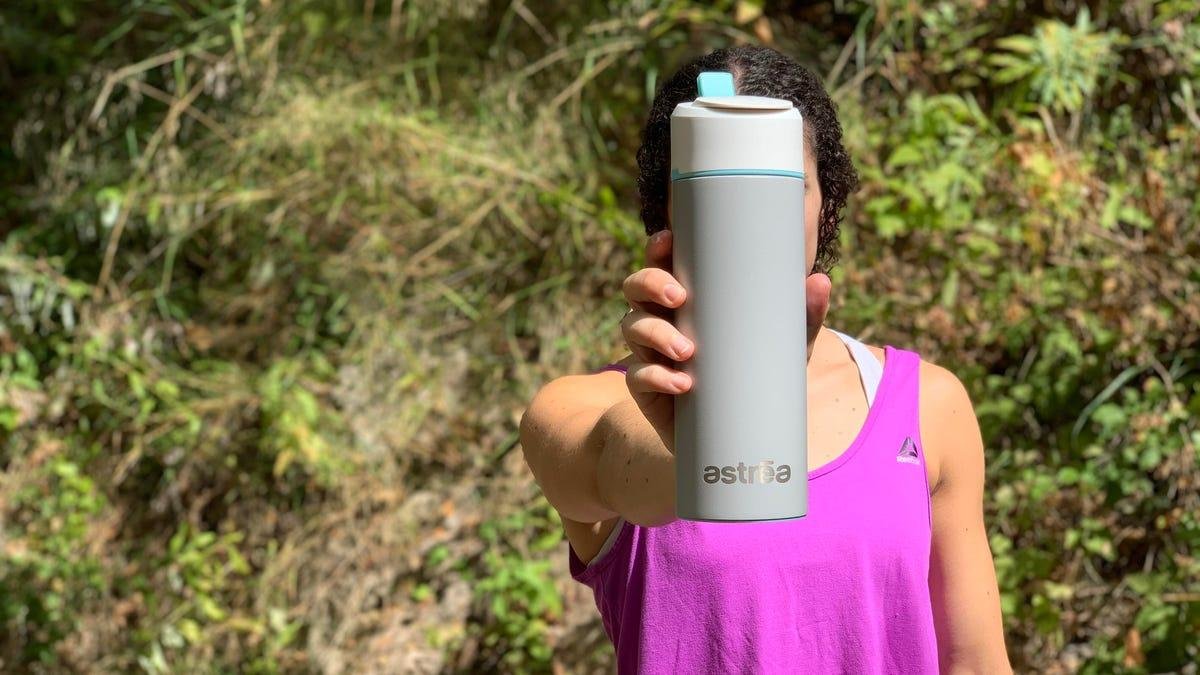
A filtered water bottle can come in handy whether you're out adventuring in the wilderness, traveling to areas with questionable water sources or simply aiming to boost your everyday hydration at home. Thanks to their built-in filters, these bottles can remove contaminants such as lead, bacteria, sediment and even microplastics, making your water safer to drink. It's like having a water filter pitcher, but in a compact, on-the-go version.
Why we like it: The natural water I tested in the bottles already looked relatively clean, but when I poured a bit from the Geopress water purification bottle, I was shocked at how crystal-clear it looked. Although I guess I shouldn't have been surprised, as Grayl's heavy-duty filtering and water purification system is designed to filter out protozoa, chemicals, particulates (like dirt and sand), heavy metals and bacteria and viruses.
Pros
- Relatively easy to clean with dishwasher-compatible parts
- Wide enough opening and 24-ounce capacity to fit ice cubes
- Filters out particulates, heavy meals and germs
- Can withstand 10-foot drops on concrete
- Has NSF/ANSI and EPA certifications
Cons
- Expensive at around $100
- Inner portion and outer portions can suction together if stored when wet
Brita is known for its faucet and pitcher filters, but the company also makes filtered water bottles. According to Brita's website, these bottles aren't intended for outside use — they're intended for just filtered tap water — but this bottle also filtered natural freshwater for me just fine. The Brita filtering water bottle uses an activated carbon filter, which is extremely porous and pulls contaminants, such as chlorine and particulates.
Pros
- Dishwasher-safe
- Comes with a handle for travel
- Affordable at less than $20
- Sturdy
- Has locking top
- Larger capacity up to 36 ounces
- NSF/ANSI certified by the WQA
Cons
- Easy to scratch up
- Best only for tap water
If you want your tap water to stay cold during the day, then you need a water bottle made of heavier, durable material, preferably steel. Luckily, Brita's Premium Filtering Water Bottle also comes in stainless steel. For about $12 more, this water bottle has all the great features of a plastic water bottle and also keeps your water cold for about 24 hours. While I did notice that the ice in my water bottle may melt, the water did stay cold.
Pros
- BPA-free
- Stays cold for about 24 hours
- Filter replacements are affordable at around $5 for each one
- Medium capacity of 20 to 32 ounces
- NSF/ANSI certified by the WQA
Cons
- The body is not dishwasher-safe
- Holds slightly less than plastic Brita bottle
To find the best filtered water bottles, I tested six different ones at a freshwater pool in Southern California’s Santa Monica Mountains. I both taste-tested and examined the water to see how clean it looked, and evaluated the bottles based on design, ease of use and cleaning, NSF/ANSI certification, taste and their filtration systems.
What is the best filtered water bottle overall?
The Grayl Geopress Water Purifier is our favorite thanks to its purification capabilities and taste.
GraylThe Grayl Geopress Water Purifier is the best overall filtered water bottle because our tests found that it turned natural water into fresh-tasting bottled water. The purification system is the most intense of the bottles tested. It can filter out chemicals, pesticides, particles, heavy metals, bacteria and viruses. It also takes little to no prep or waiting, so you can just fill and drink. The Grayl Geopress is great for backpacking, hiking or camping when clean water may be scarce.
Best filtered water bottles of 2026
Pros
- Relatively easy to clean with dishwasher-compatible parts
- Wide enough opening and 24-ounce capacity to fit ice cubes
- Filters out particulates, heavy meals and germs
- Can withstand 10-foot drops on concrete
- Has NSF/ANSI and EPA certifications
Cons
- Expensive at around $100
- Inner portion and outer portions can suction together if stored when wet
Why we like it: The natural water I tested in the bottles already looked relatively clean, but when I poured a bit from the Geopress water purification bottle, I was shocked at how crystal-clear it looked. Although I guess I shouldn't have been surprised, as Grayl's heavy-duty filtering and water purification system is designed to filter out protozoa, chemicals, particulates (like dirt and sand), heavy metals and bacteria and viruses.
The Geopress water purifier is made of BPA-free polypropylene, a durable type of plastic. The wide base diameter of the water purifier gives it a sturdy feel, and it's designed to withstand 10-foot drops onto concrete while it's full of water. Without a doubt, the Geopress is the best-filtered water bottle to keep you hydrated with pure water on a backpacking trip due to its intense filtering mechanism and durability.
Who is it best for: I think this filtered water bottle would be great for anyone going on an outdoor adventure. If you're backpacking, camping, hiking or doing anything else outside where you'd need fresh, clean water, then I think this would be a great filtered water bottle for you.
Who should not get it: If you don't need a filtered water bottle and can make do with a reusable one that you pre-fill for short adventures, then I would hold off on getting one and save money since this is a pricey investment.
Pros
- Dishwasher-safe
- Comes with a handle for travel
- Affordable at less than $20
- Sturdy
- Has locking top
- Larger capacity up to 36 ounces
- NSF/ANSI certified by the WQA
Cons
- Easy to scratch up
- Best only for tap water
Brita is known for its faucet and pitcher filters, but the company also makes filtered water bottles. According to Brita's website, these bottles aren't intended for outside use — they're intended for just filtered tap water — but this bottle also filtered natural freshwater for me just fine. The Brita filtering water bottle uses an activated carbon filter, which is extremely porous and pulls contaminants, such as chlorine and particulates.
This Brita-filtered water bottle is plastic, BPA-free and relatively sturdy. It consists of just three parts: the bottle itself, the flip-top cap and the active carbon filter, which nicely locks into place on the bottom side of the cap. It's easy to put together and requires almost no prep; just quickly wash the bottle and run the water bottle filter under hot water before your first use. I wouldn't take this filter bottle on a backpacking trip. It would suffice for day hikes if you filled it up with tap water first (use it with natural water at your own risk).
Who is it best for: This filtered water bottle is best for those who only plan to use it with tap water for short adventures, such as day hikes or an outdoor workout.
Who should not get it: I would not suggest this filtered water bottle to anyone who wants to use it with natural water on longer trips.
Pros
- BPA-free
- Stays cold for about 24 hours
- Filter replacements are affordable at around $5 for each one
- Medium capacity of 20 to 32 ounces
- NSF/ANSI certified by the WQA
Cons
- The body is not dishwasher-safe
- Holds slightly less than plastic Brita bottle
If you want your tap water to stay cold during the day, then you need a water bottle made of heavier, durable material, preferably steel. Luckily, Brita's Premium Filtering Water Bottle also comes in stainless steel. For about $12 more, this water bottle has all the great features of a plastic water bottle and also keeps your water cold for about 24 hours. While I did notice that the ice in my water bottle may melt, the water did stay cold.
This bottle is also BPA-safe, double-insulated and very sturdy. It looks just like the plastic Brita bottle but a bit heavier. Both are also the same circumference and should fit into most car cup holders. Do note that while the straw and lid are dishwasher safe, the body needs to be hand-washed.
Who is it best for: This filtered water bottle is best for those who plan to use it with tap water -- not natural water. I would recommend it to those who are going to use it for cold drinks while traveling in the car, since it can fit into most car cup holders.
Who should not get it: I would not recommend this filtered water bottle for anyone who needs one for natural water. Also, if you'd like your entire bottle to be dishwasher-safe, this is not the one for you.
| Product | Price | Material | Capacity | Filter replacements | Dishwasher safe? | Certifications |
|---|---|---|---|---|---|---|
| Grayl Geopress Water Purifier | $$$ | Polypropylene | 24 ounces | $30 for one filter | Outer refill, inner press, cap | NSF/ANSI, EPA |
| Brita Premium Filtering Water Bottle | $ | Plastic | 26 to 36 ounces | 3 for $15 | Yes | NSF/ANSI, WQA |
| Brita Stainless Steel Premium Filtering Water Bottle | $ | Stainless steel | 20 to 32 ounces | 3 for $15 | Top only | NSF/ANSI, WQA |
Lifestraw Go: Despite being one of the most popular water-filtering products on the market, it did not meet my expectations for filtering. The double-stage filtration includes a hollow-fiber membrane and a carbon capsule, yet this is the only bottle that produces water with particles after passing through the Lifestraw filter. That's not to say the Lifestraw Go isn't safe to drink from. The particles were probably just sediment, but it did produce a relatively strong mineral taste compared to the other bottles on this list.
The Lifestraw Go is made of BPA-free plastic throughout and has three simple parts (bottle, cap and filter; four parts if you count the carbon capsule inside the filter). Overall, the Lifestraw Go feels pretty sturdy. I prefer the durability of stainless steel, but it's lightweight and comes with a carabiner, so it would make a good backpacking water bottle. Any time you use the bottle, let the water sit for a few moments to prime the hollow-fiber membrane filter.
Waterwell Ultrafiltration Travel Water Bottle: Waterwell says its double-stage filtration system removes 99.9% of waterborne pathogens, but based on the taste of the water that came from this bottle, I wouldn't be so sure. I didn't feel or see any particles like I did with the Lifestraw Go, but the taste alone was enough to make me wary of bringing this bottle into the backcountry for clean water.
The bottle and cap are made from BPA-free plastic and feel just as sturdy as a plastic bottle should. The filter is attached to the straw by a flimsy rubber tube, which could be the culprit behind the poor filtering. The water tasted sour, but I couldn't quite place the taste (sulfur, maybe). Despite its poor filter attachment and sour taste, the Waterwell is easy to use, with the same setup as most of the other bottles on the list: bottle, cap and filter. The water bottle filter detaches easily and the bottle opening is large enough to insert a standard dish scrubber.
For the sake of safe drinkable water, two friends and I ventured out to a freshwater source in Southern California. We were lucky to find a tiny trickle of a waterfall in the Rancho Sierra Vista/Satwiwa Wilderness area in the Santa Monica Mountains, which culminated in a series of four tiny pools of water. Of the four water holes, we settled on testing the bottles in the one that looked the least stagnant (and had the fewest bugs and tadpoles).
The day before the hike, I cleaned and prepped each water filtration bottle on my list according to its instructions. I filled each bottle from the same water source and tasted the water from each bottle on site. I then drank from the bottles one by one and poured some water from each to see how clean it looked. I was ready to drink gallons of water and keep drinking until I determined the best reusable water bottle.
I put six filtered water bottles to the test at a water source of fresh groundwater in Southern California.
Paige Thies/CNETI considered six important criteria when using each reusable water bottle: filtering and filter capacity, materials, taste, ease of use and cleanup. These are all factors you should consider when looking for a water purifier bottle. You'll want to purchase one that suits the activity you plan to use it for. For instance, if I was looking for a filtered bottle to take backpacking, I wouldn't choose the Brita. I also wouldn't invest in the Grayl Geopress if I only needed a bottle for tap water.
Filtering
Look for a filtering mechanism that filters out harmful contaminants, bacteria and viruses and other unpleasantries out of the presumably non-potable water. Does the filter leave any particles in the water after filtering? Also, consider how much replacement filters cost and how easy it is to replace them.
Materials
Most filtered water bottles are made of plastic or stainless steel. If the bottle you are considering is made of plastic, make sure it is BPA-free. Also, make sure it is durable. Would a few drops dent the water bottle? If you are a hiker and need a lightweight bottle, is the material too heavy?
Taste
It's pretty obvious, but you want a filtered water bottle that leaves you with fresh-tasting water. You don't want any remnants of mineral odor or chemical tastes such as a chlorine taste.
Ease of use
Putting the bottle together should be easy. Inserting and replacing the filter should be simple. Also, consider how the water flows from the straw to your mouth. Do you have to tilt it a certain way to get the water out?
Cleanup
You want a filtered water bottle that is easy to clean. Check to see if the bottle is dishwasher-safe. After use, what are you supposed to do with the bottle? Can you easily store it?
NSF/ANSI certification
Refers to products that have been tested by the National Science Foundation and American National Standards Institute to ensure safety, reliability and quality.
Stainless steel or glass water bottles are the healthiest because they are natural and chemical-free. Some plastic water bottles can expose you to chemicals when the material is under the hot sun for too long. If you opt for a plastic water bottle, look for one that is BPA-free.
Yes, filtered water bottles are good for you because they can remove harmful contaminants from your drinking water. While your tap water may already be clean, filters can help remove bad taste from your water. Additionally, these water bottles are great for hiking when you need to purify natural water.
The disadvantages of a stainless steel water bottle include the bottles being a little heavier than plastic, often they're not dishwasher safe, may cost more and they may dent easily when dropped.
The pros of drinking filtered water from a filtered water bottle far outweigh the cons. After all, filtered water bottles can protect you from drinking harmful contaminants and chemicals. However, they can strip away other minerals that are far more beneficial, such as magnesium and calcium.
Filtered water bottles are predominantly helpful for situations such as hikes and exploration. And there are more benefits to drinking filtered water than not.