Olga Prosvirova,BBC News Russianand Nataliya Zotova,BBC News Russian

 AFP via Getty Images
When her seven-year-old daughter was told to learn a poem about Russia's "glorious army" for a school event, Nina from Moscow thought it was too much.
She has struggled to shield her daughter from an ever-increasing number of "patriotic" activities and lessons.
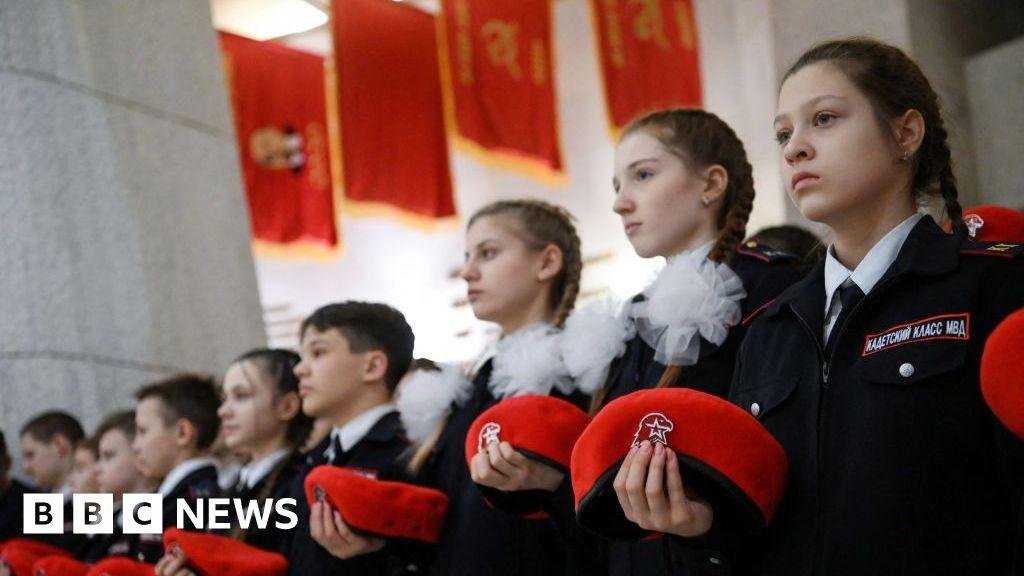
That ramping up of war propaganda directed at Russian children has been brought to life before a global audience in an Oscar-winning documentary, Mr Nobody Against Putin.
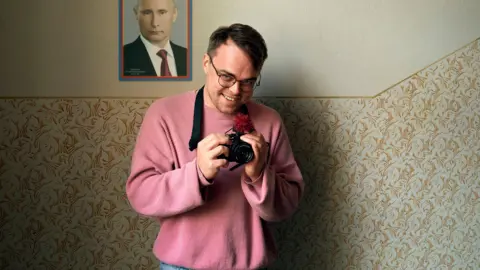
The BBC documentary was based on footage by a primary school events co-ordinator and videographer called Pavel Talankin in the small provincial town of Karabash in the Ural mountains.
What troubles Nina most is that her daughter enjoys taking part in the state-backed patriotic programme. We have changed her name and others in this piece for their safety.
"She likes her teacher, she likes her classmates - she likes being a part of it," says Nina.
Nina worries that openly opposing school activities could isolate her daughter socially, and when she once kept her home to avoid a patriotic school event, her daughter was upset: "I don't want her to feel like she doesn't belong."
Talankin's BBC film documents how he was reluctantly drawn into Putin's propaganda machine as Russia's full-scale invasion of Ukraine unfolded in 2022.
Flag-raising ceremonies were introduced, as well as compulsory lessons to teach pupils about the government's take on Russian values and world events.
History books were re-written and updated to include latest developments, including what Russians were told was a "special military operation".
Those diktats have continued. Only last month Russia's education ministry announced plans to introduce a list of state-approved toys and games for nurseries, to promote "traditional Russian values".
The messages the government wants the children to absorb are clear: the invasion is a defensive war and patriotism means unquestionable loyalty. At home though, some encounter different views.
Maksim, eight, lists everything he has learnt in his patriotic education lessons: about great Russian poets and painters, about friendship and how not to quarrel. His excitement grows as he remembers discussions about robots, tanks and laser tag.
"They told us this is how to prepare for war," he says.
Like Nina, Maksim's mother Marina opposes Russia's invasion. But she avoids openly discussing it in front of her son, in case he repeats what she says in public.
"An active anti-war position might attract unwanted attention", Marina tells the BBC.
Navigating a line between the messages from school and what they say at home is difficult, says Anastasia Rubtsova, a psychotherapist.
"A child has to live in this environment - attending the school, being a part of this group", she says. "This doesn't mean parents should agree with the propaganda. But there is no need to take a political stance in front of your child."
She suggests that parents focus on universal values such as the importance of human life, and the idea that conflicts should always be resolved peacefully - instead of directly confronting school narratives.
 AFP via Getty Images
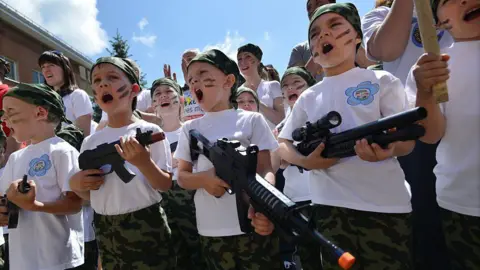
Studies show younger children are particularly receptive to messages from figures of authority. "If you tell a young child that the war is good, they will accept it," says Rubtsova.
According to Emily Willoughby, a researcher in behavioural genetics at the University of Minnesota, childhood and adolescence provide a genuine window of opportunity for shaping attitudes. The key question is whether those attitudes will persist, and that is where the individual's broader social world plays a key part.
"When parents actively disagree with institutional messaging, family influence usually prevails in the long run," she says.
However, when the state controls most sources of information and alternative narratives are limited, the outcome is less predictable. And that is very much the case in Russia.
One well-known study into Nazi-era education found that school-based indoctrination could have long-lasting effects, particularly when reinforced by the wider social environment.
Implementation of the Russian government's guidelines varies widely.
Some schools follow them enthusiastically, while others soften or sidestep them. Teachers may adapt, dilute or quietly resist the messaging.
 BBC/Made in Copenhagen/František Svatoš
In one scene from Talankin's film, children in Karabash are handed Russian flags as they gather in the school hall to listen to Putin announcing the creation of a children's movement reminiscent of the old Soviet-era Pioneer youth organisation.
In another, a class is warned that the enemy will try to recruit from their communities and spread propaganda to defeat them from within.
The patriotic education lessons are known is Russian as "Conversations about Important Things". Maia, a 14-year-old from St Petersburg, complains they are very boring.
"No one is participating in the discussion. We just sit there and listen to the teacher, and then leave," she explains.
"Compelling citizens to engage in public performances of patriotism is a way of reminding citizens of the regime's overwhelming power," says Paul Goode, professor of Russian studies at Carleton University, Canada. That perception is reinforced by state-run media, state-commissioned public opinion polls and rigged elections, he adds.
Maia, like her parents, believes Russia's war is wrong but does not discuss it at school and does not know what her classmates think.
"At first I was worried that I couldn't be friends with those who support the war and Putin," she recalls. "But nowadays everyone behaves so neutrally that everything feels normal".