Littlebird raises $11M for its AI-assisted ‘recall’ tool that reads your computer screen
Littlebird raises $11M for its AI-assisted ‘recall’ tool that reads your computer screen
There has been a lot of talk around building context for AI systems. In consumer software, we have seen startups being built around search, documents, and meetings. All of them want to capture context from your digital life, provide connections to other tools, and let you query all that data. Some tools went further. For instance, Rewind (which became Limitless and sold to Meta) and Microsoft Recall aim to capture everything happening on your screen and help you remember it all.
A new startup called Littlebird is trying a similar thing with a slightly different approach. While apps like Rewind store screenshots or some kind of visual data, Littlebird is “reading” the screen and storing the context in text format.
The core idea behind the product is that since it is reading your screen all the time, you don’t need to provide additional context for productivity. The startup believes that while a lot of AI tools are trying to distract you, Littlebird can work in the background and can only appear when you want it to.

When you set up Littlebird on your computer, you can customize which apps you want the app to ignore and not capture any context. The startup said that it automatically ignores password managers and sensitive fields in web forms like passwords and credit card details. You can opt to connect other apps like Gmail, Google Calendar, Apple Calendar, and Reminders with the app, as well.
The app lets you ask questions about your data, offering pre-generated prompts to get you started, such as “What have I been doing today?” or “What kind of emails are important to me?” In a couple of days of usage, I noticed that these prompts became more personalized as time went on.
Littlebird also has an in-built Granola-like notetaker that uses system audio and runs in the background to capture transcription from meetings and create notes and action items based on that. When you open up a meeting in the detailed view, there’s an option called “Prep for meeting” that takes the context of past meetings, emails, and company history into account to give you more details about the meeting. The feature also fetches information from sources like Reddit to inform you what users are thinking about a particular product or a company.

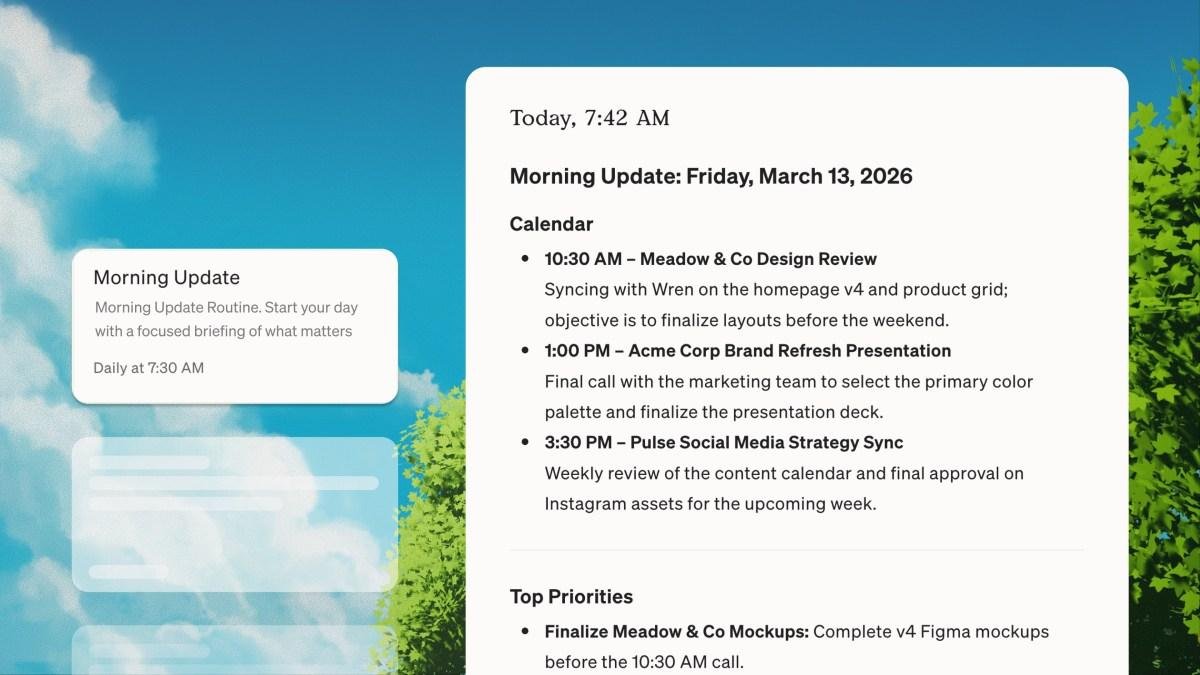
Another tool called Routines offers detailed prompts for Littlebird to run at a repeated interval, such as daily, weekly, or monthly. The company lists some ready-to-use routines like daily briefing, weekly activity summary, and yesterday’s work summary. Users can create their own routines as well with custom instructions.
Littlebird was founded by Alap Shah, Naman Shah, and Alexander Green in 2024. Brothers Alap and Naman founded Sentieo, a platform for institutional investors, which was sold to market intelligence firm AlphaSense. They previously also co-founded a healthy food company called Thistle. Alap was also a co-author of the viral Citrini paper on how AI agents could destroy the economy, which resulted in various tech stocks dipping. Green has built various companies in hardware, software, and AI.
“We got started when Alap posed an interesting problem that AI is going to be about your [users’] data. Models don’t know anything about you, and that limits their utility. We were thinking about various UI and OS paradigms that were likely to be ripe for disruption with AI and that kicked off Littlebird as a project,” Green told TechCrunch over a call.
Green noted that while Rewind was close to what Littlebird is trying to do, it relied on screenshots and didn’t have a great search experience. He said that the startup is just getting started and there are many more problems to solve, including making large language models (LLMs) understand different kinds of context about users.
With Littlebird, users can remove their data at any time, and their data is stored in the cloud with encryption. Green said that the rationale behind storing the data in the cloud was to run powerful models for different AI workflows, which is not possible locally.
“We don’t store any visual information. We only store text, which makes the data a lot lighter-weight. I think that was probably another reason that Recall and Rewind struggled, which is that taking a screenshot is a lot more data hungry. I also think it’s more invasive,” he said.

Littlebird is free to download and use, but to get more usage limits and access to features like image generation, users can pay for plans starting from $20 per month.
The startup has raised $11 million in funding led by Lotus Studio, with participation from Lenny Rachitsky, Scott Belsky, Gokul Rajaram, Justin Rosenstein, Shawn Wang, and Russ Heddleston.
Several of these investors are regular users of the product. Rajaram, who has worked at Google and Facebook on ad products, said that the product removes the friction of remembering, retrieving, and re-explaining your own work. DocSend co-founder and CEO Heddleston said that he rewrote the company’s marketing site using the tool, using context from meetings, email, Notion, and more.
Rachitsky, who runs his own newsletter and podcast, said that AI is as good as the context it has, and it misses so much about your day. He said he asks the tool about improving his productivity workflows and being happier. He said that for long-term success, the product will need to find a killer use case.
“I think it’s all about finding that killer must-have use case. That’s all that matters to this product’s success right now. I know a lot of people already have found that for themselves, and the team is leaning into these experiences as they see these use cases emerge,” he noted.
“I’ve had a lot of AI product builders on the podcast, and the most consistent theme is that you don’t actually know how people will use your product until you put it out. The strategy is to put out early stuff, see how people use it, and double down on those use cases versus waiting for something totally figured out.”
Commandité
Commandité
Commandité
Commandité
Annonces
Catégories
Lire la suite
Season 12 in Diablo IV doesn't just hand you a new pile of content and call it a day. It messes with your rhythm, the part you feel in your hands, because Bloodied Items turn power into something you keep alive. If you're the type who likes to play safe, back up, wait for cooldowns, you'll notice the change fast. As a professional like buy game currency or items in U4GM platform, U4GM is...

Massachusetts votes to pass new privacy rights bill that bans sale of precise location data Massachusetts lawmakers have voted to pass privacy protections that grant the state’s residents new rights over accessing and deleting their data held by big tech giants. The bill also bans companies from selling their users’ precise location data. Lawmakers in the Massachusetts House passed the state’s...
Google will save your Lens photos, Search Live recordings, and Translate audio for AI trainingYou can turn off this option under a new ‘Search Services History’ setting.You can turn off this option under a new ‘Search Services History’ setting.by Emma RothJun 10, 2026, 4:18 PM UTCImage: The VergeEmma Roth is a news writer who covers the streaming wars, consumer tech, crypto, social media, and...

Niger: Nearly 50 people die of thirst after lorry breaks down in Sahara desertAgadez governorate/FacebookThe victims were buried in mass graves by the rescue team dispatched to the areaAt least 49 people have died of thirst in a remote part of the Sahara desert in northern Niger after the truck carrying them broke down, authorities said. The group had been returning from Mali where they had...

US' and Iran's options for ending war narrow the longer it goes onAmir AzimiBBC News PersianGetty ImagesFor weeks, the US and Israel have insisted that Iran's military capacity has been severely degraded. US President Donald Trump and his defence secretary, Pete Hegseth, have repeatedly claimed that sustained strikes have crippled Iran's command structure and weakened its ability to respond. By...