Airstrikes may have destroyed Iran's last F-14s, ending a long, strange saga
Airstrikes may have destroyed Iran's last F-14s, ending a long, strange saga

The final catapult launch of the F-14 Tomcat fighter aircraft aboard the USS Theodore Roosevelt on July 28, 2006. The U.S. military retired the plane that year. U.S. Navy/Getty Images hide caption
toggle caption
U.S. Navy/Getty Images
Since the start of the Iran conflict, retired U.S. Navy Cmdr. Ward Carroll has been keeping a close eye on satellite photos and videos that appear to show Israeli airstrikes hitting Iranian F-14 fighter jets, the same type of aircraft that he flew for much of the 1980s and 1990s.
Carroll thinks what he is seeing might represent the destruction of the last operational F-14s anywhere in the world.
"While I understand the tactical necessity of taking them out … I'm also filled with sadness at their demise," he says of the airplane that defined his military career.
It's unclear if Israeli strikes have in fact destroyed the last of Iran's F-14s. Still, if confirmed, their loss would close the book on a decades-long saga that saw their unprecedented sale in the 1970s to a Middle Eastern ally — a move that only a few years later would land them in the hands of a virulently anti-U.S. regime.
In 2006, the U.S. Navy replaced the venerable jet, known as the "Tomcat," leaving Iran as the sole operator of the aircraft type.
Tehran's relentless effort to keep them flying in the face of a U.S. embargo eventually led to a long-running spare parts smuggling ring. When the U.S. replaced its F-14s, the issue was still such a high concern that it prompted the Pentagon to destroy them to make sure that Iran could never gain access to their components.
The F-14 and how it landed in Iran

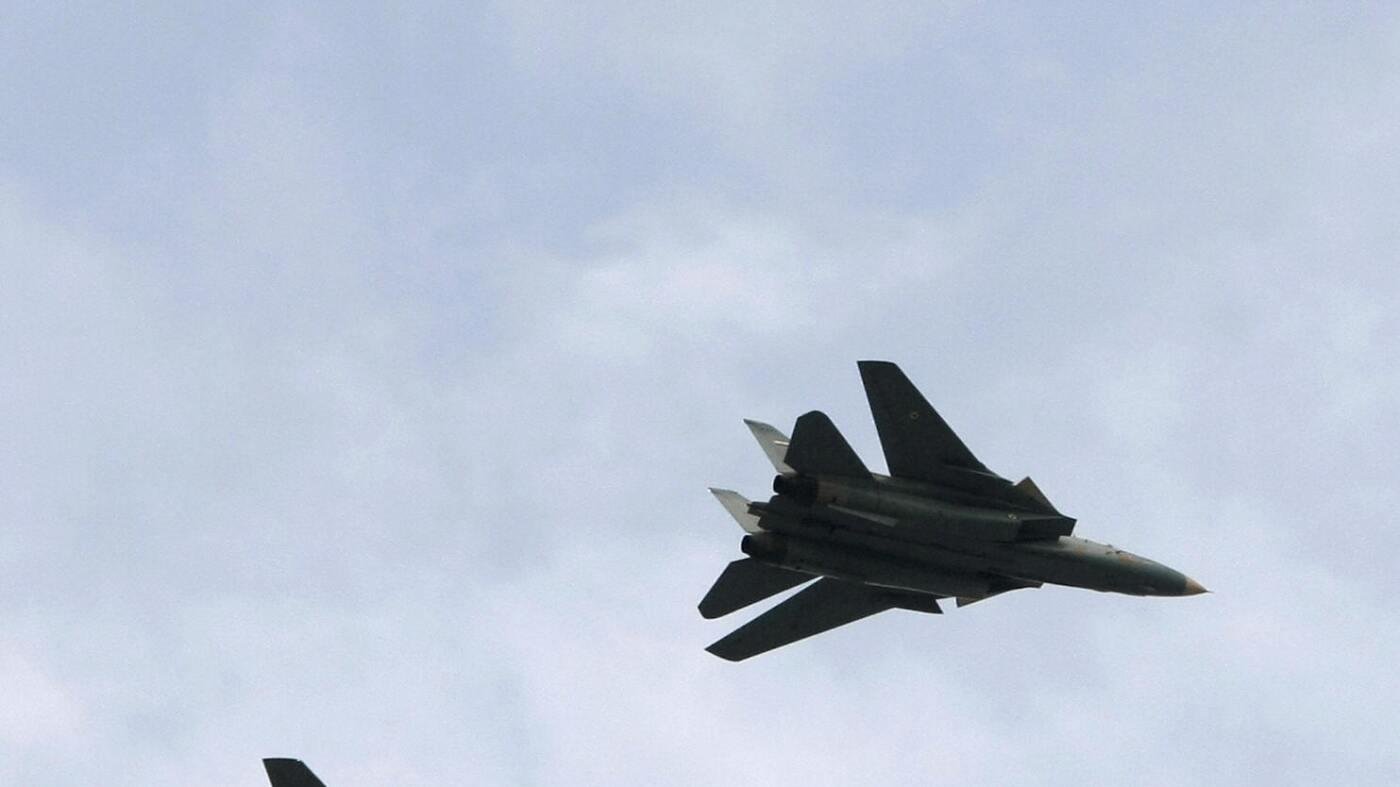
Iran's F-14 fighter jets fly during the annual army day military parade in Tehran on April 17, 2008. Behrouz Mehri/AFP via Getty Images hide caption
toggle caption
Behrouz Mehri/AFP via Getty Images
The twin-engine, swing wing F-14 was a challenge to fly and maintain, but Carroll likens it to "a muscle car" — raw power and "a cool looking airplane."
Serving as a radar-intercept officer, Carroll was seated directly behind the pilot. For fans of the 1986 film Top Gun and its 2022 sequel — which made the F-14 famous — he was the "Goose" to Tom Cruise's "Maverick."
The Tomcat, made by Grumman, was first flown in 1970 and delivered to the Navy in 1972. It was built around an advanced radar system and supported the cutting-edge Phoenix, a new radar-guided, beyond-visual-range air-to-air missile. The F-14 also sported the first custom-built microprocessor-based system used to automatically manage the plane's variable sweep wings, which can change position. That chip set, known as the Central Air Data Computer, was so advanced that it remained top secret for decades.
The F-14 had its share of teething problems during development and the early years of deployment in the 1970s. Still, Tom Cooper, an Austrian military aviation analyst and an expert in Middle East air forces, says it was 20 years ahead of its time and "absolutely superb … at least in warfighting capability."
So, how did Iran end up with a warplane that at the time arguably outclassed anything in the world? The story begins in May 1972, with a visit to Tehran by President Richard Nixon. Nixon was there to meet Shah Mohammad Reza Pahlavi, the then-leader of Iran. The Shah was interested in buying U.S. arms – lots of them, according to naval historian and author Norman Friedman.
"We regarded the Shah as an absolutely steadfast ally, and it was well known that he was interested in building up [his military] and would buy almost anything," Friedman says.
The Shah had been given a demonstration of the F-14 and persuaded Nixon to sell the plane to Tehran. Iran, the only other country ever to operate the F-14, would go on to take delivery of 79 Tomcats, which were sold with a maintenance package, 10 years of spare parts, the Phoenix missile system and U.S. training for Iranian pilots.
But the Shah was ousted a few years later during Iran's 1979 Islamic Revolution, which suddenly upended the U.S.-Iran relationship and effectively ended one of Washington's closest military partnerships. Iran's new regime was led by Ayatollah Ruhollah Khomeini, whose supporters took to the streets chanting "Death to America!"
Iran thought about selling its F-14s back to the U.S.
Initially, Khomeini's government discussed selling the F-14s and the Phoenix missiles back to the U.S., either directly or through a third country, such as Britain. "The new regime said, 'No, we don't need this kind of stuff. We are not going to pay for this,'" according to Cooper. But it never happened. Months later, in November 1979, Iranian students stormed the U.S. Embassy in Tehran, seizing 66 American hostages, and sending relations with Washington into a tailspin.
Meanwhile, President Jimmy Carter imposed severe sanctions on Iran, with one of the aims being to keep F-14 parts from reaching the country.
In September 1980, as the hostages were still in custody, Iraq launched a full-scale invasion of Iran, setting off a brutal, eight-year war between the two countries and prompting Tehran to change its view of its Tomcats. Now they were seen as essential.
Farzin Nadimi, a senior fellow with the Washington Institute for Near East Policy, says despite the departure of American technicians after the revolution, the Iranians were able to quickly make the F-14s fully operational at the onset of the Iran-Iraq war. U.S.-trained Iranian F-14 pilots — some of whom had been purged from the ranks under the new regime — were brought back and became instructors for a new pilot course in Iran, he says.
Some estimates put the number of Iraqi airplanes shot down by Iranian F-14s at more than 160. Carroll says Iranian pilots "were savvy and they were lethal."
"They flew very long combat air patrols," Nadimi says. "They had large stockpiles of parts, but … they burned through them very quickly," adding that they also "ran out of Phoenix missiles, firing almost all of them during the war."
Iran kept "20 to 30 operational" F-14s during the war, turning many of the others into "hangar queens" that donated parts to keep the others flying, he says.
Iran also launched a "self-suffiency jihad" to reverse-engineer and produce some key components. This effort also helped spur Iran's ballistic missile and drone program. Among other innovations, Iranian engineers figured out how to adapt the U.S.-made Hawk ground-to-air missile for air-to-air use, Nadimi says.
International brokers and front companies
Iran evaded U.S. sanctions by relying heavily on international brokers and front companies to obtain spare parts for its U.S.-made military equipment, including the F-14s.
In 1985, eight suspects were arrested in an investigation into allegations that F-14 parts were stolen from the USS Kitty Hawk aircraft carrier and sent to Iran. In 1998, an Iranian-born U.S. citizen pleaded guilty to attempting to smuggle F-14 parts to Iran and was sentenced to five years in prison and fined $125,000. Additional arrests followed in the decades after.
Concern over Iran's F-14s was so high that when the last of the U.S. F-14s were retired in 2006, Washington made an unusual decision. Instead of "mothballing" the planes in the Arizona desert so they could be reactivated in an emergency, the Pentagon decided to have them destroyed to keep their valuable components away from Iran. The Associated Press reported in 2007 that the planes were destroyed by a mechanical "shearing machine, which uses pincers to rip apart the planes."
It's unclear if the story of the F-14s is completely over.
Earlier this month, Israel said it destroyed "several" F-14s on the ground. But not everyone agrees that they are gone. Cooper is skeptical. "Some of what the Israelis have shown us about the destruction of Iranian Tomcats is absolutely 100% wooden decoys," he says. "If you know where to search for them, you can actually see them standing in the same place for two, three, four or five years."
Still, he believes only about 10 F-14s were operational at the onset of the current conflict.
Despite his love for the F-14, Carroll acknowledges that if the Israeli strikes have destroyed them, the loss is largely symbolic. Against today's more advanced aircraft, such as the F-18 or F-35, "a Tomcat would have no chance," he says.
Προωθημένο
Διαφημίσεις
Διαφημίσεις
Διαφημίσεις
Κατηγορίες
Διαβάζω περισσότερα
Apple's Health App Now Supports Both Menopause and Perimenopause Announced at WWDC 2026, Apple's Health app supports cycle tracking for menopause and perimenopause. Anna Gragert Senior Editor, Health and Home Anna Gragert (she/her/hers) was previously the lifestyle editor at HelloGiggles, the deputy editor at So Yummy and the senior lifestyle editor at Hunker. Over the past 12...

Streetwear has become one of the strongest forces in modern fashion, but only a few brands manage to create a real identity around their clothing. Geedup is one of those names. Known for its bold designs, relaxed fits, and strong streetwear attitude, Geedup has developed a loyal following among people who want clothing that feels connected to everyday culture. The appeal of Geedup goes beyond...

Valve Warns Steam Machine Buyers About Scam Messages After Cyberattack If you’ve been holding out on buying Valve’s ludicrously expensive home console, you may have saved yourself from more than an empty wallet. European customers who ordered a Steam Machine or Steam Controller may be the victims of a personal information data breach after one of Valve’s hardware distribution partners was hit...

I 3D Print Over 10 Pounds of Material Every Week -- These Are the Filaments I Recommend3D printing is a household hobby with millions of Americans owning these creative machines. Even the best 3D printers need some kind of material, though, and the type you use is important. Filament is the material used for FDM 3D printing, and there are a ton of options available. A high-quality filament will...

Bondi Beach attack: Australia royal commission into antisemitism beginsLandmark royal commission into antisemitism prompted by Bondi shooting beginsGetty ImagesThe federal royal commission will look at antisemitism and its drivers in AustraliaAustralia's royal commission into antisemitism, prompted after the Bondi Beach shootings that killed 15 people and injured 40, has begun public...