
 AFP via Getty Images
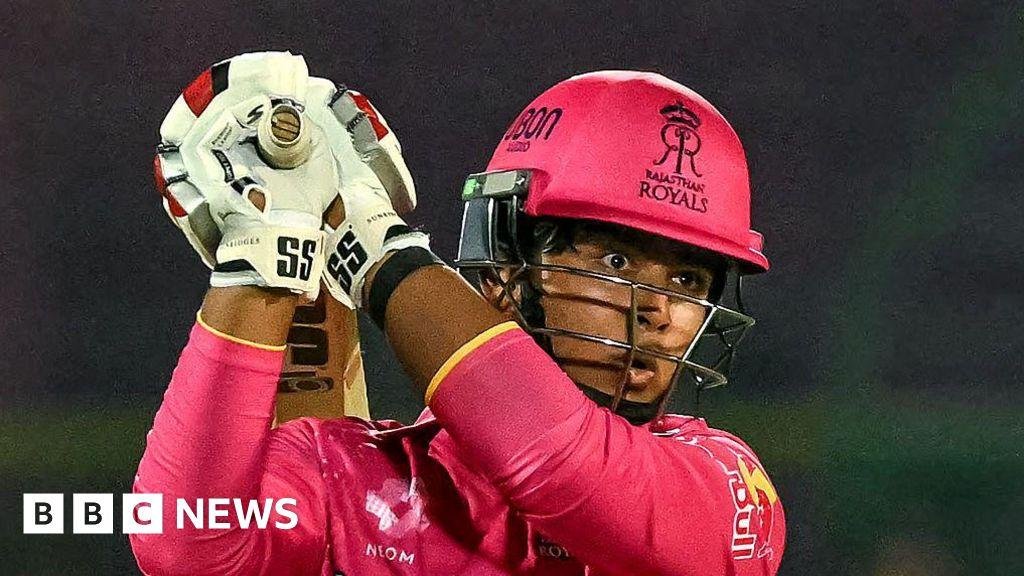
As the world's richest cricket tournament Indian Premier League (IPL) returns on Saturday, there will be a lot of attention on the big names. Some of it will also be on a teenager.
A day before the IPL starts on 27 March, Rajasthan Royals batter Vaibhav Suryavanshi turns 15. And with that, one of Indian cricket's most intriguing questions sharpens into focus: is he ready for the big stage?
Suryavanshi first turned heads three years ago when he was a 12-year-old batter taking bowlers old enough to be his father to the cleaners.
Since then, however, the quality of his batting, consistency and hunger for tall scores at an extreme strike rate have taken centre-stage.
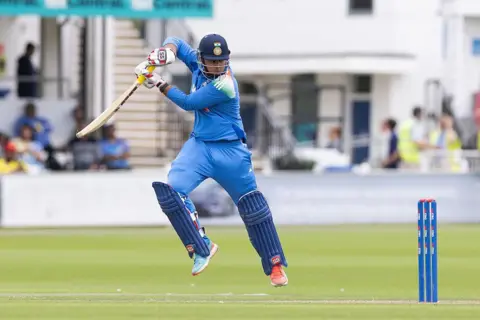
Standing tall at the crease, Suryavanshi is an instinctive aggressor - he attacks the ball rather than waiting for it, and at his best, his strokeplay carries a flourish that many have likened to the great Garry Sobers.
In 2020, the International Cricket Council (ICC) drew a line - introducing minimum age rules in the name of "safeguarding of players". Even at the Under-19 level, the message was clear: no-one below 15 would step onto the international stage.
This was the first time the ICC had put in a minimum age requirement, with Pakistan's Hasan Raza holding the record for being the youngest male Test cricketer at 14 years and 227 days when he made his debut in 1996.
While Raza's record remains safe, one barrier has quietly fallen: Sachin Tendulkar's benchmark - an international debut at 16 years and 205 days - is no longer out of reach for Suryavanshi.
It would be a surprise if India's selectors waited long. Plenty of young talents have been fast-tracked since Tendulkar, but few have carried this kind of inevitability so early. Suryavanshi doesn't just look promising - he looks preordained for India colours.
 AFP via Getty Images
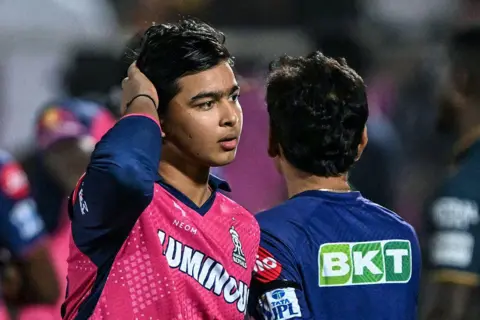
Oddly enough, Suryavanshi's fast-tracking in 2023 owed as much to chance as to talent.
A Vinoo Mankad Trophy game in Chandigarh - the Board of Control for Cricket in India's (BCCI's) domestic Under-19 competition, and one that selector Thilak Naidu had been assigned to watch - was washed out.
With time on his hands, and having already heard murmurs about a gifted boy from Bihar, Naidu headed to another match being played simultaneously.
That detour proved decisive. There, Suryavanshi - still not a teenager - struck 86 off 76 balls to steer Bihar past Assam, an innings compelling enough to trigger the fast-track that followed.
Naidu was so convinced of Suryavanshi's ability - backed up by a couple more half-centuries - that he fast-tracked the batter, having had a word with VVS Laxman, who headed the BCCI's Centre of Excellence in Bangalore.
Suryavanshi found his rhythm at every step up the ladder.
He piled on runs in the Under-19 Challenger Trophy in November 2023, then carried that form into a quadrangular series later that month, representing India Under-19 against England and Bangladesh.
The real statement came a year later. Picked for the youth Test against Australia in October 2024, Suryavanshi hammered a 58-ball hundred - an innings that announced him.
It was then argued that the IPL might be a step too far for a boy still finding his feet and that facing the world's best so early could do more harm than good.
In the 2025 season, Suryavanshi put those concerns to rest: launching the very first ball he faced, from the experienced Shardul Thakur, for six.
Not long after, he justified the roughly $130,000 investment the Rajasthan Royals made in a 13-year-old - becoming the youngest centurion in competitive senior cricket with a blistering 35-ball hundred against the Gujarat Titans.
 ICC via Getty Images
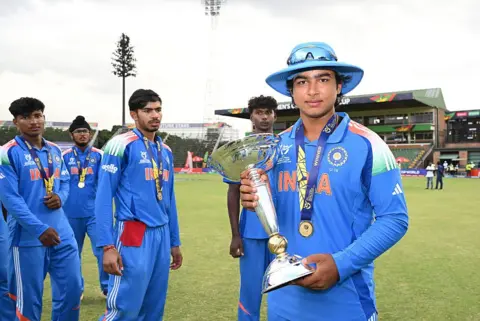
There was still a caveat, though. The IPL, critics argued, was a domestic proving ground - impressive, but not definitive. That lens followed Suryavanshi into the Under-19 World Cup in early 2026.
By then, India had tightened its approach: one shot at the tournament, no matter how young you were. The thinking was clear - cut out age fraud, raise the bar and ensure players arrived not early, but ready.
Suryavanshi made 72, 40, 52 and 30 in the league phase as India qualified for the knockouts, and then climbed into Afghanistan in the semifinal with a 33-ball 68.
But it was in the final, against England, that he was at his best. The half-century came off 32 balls, the century in 55, and Suryavanshi eventually ended on 175 off only 80 balls, with 15 sixes and as many fours.
By this time, the clamour to stop playing Suryavanshi at the age-group level, even against players five years older than him, had reached a crescendo.
It was just too much of a mismatch. But Indian cricket was stymied by the ICC regulation that meant Suryavanshi could not yet be picked for the senior team.
Among ex-cricketers, the reaction veered between awe and disbelief. "How good were a Sachin Tendulkar or a Virat Kohli at that age? If this guy is that good this early, there's no reason he can't be playing four-day cricket," said Ravi Shastri.
 MB Media/Getty Images
AB de Villiers suggested that Suryavanshi was "mature for his age". Matthew Hayden called his IPL century a "moment of inspiration for young dreamers across all sports".
WV Raman was wowed by Suryavanshi's "licence to thrill", and Tendulkar praised his "fearless approach, bat speed, picking the length early, and transferring the energy behind the ball".
On 27 March, as Suryavanshi blows out the candles, the question quietly turns on its head: not whether he is ready - but whether the world is.
The date is already a special one for Indian cricket fans.
In 1994, Navjot Singh Sidhu pulled up with a stiff neck in Auckland ahead of a One-Day International against New Zealand, and Mohammad Azharuddin promoted Tendulkar to open the batting.
Tendulkar made 82 off 49 and did not look back.
From then on, Tendulkar piled up 15,310 runs at an average of 48.29 as an opener in ODIs, with all but four of his 49 hundreds coming in that position.
It's fair to say that 27 March 1994 changed the trajectory of Indian cricket forever.
Now, 32 years on, another turning point beckons.