Rubio heads to Europe to try garner support for Iran war
Rubio heads to Europe to try garner support for Iran war

Iranian women mourn during a funeral for victims of the Middle East war at the Behesht Zahra cemetery in southern Tehran on March 26, 2026. AFP via Getty Images hide caption
toggle caption
AFP via Getty Images
Representatives of the world's wealthiest democracies gather in France today for a G7 meeting, where U.S. Secretary of State Marco Rubio is expected to try to shore up support among reticent allies for the Trump administration's war on Iran.
The meeting comes after President Trump on Thursday announced a new deadline for Iran to reopen the Strait of Hormuz, or face destruction of its power plants, saying he was giving them until April 6.
"Talks are ongoing and, despite erroneous statements to the contrary by the Fake News Media, and others, they are going very well," Trump said.
Rubio's Europe trip also comes a day after Trump again slammed NATO for not coming to the aid of the U.S. when he asked for help reopening the Strait of Hormuz, a vital economic waterway practically blocked by Iran since the start of the conflict.
Trump warned the transatlantic military alliance that the U.S. would "never forget" they hadn't come to its aid, not, he said, that the U.S. really needed them anyway.
European countries have said they were not informed of Trump's Iran plans beforehand and have no interest in entering what could be a protracted war. Germany's defense minister was blunt in his assessment this week, saying Washington had "no exit strategy."
Here are more updates on Day 28 of the Iran war.
To jump to specific areas of coverage, use the links below:
G7 meeting | Zelensky in Middle East | Attacks continue | Global economy
Iran to dominate G7 meet
Foreign ministers from Britain, France, Germany, Italy, Japan, Canada and the European Union will be meeting in France.
The meeting is meant to shrink the growing chasm that has opened up between the Trump administration and some of the U.S.' main Western allies. Rubio has said countries should "step up" to help deal with the blockade of the Strait of Hormuz.
"Very little of our energy comes through the Strait of Hormuz. It's the world that has a great interest in that, so they should step up and deal with it," he told reporters before heading to Europe.

President Donald Trump listens as U.S. Secretary of State Marco Rubio (L) speaks during a Cabinet meeting in the Cabinet Room of the White House on March 26, 2026 in Washington, DC. Chip Somodevilla/Getty Images North America hide caption
toggle caption
Chip Somodevilla/Getty Images North America
Kaja Kallas, the European Union's foreign policy chief, said on the eve of the meeting that "With our G7 partners, we'll discuss how to drive de-escalation in the Middle East, as the war's consequences are felt severely worldwide."
She added that "at the same time, we can't overlook Ukraine," noting that the two wars are linked.
The U.S. has left Europe to deal with Russia's aggressive war in Ukraine, and even cut them out of peace talks. Meanwhile, Russia launched more than a thousand drones at Ukraine Tuesday, according to Ukrainian officials, one of its largest attacks of the war.
Zelensky in Middle East
On Thursday, Ukrainian President Volodymyr Zelensky made a surprise trip to Saudi Arabia, having said Ukraine's expertise with drone technology could help Gulf countries with their security.
"Important meetings are scheduled. We appreciate the support of those who are ready to work with us to ensure security, and we support them too," he said on X.
Previously the Ukrainian leader posted a video message saying: "The key is not only producing new weapons - especially drones - not just technology, but also real experience in using it, and integrating it with radars, aviation, and other air defence systems. We have this experience."
In an interview with French newspaper Le Monde, he added that he'd be seeking assistance for Ukraine's war in exchange.
"We would like Middle Eastern states to also give us an opportunity to strengthen ourselves. They have certain air defence missiles of which we don't have enough. That's what we'd like to reach a deal on," he said.
Attacks continue on all fronts
Despite what Trump said are promising negotiations with Iran, with Pakistan acting as go-between, strikes continued in the Middle East into Friday. The Israel Defense Forces (IDF) announced they had struck ballistic missile production sites and air defense systems across Iran.

Israeli soldiers grieve during the funeral of Staff sergeant Ori Greenberg, 21, at the Mount Herzl military cemetery in Jerusalem on March 26, 2026. Odd Andersen/AFP via Getty Images hide caption
toggle caption
Odd Andersen/AFP via Getty Images
"In strikes carried out across Tehran, the IDF targeted infrastructure and sites used by the regime to produce weapons, with an emphasis on ballistic missile production facilities," it said on X.
"In western Iran, the Air Force, guided by Military Intelligence, struck the Iranian terror regime's fire arrays throughout the night. Among the targets struck were launchers and missile storage sites that pose a threat to the State of Israel," the post continued.
In Lebanon, the Israeli army issued another forced evacuation order as they push north in the fight against the militant group Hezbollah.
But Israel was also under attack Friday, reporting a salvo of missiles from Iran.

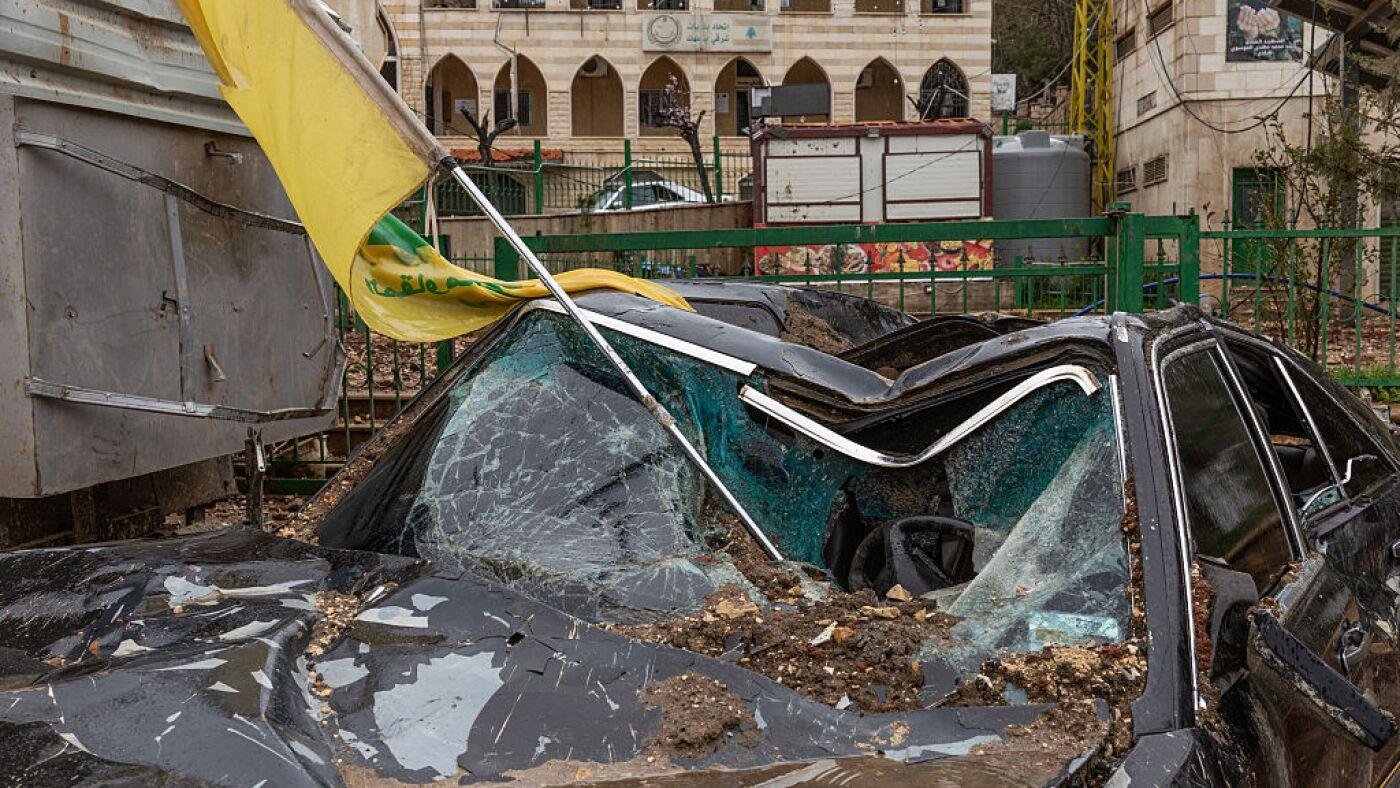
A Hezbollah flag is seen in a destroyed car after an Israeli airstrike in Nabi Chit (Al-Nabi Shayth), Lebanon, on March 26, 2026. Fabio Bucciarelli/Middle East Images/AFP via Getty hide caption
toggle caption
Fabio Bucciarelli/Middle East Images/AFP via Getty
And the Gulf states continued to suffer collateral damage. On Thursday night, Iran's Revolutionary Guard Corps said it had struck at U.S. bases in the UAE, Bahrain, and Kuwait, in the Gulf using missiles and drones.
Kuwait reported its port was attacked by drones, while sirens sounded in Bahrain and Qatar briefly issued a heightened security alert.
Global economy hit hard
The war and Iran's virtual blockade of the Strait of Hormuz – through which one-fifth of the world's oil passes – have economists very worried.
On Thursday, stocks on Wall Street suffered their largest daily decline since the war began, falling as oil prices rose sharply. Asian shares mostly fell early Friday.
Asian countries, which get most of their oil and gas through the waterway, have been making contingency plans. Local media reports Japan plans to temporarily lift restrictions on coal-fired power plants, while Vietnam has temporarily waived an environmental tax on fuel to cut petrol prices by a quarter.
The Philippines has declared a national energy emergency and transport workers have been staging protests.
Finland's President Alexander Stubb warned in an interview with Politico this week that the Iran war could trigger a global recession that is worse for the economy than the coronavirus pandemic.
Eleanor Beardsley in Paris, Emily Feng in Van, Turkey, Michael Sullivan in Chiang Rai, Thailand, and Kate Bartlett in Johannesburg contributed to this report.
Sponsorluk
Reklam
Reklam
Reklam
Kategoriler
Read More
United Airlines App Adds TSA Wait Predictions, AirTag Luggage TrackingAir travel comes with plenty of guesswork, especially before you even reach the gate. Starting Wednesday, United Airlines is rolling out several new features in its mobile app that could help. The new additions are designed to help travelers gain insights into flight details, notably how long security check-ins...
OpenAI Gives Users a Long-Term Storage Option With ChatGPT Library Right now, you need a Plus plan or better to access the library feature. Julian is a contributor and former staff writer at CNET. He's covered a range of topics, such as tech, crypto travel, sports and commerce. His past work has appeared at print and online publications, including New Mexico Magazine, TV Guide,...

3D Printers Are Under Fire From New Ghost Gun Laws. Tell Us What You Think3D printing at home has become so mainstream that blockbuster movies are releasing 3D models directly from the screen to you. With that level of popularity comes the risk that 3D printers will be used for nefarious purposes. The production of "ghost" guns -- guns and gun parts that are untraceable through standard serial...

Today's NYT Connections: Sports Edition Hints and Answers for May 19, #603Looking for the most recent regular Connections answers? Click here for today's Connections hints, as well as our daily answers and hints for The New York Times Mini Crossword, Wordle and Strands puzzles. Today's Connections: Sports Edition features kind of a mix of difficulties. If you know your NFL...

Introduction As restaurants, hotels, and fine dining establishments continue to seek distinctive ways to enhance food presentation, Himalayan Salt Cooking Slabs have become an increasingly popular choice. These natural slabs are valued for their elegant appearance, versatility, and ability to elevate the dining experience. However, selecting the right product for commercial use requires more...