Jessica Parker,Berlin correspondentand Kristina Völk

 Morris MacMatzen/Getty Images
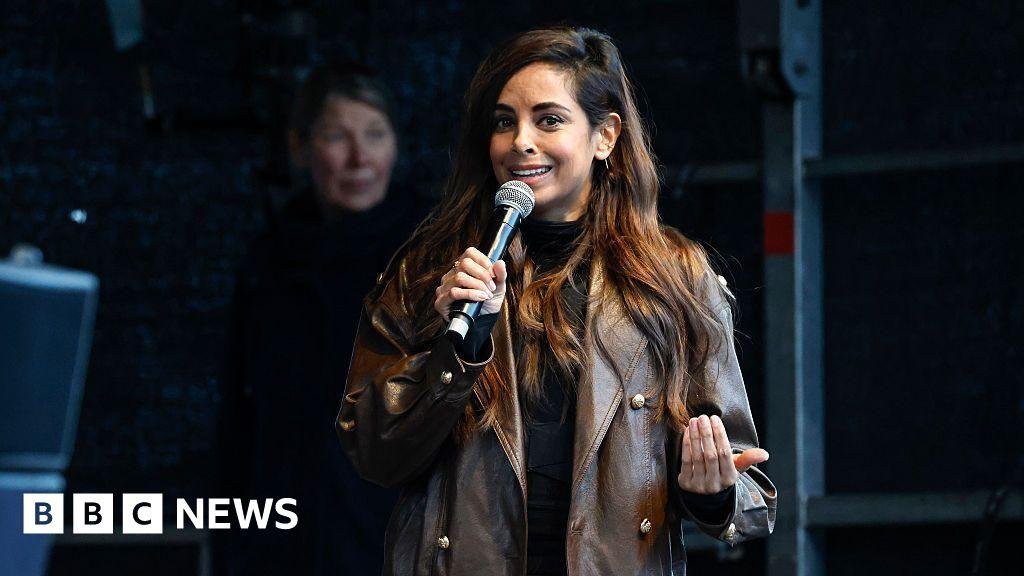
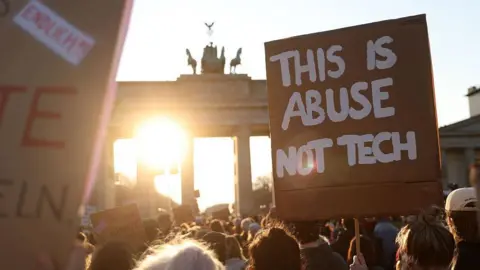
It is a story that is gripping Germany and has led to one of its best known TV stars tearfully telling thousands of protesters from a stage in Hamburg how she had to wear a bulletproof vest, due to death threats.
A week ago Collien Fernandes, 44, accused her ex-husband of spreading pornographic deepfakes of her online, in bombshell allegations published by German news magazine Der Spiegel.
Her claims have triggered demonstrations, promises to tighten the law and criticism that Chancellor Friedrich Merz has bungled his response.
Fernandes' ex-husband, Christian Ulmen, denies the allegations and has not been charged. He is also taking legal action against the magazine that broke the story.
His high-profile media lawyers, Christian Schertz and Simon Bergmann, have told the BBC that Ulmen has never "produced and/or distributed deepfake videos of Ms Fernandes or any other individuals. Any such claims are false".
They argue that what happened between Fernandes and Ulmen is completely unrelated to the German debate surrounding legal loopholes in criminal law over deepfake pornography.
 Isa Foltin/Getty Images
Ulmen and Fernandes were for years known as a prominent, celebrity couple chalking up extensive TV, presenting, production, writing and acting roles between them.
The pair's status as public figures partly explains why the case has captivated Germany.
But, regardless of the outcome of this case, it has also exposed anger about what campaigners say are glaring gaps in criminal law.
A group of 250 women from politics, business and culture has released 10 "demands" including the clear criminalisation of producing and distributing non-consensual sexualised deepfakes.
The group includes Labour minister Bärbel Bas from the centre-left SPD party, rapper Ikkimel and climate activist Luisa Neubauer.
 Maryam Majd/Getty Images
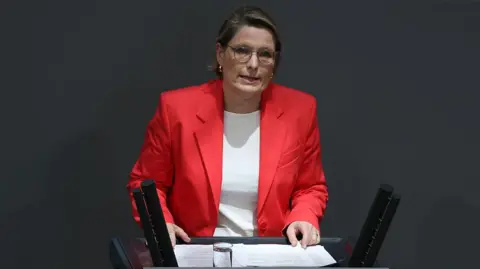
Federal Justice Minister Stefanie Hubig has announced plans to change the law so that the creation and distribution of pornographic deepfakes would become an explicit offence.
The crime would be punishable by up to two years in prison - according to draft plans seen by German media.
Currently under German law, only the dissemination of such pictures is potentially punishable if it is found to have breached someone's right to their own image.
Fernandes told thousands of protesters gathered in her native Hamburg on Thursday night of the abuse she has experienced since going public with her allegations.
"I'm standing here with a bulletproof vest under police protection… because men want to kill me."
She has claimed that her ex-husband confessed to her on Christmas Day 2024 that he had been spreading fake, sexualised images of her online.
"It was like receiving news of a death," she told Der Spiegel. "I couldn't speak, I couldn't cry."
That has been countered by Ulmen's lawyer Schertz, who says the key points that have been reported about Ulmen are "demonstrably incomplete and incorrect" and subject to legal proceedings.
 Sean Gallup/Getty Images
Fernandes has filed a legal complaint in Spain, where the couple previously lived together, making allegations of threats and abuse.
However, Ulmen's lawyers have rejected her characterisation of the situation and say no "unilateral attribution of blame" has been made towards their client.
The TV presenter told German public broadcaster ARD that she chose to make a complaint in Spain as it has stronger gender-based violence laws than Germany - a country she describes as a "paradise for perpetrators".
There is no dispute that Fernandes has been a victim of AI-generated porn. The material is out there on the internet and her broader claims, about being the victim of online abuse, are not new.
She has previously spoken about this in a 2024 ZDF documentary entitled Deepfake porn: Digital abuse.
In November 2024, Fernandes lodged a criminal complaint in Germany against persons unknown, a month before she alleges that Ulmen confessed.
It has now emerged that an investigation in Germany has been reopened, in the wake of the Spiegel report.
The public prosecutor's office in Itzehoe, a small town near Hamburg, told the BBC that the prior investigation was discontinued last June as there were "no leads" about who may have allegedly created fake accounts in Fernandes' name.
"It should be noted that the presumption of innocence applies in favour of the accused," the prosecutor's office added.
The story is also putting political pressure on Chancellor Friedrich Merz, who has long been accused of being out of touch when it comes to younger, female voters - sometimes referred to by critics as his "woman problem".
When asked about violence against women in parliament on Wednesday, Merz said that there had been an "explosion" of violence in the physical and digital spheres with a "considerable portion" originating from immigrant groups.
The chancellor's remarks did prompt some applause in the Bundestag, among his own MPs in the conservative CDU party as well as from lawmakers in the far-right AfD.
However, others say his remarks were misjudged, including Clara Bünger of the Left party who told German TV: "Whoever points as a reflex to immigration in violence against women, downplays structural violence instead of fighting it."
Government figures show that non-Germans are over-represented as suspects in family and domestic violence cases, although exact nationalities are not specified.
Non-German suspects, in this case, are people who have either foreign nationality, are stateless or their nationality is unclear. Anyone who has both German and another nationality is considered German in these statistics, while a general migration background is not recorded.
Meanwhile, the number of female victims of violence and other crimes, in person and online, has risen to an all-time high in Germany, according to police crime statistics for 2024.