Jonathan BealeDefence correspondent, Cyprus

 Lee Durant/BBC
The loud screech of a Typhoon and F-35 jet rips through the night sky above RAF Akrotiri in Cyprus. It's followed by the heavier rumble of the larger refuelling aircraft that will join its mission - hunting down Iranian drones.
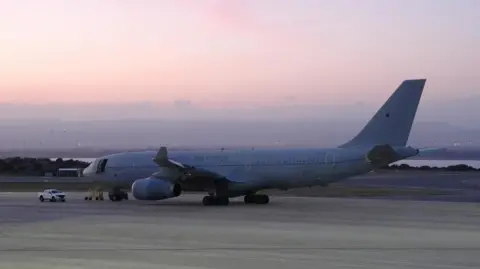
The RAF Voyager is the giant petrol station in the sky for the Typhoon and F-35 jets which have been patrolling the skies over Cyprus and Jordan for the past month.
The BBC is among the first news outlets to witness these defensive missions in the air being conducted day and night, ever since the US and Israel began their bombing campaign against Iran.
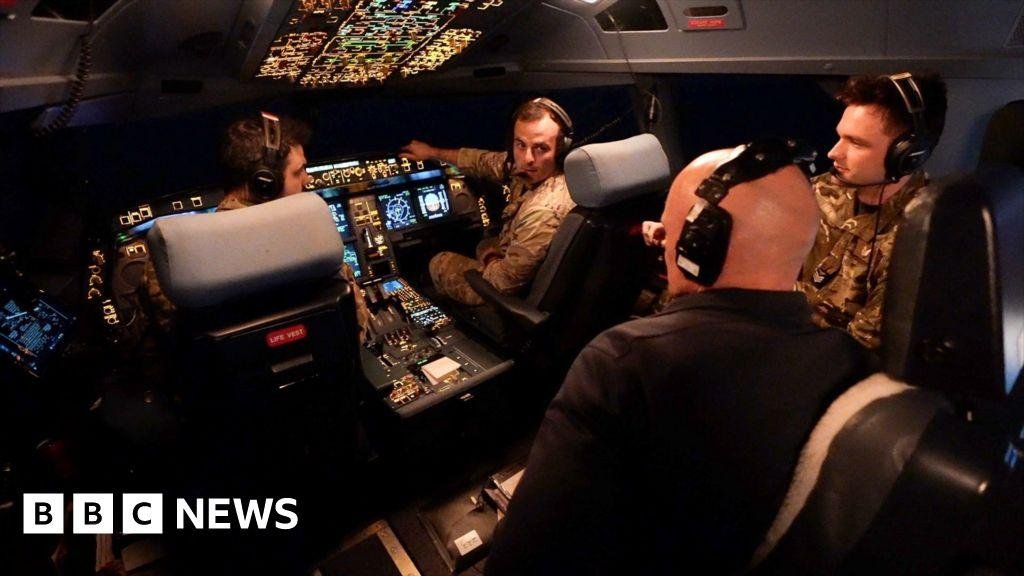
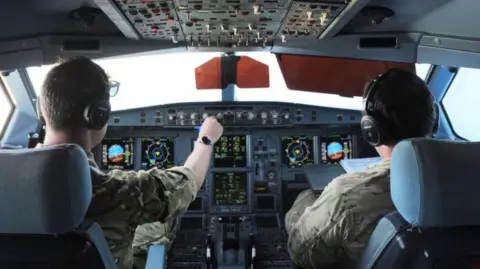
From the cockpit of the Voyager we watched the shimmering lights of Cyprus fade into the distance. We were getting closer to the coast of Israel and Lebanon.
From that direction we see a brief flash of orange light. One of the crew points to it and tells me: "Quite often you can see either incoming missiles from Iran or the Israeli response."
"It might be the Iron Dome from Israel," the pilot interjects over the intercom, referring to the country's air defence system.
"We don't know for sure," he adds, "but there's a lot of kinetic things happening in that area at the moment".
Evidence, then, that even after a month of heavy bombing Iran still poses a threat an is still firing missiles and drones.
 PA Media
During this nine-hour mission, the Typhoon and F-35 jet refuel seven times - taking on a total of 30 tonnes of aviation fuel.
We see them appear out of the dark at speed to make the delicate manoeuvre to feed their fuel-hungry jets - locking on to a hose trailing from the tanker wing.
For the fighter pilots, it's routine. It's the hunting down of Iranian drones which poses more of a challenge.
Over the past month, British jets operating out of Cyprus and Qatar have shot down several. They won't say exactly how many times they've fired their sophisticated advanced short range air-to-air missiles (ASRAAM) to take down a drone, but it's in the single figures. It's an expensive golden bullet to bring down a relatively cheap fibreglass drone.
 PA Media
On the ground, Squadron Leader "Bally", an RAF F-35 pilot, explains the complexity of the mission.
"Operating on a fast jet is already a dangerous business", he says. "Let alone when trying to target something close to the surface."
With the drones flying low and slow, he says that "there's a risk of flying into the ground".
The threats, he says, are "not just enemy activity", but also the dangers of flying too close to other jets operating in the area.
On this mission they identify no targets. But the jets have been conducting what's been called "Operation Luminous" since the start of the war.
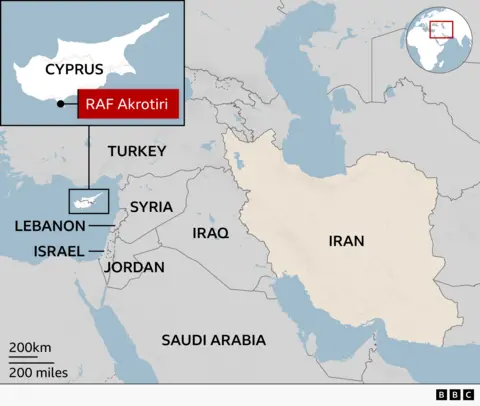
Despite criticism, government ministers have repeatedly said they made sufficient preparations - moving in additional jets, air defence systems and personnel to Cyprus weeks before the conflict started.
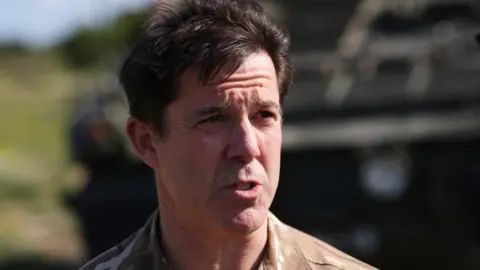
Maj Gen Tom Bewick, Commander British Forces Cyprus, insisted there'd been "prudent planning" before the war - including additional ground-based air defences and radar.
But that didn't stop a drone hitting the base on the second night of the war. The small drone, probably fired from Lebanon, hit a hangar on a side of the base used by the US Air Force.
It's well known the US regularly flies a U-2 spy plane from RAF Akrotiri, though it's not publicly acknowledged.
The BBC understands the drone - with a two-metre wingspan - had been tracked by radar approaching the base, time enough to sound the air raid warning and to get people out of harm's way.
But Gen Bewick says the damage was minimal.
"They didn't get much bang for their buck," he says, adding that he "suspects" whoever fired it "hit what they were aiming at".
Since that incident, Gen Bewick says Akrotiri's air defences have been "thickened".
 PA Media
There are now eight Typhoon jets and eight F-35 jets on the base. There's been the recent arrival of Wildcat helicopters fitted with short range air defence missiles and Merlin helicopters with Early Warning Radar.
The Royal Navy destroyer, HMS Dragon, is now providing additional air defences operating off the coast of Cyprus. Gen Bewick says he's "chuffed to bits" to have a "super high-end" warship in the region, but adds that they now have good air defences on the base.
Given that Iran has publicly stated that RAF Akrotiri is a target, Gen Bewick says he'd be "a fool not to take the Iranians at their word". He acknowledges the base "could easily be attacked again", but says it's now "as well protected as it can be".
There are signs of reassurance at the base. Most of the service families who left their homes after the attack have now returned. The air raid warnings are less frequent - with improved intelligence and detection.
The UK has also been giving assurances to Cyprus. In the aftermath of the attack, the President of Cyprus called for "open and frank discussions" about the future of RAF Akrotiri.
Gen Bewick says he's now working in close co-operation with the Cypriot authorities, but stresses the UK's sovereignty of the base "is not up for debate".
No one knows how long this war will last. When and how it ends is completely out of the UK's control. The heightened defence posture at RAF Akrotiri will inevitably stretch the UK's already strained armed forces.
Some of the Royal Navy helicopters now based at RAF Akrotiri were supposed to join the aircraft carrier HMS Prince of Wales on her planned voyage to the North Atlantic.
RAF jets have paused their decade-long counter ISIS missions "Operation Shader", while they focus on defending Cyprus.
Group Captain Adam Smolak, the Station Commander at RAF Akrotiri, also does not expect a quick end to the war. He predicts they'll be defending the base "for quite some time to come".
History suggests that US military interventions in this volatile region is rarely quick or easy.