While the iPhone Fold is expected to launch later this year, foldable phones appear to be finding their place well before Apple releases its first. It's been a long road to get here since the 2019 release of Samsung's Galaxy Fold, but the maturity of the foldable phone couldn't be coming at a better time. While the early phones in this category were thicker, expensive and had a very noticeable crease, many of these issues are on their way out.
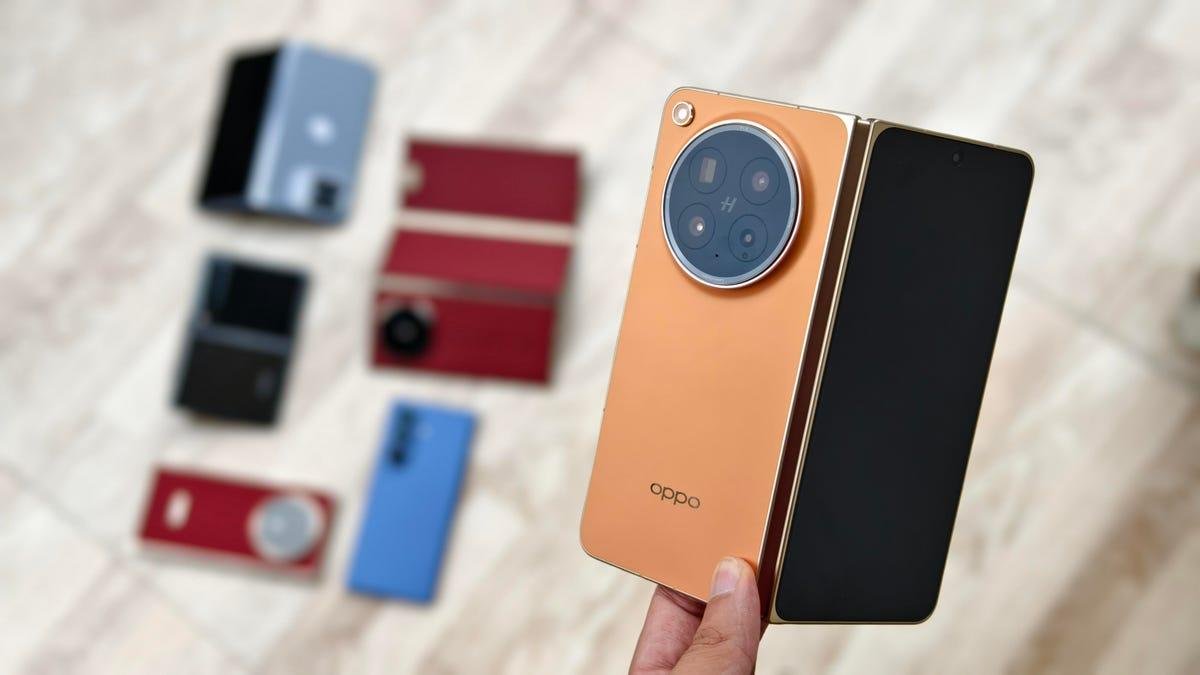
Samsung's Galaxy Z Fold 7, for instance, is thin enough to feel like a standard slab phone while folded. The new Honor Magic V6 has a larger battery capacity than the Samsung Galaxy S26 Ultra. Huawei's Mate X7 has a 50-megapixel main camera with a 10-stop variable aperture -- a feature previously limited to top-of-the-line camera phones. And Oppo finally fixed the crease issue with its Find N6 foldable phone, making an almost flat inner screen in the process. These are all quality-of-life upgrades that led me to shift from my iPhone 17 Pro Max full-time. I love the foldable phones for their productivity-focused use, and they no longer hold back on design, battery life or (to an extent) cameras.
These improvements appear to be reflected in sales numbers. The global foldable phone shipments were expected to grow 10% in 2025 compared with 2024, according to a December report from market research firm IDC. This number is expected to continue growing in 2026, with an expected 30% year-on-year jump.
This uptake shows that the foldable category is ready for wider audiences, and these features that we're seeing right now are the reasons why they are ready to shine.
Creaseless folding screens are now a reality
The Oppo Find N6 has almost eliminated the crease, as compared to the Galaxy Z Fold 7.
Prakhar Khanna/CNETFor the longest time, foldable phones have had a deep bump (crease) running through the middle of their inner screens. While Chinese phone manufacturers minimized it with a water-drop hinge design, the crease has been very much present. That's why seeing the creaseless concept screen from Samsung Display at CES 2026 was one of my highlights of the tradeshow.
However, the mobile vertical, Samsung Mobile, has yet to use it on a consumer product. While the Korean company surprised me with its thin and light Galaxy Z Fold 7, its crease wasn't impressively less. In fact, it has only deepened with use over time. I put it next to the new Oppo Find N6, and the difference was night and day.
The crease on Oppo's Find N6 is barely visible, even under direct light.
Andrew Lanxon/CNETThe Find N6 has set a new standard for book-style foldables. Oppo used 3D-printed liquid photopolymer droplets in the gap between the hinge and the inner screen. These droplets filled the imperfections inherent to each hinge mechanism in a bid to reduce the height variance from the industry standard of 0.2mm to just 0.05mm, as per the company.
This resulted in an almost crease-free folding screen. You can't feel it unless you rub your nail (slightly) firmly in the middle of the display. The crease is still there, but Oppo has gotten pretty darn close to getting a fully flat canvas.
The Oppo Find N6 is claimed to be 338% more deformation-resistant than before, which should, theoretically, prevent the crease from deepening over time. It is one of those features that will push other phone manufacturers to do better and hopefully, give us more foldable phones with minimal creases.
Antireflective screens for the win
The Oppo Find N6 (left) has an anti-reflective coating on the folding screen, which makes it more legible as compared to the Galaxy Z Fold 7 (right). Both screens are on maximum brightness.
Prakhar Khanna/CNETAs someone who is outdoors most of the time, I've been a big fan of Samsung's antireflective screens, starting with the Galaxy S24 Ultra. It had a slightly dimmer display, but that issue was solved with the Galaxy S25 Ultra last year. I like antireflective coatings because they make the screens more legible in harsh lighting conditions -- whether outdoors or in direct light inside public spaces. And this feature is now slowly coming to foldable phones. It's a crucial upgrade because, unlike slab phones, you can't add third-party matte screen protectors on folding screens.
Honor introduced an antireflective matte cover screen on the Magic V5 and improved it with the Magic V6 this year. On the other hand, Oppo added this coating to its inner screen with the Find N5 and upgraded its latest iteration. As a result, these phones are easier to use outdoors, especially when you're navigating maps or reading on your commute.
It makes more sense to have an anti-reflective coating on the inner screen because most of those folding displays attract smudges very easily (due to their glossy plastic properties). I have to wipe my Fold 7 every time I unfold it on the commute. I like having an expansive canvas to read, but smudges combined with high reflectivity result in a poor viewing experience. I have to wipe the Oppo Find N6 too, but it offers better legibility even on a smudged panel.
Ideally, I'd love to have an antireflective coating on both the cover screen and the inner display, but we've yet to see a foldable phone of that kind. However, we're getting closer with each generation.
Larger batteries in slimmer designs
The Honor Magic V6 (left) and Oppo Find N6 (right) have some of the biggest batteries on foldable phones.
Prakhar Khanna/CNETBattery life is arguably the most important feature in any mobile device. I wouldn't want to have all the bells and whistles only for my phone to die in the middle of the day. This is corroborated by the readers who voted in a CNET/YouGov survey. They ranked "longer battery life" second only to price among reasons to upgrade to a new phone.
Having a larger cell in a phone matters to most people, and it is made possible by silicon-carbon batteries. It is a relatively new type of power source that's denser than lithium-ion batteries. As a result, phone manufacturers can fit more battery capacity in the same body. This is how the OnePlus 15 has a 7,300-mAh cell, and the Realme P4 Power packs a 10,001-mAh battery without weighing more than the iPhone 17 Pro Max.
While Apple, Samsung and Google have refrained from adopting silicon-carbon anode batteries, the tech is already maturing elsewhere. Honor was one of the first phone manufacturers to adopt it with the Magic 5 Pro in 2023 and is already on the fifth generation with its new Magic V6.
The Huawei Mate X7 is thin and light and has a very comfortable in-hand feel, despite packing a 5,600mAh battery.
Prakhar Khanna/CNETA silicon-carbon battery becomes more important on foldable phones because they have space constraints and require more display power for their larger screens. The new-gen batteries are slimmer than traditional ones and allow for more cell capacity inside a foldable's slim body.
Samsung has yet to use it in a device, which is why the Galaxy Z Fold 7 is stuck with a 4,400-mAh battery. Meanwhile, the Honor Magic V6, Oppo Find N6 and Huawei Mate X7 have much bigger 6,600-mAh, 6,000-mAh and 5,600-mAh cells, respectively.
I hope both the upcoming Apple iPhone Fold and Galaxy Z Fold 8 adopt this type of battery so we get all-day power on foldable phones in the US.
Close to flagship cameras
The Huawei Mate X7 has one of the best main cameras on a foldable phone.
Prakhar Khanna/CNETCameras have been one of the most problematic compromises on foldable phones. They are right up there with noticeable creases and smaller batteries. After all, nobody would like to get an inferior set of cameras on a phone that costs considerably more than traditional flagship phones. But that's changed in the last few months.
In December, Huawei launched the Mate X7 with a 50-megapixel main camera with a 10-stop variable aperture ranging from f/1.5 to f/4.0. This allows it to take in 86% more light than before and perform better in low light, according to the company. On the other hand, both Oppo and Samsung have high-resolution 200-megapixel main cameras on their latest folding phones.
Honor, Oppo, Vivo and Huawei foldables also have capable telephoto cameras for improved zoom. These are combined with exceptional processing (in some cases) for pleasing-looking portraits. While there's room for improvement, these cameras are on par with the Galaxy S26 Ultra and Pixel 10 Pro. And they're no longer the weak point they used to be on foldable phones.
True multitasking that takes advantage of the big screen
The OnePlus Open was one of the first foldable phones that could run three apps simultaneously.
Prakhar Khanna/CNETWhen OnePlus Open debuted in 2023, it was hailed for its Open Canvas multitasking feature. The foldable allows you to use up to three apps simultaneously without needing a pop-up window. I used it to research in two browsers side by side and add notes in a Google Docs file at the bottom. I loved the experience, especially when compared to Samsung's multitasking.
Vivo upped the game last year with its Stage Manager-like Atomic Workbench on the X Fold 5. It added pinned windows to the side of the screen, so I could have one app for focused use with another just a tap away for quick reference. It was a refreshing experience to get that level of multitasking on a mobile device without needing an external accessory for support.
Multitasking on Android should only get better with Android 17, as Google has made it mandatory for apps to properly support resizing and windowed multitasking on the new version. Existing foldable phones like the Galaxy Z Fold 7 and Pixel 10 Pro Fold should benefit significantly from this improvement.
In the Apple land, the upcoming iPhone Fold will support iPad-like multitasking, according to a report from Bloomberg's Mark Gurman. You should expect a side-by-side app layout for true multitasking, which has been notably absent from iOS despite being supported by Android phones for years. The Cupertino-based company is reportedly also updating its core apps with a sidebar on the left side of the screen to take advantage of the larger screen.
More durable foldable phone designs
The Google Pixel 10 Pro Fold is the most durable foldable phone on the market.
Prakhar Khanna/CNETWhile many of the aforementioned features are shared by multiple foldable phones, only one device -- the Google Pixel 10 Pro Fold -- is rated for true dust resistance.
An IP rating might be an afterthought when purchasing a new mobile phone, but it becomes more important on a folding phone than on a slab phone. That's because small dust particles like pocket lint can penetrate foldables through their moving parts, especially around the hinge corners.
Most of these phones (Oppo, Honor and Vivo, among others) are now IP58 or IP59 rated for resistance against harmful dust particles, water submersion and high-pressure water jets, whereas the Samsung Galaxy Z Fold 7 is still stuck at IP48. The "4" means it is protected against solid objects larger than 1mm, but pocket lint and dust are smaller than 1mm. So, these tiny particles can enter the phone and potentially harm the internals.
The IP68 rating on the Pixel 10 Pro Fold means it is dust-tight and doesn't allow dust particles to enter even through the hinge.
Prakhar Khanna/CNETOn the other hand, the "5" in IP58 or IP59 stands for a dust-resistant design and not a dust-tight build. This means it is protected against tiny solid particles (less than 1mm), but they can still enter the phone. That's why Google's IP68 rating on the Pixel 10 Pro Fold was a game changer last year. It made a foldable phone with moving parts that's truly dust-tight, at least according to IEC's rating guide. This is a major win for durability, and I hope we see more companies work on their phones to make dust-tight designs.
In 2026, we could get multiple different-looking foldable phones. Some might be taller, while others could be wider.
I'm stoked because, for the first time in modern folding phones' existence, it feels like they have a chance to compete with the best phones in the market. The hardware, software and technology required for it to function flawlessly are finally coming together. These improvements should give us foldable phones that don't compromise on anything (albeit the price, I don't expect them to get cheaper anytime soon).