Paul KirbyEurope Digital Editor in Budapest

 BBC
BBC
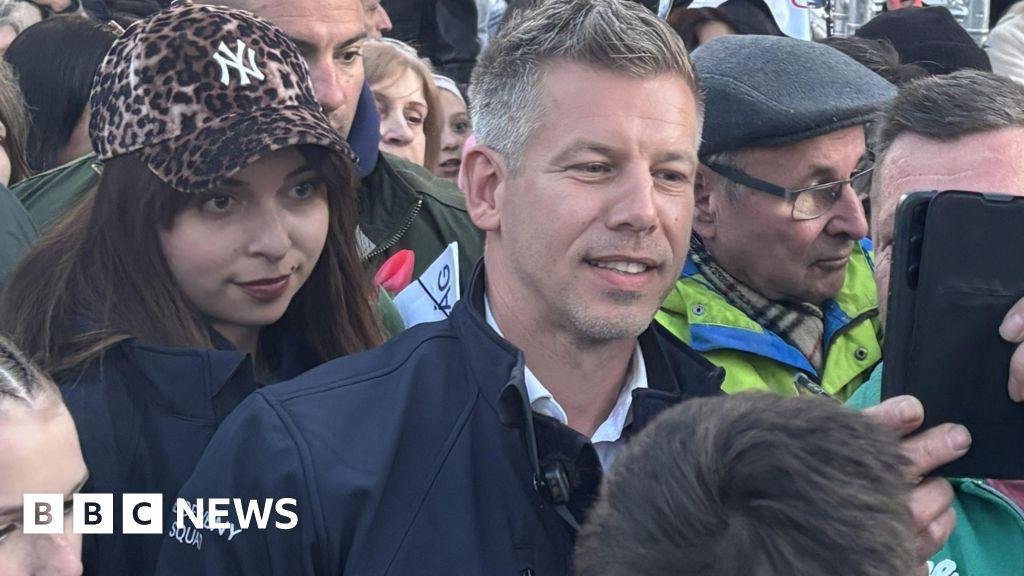
On the eve of Hungary's bitterly fought and highly significant election, the two main rivals are taking their campaigns to the wire, as Péter Magyar attempts to end 16 years of continuous rule by Viktor Orbán's Fidesz party.
"We're at the gates of a two-thirds majority victory. Let's gear up and push for the last 100m!" he told cheering supporters, before mingling for selfies.
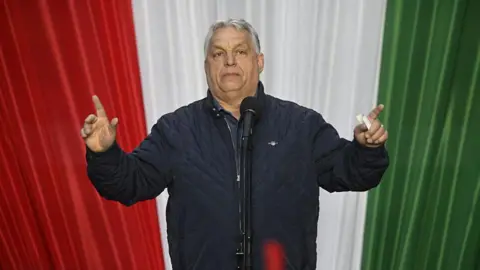
His final campaign stop will be in the second city, Debrecen, in the north-east, while Orbán, who trails in most of the polls, will address a rally in Budapest.
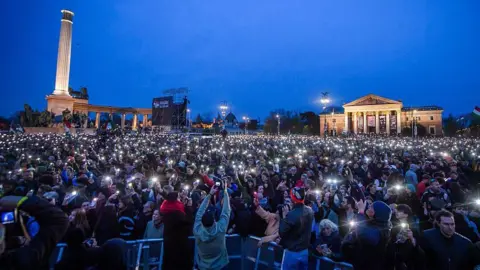
But perhaps the biggest rally of all came on Friday night, when tens of thousands of Hungarians crammed the capital's Heroes' Square and surrounding streets for an anti-Fidesz concert.
"I feel it in my bones something's going to change," said first-time voter Fanni, who came with her mother from a village two hours' drive away in the south. "I don't believe I'd vote for [Magyar] in an ideal situation, but this is our only chance."
 AFP via Getty Images
Orbán's biggest threat is that he is facing a cross-section of public anger, and it has been largely channelled into one single opposition movement, led by a former Fidesz insider who rebelled.
There may only be 9.6 million people in this landlocked Central European nation, but Orbán has made himself a key player on the international stage.
He is a close partner of both Trump and Russia's Vladimir Putin, and he has become a big thorn in the side of his European allies in the EU and his neighbour Ukraine.
Some pro-Fidesz pollsters do still give the veteran prime minister the edge and there are plenty of shy Fidesz voters who will support him, but his big message to voters has lacked the momentum and energy of his rival. "We could lose everything we have built," he warns his audience, and calls for national unity in a time of difficulty.
His attempt to identify the EU and Ukraine's Volodymyr Zelensky as Hungary's main threat has failed to dent his challenger's average 10-point lead in the opinion polls.
Most of the running in this election has come from Magyar, who now believes victory is in his sights, having criss-crossed the country in a gruelling schedule of up to seven campaign speeches a day, in villages, towns and cities.
It was time to rewrite history with "regime change", Magyar told the crowd in the small north-western town of Mosonmagyaróvár.
He is at heart a centre-right conservative, who held key roles for years in Fidesz before deciding to establish a grassroots movement called Tisza to drive them from power.
But Tisza has since attracted support from across the political spectrum, and particularly among young voters who sense change may be coming.
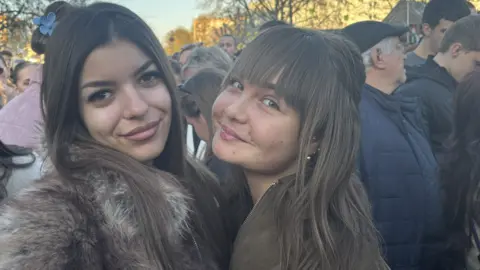
"Right now there's no future for the young in Hungary," said Laura, a first-time voter in the crowd with her friend Napsugár who have no memory of any other government than Fidesz.
Political analyst Zsuzsanna Végh of the German Marshall Fund of the US says there has been a clear shift away from Orbán among younger voters aged 18-29, with opinion polls giving Fidesz less than 10% of the younger vote.
"There are overall shifts in terms of the smaller towns and to a lesser extent in the villages too towards the opposition which have been Fidesz strongholds," she says.
Rallies rarely point to election results, but Végh says the numbers that Magyar has been able to attract are unprecedented: "What I find very telling is the extent of engagement and mobilisation."
If he were to achieve a majority in parliament it would mean an end to Orbán rule and many of his policies, but without winning two-thirds of seats he will struggle to scrap much of the Fidesz-supporting infrastructure in the judiciary and elsewhere.
To do that he needs to overturn Fidesz's long-running control of a swathe of towns and cities, such as Székesfehérvár, Hungary's medieval "city of kings", an hour south of Budapest.
This was the scene of Orbán's last-but-one visit on Friday, which he told the crowd was traditionally a Fidesz seat. Losing here would be a humiliation.
 NurPhoto via Getty Images
At the covered market one stallholder estimated 90% of the people here were Fidesz supporters.
One of them, a pensioner called Agota, complained about the opposition's intention to embrace the European Union and Ukraine: "Their approach to Hungary is not what it should be. It's a realistic fear to be dragged into the war."
Anti-EU and anti-Ukraine rhetoric is a staple of the Orbán campaign, repeated on pro-Orbán TV and news sites, and portrayed by Fidesz posters of Ukraine's Volodymyr Zelensky alongside Magyar with the words "They are dangerous!" underneath.
One of Hungary's richest men, György Wáberer, has accused Fidesz of "fear-mongering" about the EU and Ukraine while cosying up to the Kremlin. "12 April is a fateful date: You will decide whether you want to belong to Europe or to the Russians!" he said, prompting an angry response from the state secretary in Orbán's office, who said he was betraying the party and selling out.
Péter Magyar has welcomed Russian "propaganda" TV crews to his rallies, telling them that they can look forward to real "regime change", and his supporters have chanted "Russians go home", a sign that many Hungarians have had enough.
The same chant was repeated at an Orbán rally too, where protesters disrupted the prime minister's speech.
Orbán's ties to Putin have meant cheap fuel supplies for Hungarians throughout the Russian full-scale war in Ukraine. But the words "Russians go home" resonate here, dating back to 1956 when Moscow sent in the tanks to crush Hungary's revolution against Soviet occupation.
At a florists' stall in Székesfehérvár, Eva, 73, believes it is time for a change, while her daughter-in-law Andrea sees Péter Magyar as arrogant and his supporters loud.
"Fidesz rule has to stop, they stole a lot and the country's dying," says Eva, who believes 90% of people in the market still back them. "Tisza supporters only see the bad things about Orbán," Andrea retorts. "If you look around in the city, they renovated six schools, and built new buildings in the hospital." That may be true, Eva argues, but she alleges a lot of the money for it disappeared.
Corruption and cronyism have pushed many Orbán voters away from the governing party, both on a local and a national level. Big public contracts were handed to his inner circle and independent media companies were bought up by his allies.
After 16 years in charge, Fidesz may finally have run out of road.